
Why IUL Is a Bad Investment
Many people searching for long-term financial products come across Indexed Universal Life insurance, commonly called IUL. This product combines life insurance with a cash value account linked to a market index. Sales presentations often highlight tax advantages, flexible premiums, and upside potential. However, many critics argue why IUL is a bad investment because the product can be expensive, complex, and less efficient than simpler alternatives.
An IUL is first and foremost an insurance contract, not a pure investment account. That distinction matters because a portion of every premium may go toward insurance costs, fees, and commissions before cash value growth is credited. While some people may find IUL useful for estate planning or specific insurance needs, many investors discover it does not match the promises they expected.
Understanding How IUL Works
To understand why IUL is a bad investment, it helps to know the structure. Premium payments are divided among policy charges, cost of insurance, and cash value. The cash value may earn returns based on an index such as the S&P 500, but it does not directly invest in the market. Instead, the insurer credits interest according to contract rules such as caps, participation rates, and spreads.
That means if the index performs strongly, the policyholder may receive only part of the upside. At the same time, internal fees can continue regardless of performance. This combination often creates disappointment when real returns fall below expectations.
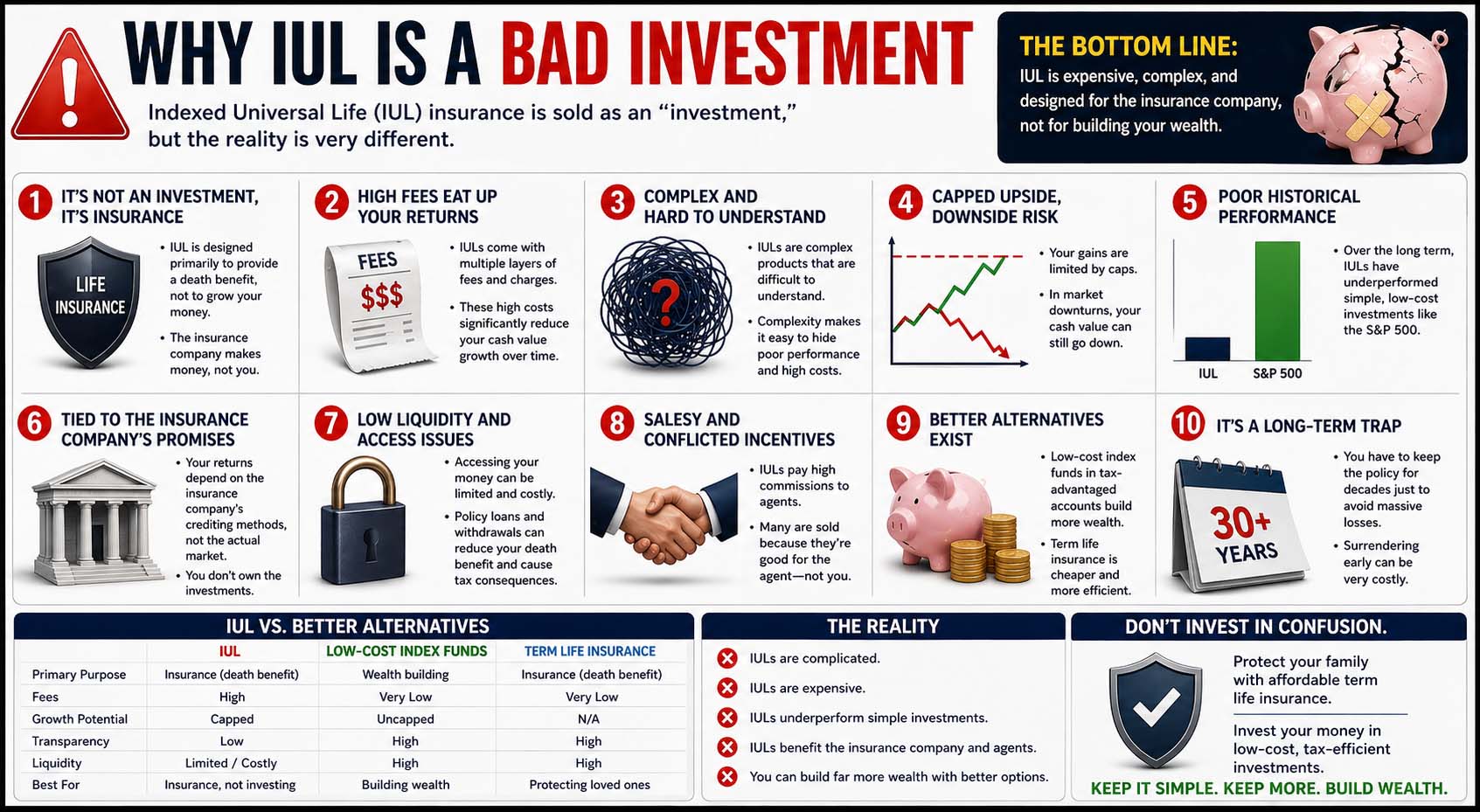
10 Reasons Why IUL Is a Bad Investment
Many consumers search for because they want a straightforward explanation. One major concern is high fees, especially in the early years. Another issue is complexity, since many buyers do not fully understand caps and participation rates. Returns can also lag basic index funds because of policy limits.
Liquidity may be restricted if you need money early. Surrender charges can reduce access to funds. Cost of insurance often rises with age, which may pressure the policy later in life. Policy loans, while promoted as a benefit, can create risk if unmanaged. If the policy underperforms, additional premiums may be needed.
Tax advantages are often real but can be overstated compared with retirement accounts like 401(k) or IRA. Finally, commissions can create incentives for aggressive sales tactics.
Why Is IUL a Bad Investment
A common question is why is iul a bad investment compared with simpler options. For many households, the better approach is separating insurance from investing. Buy affordable term life insurance for protection, then invest the savings into diversified low-cost funds.
This strategy is often easier to understand, cheaper to maintain, and more transparent. With IUL, the insurance and investment components are blended into one contract. That can make it harder to measure true costs and expected performance.
If your main goal is building wealth, a low-fee portfolio may offer clearer long-term advantages. If your main goal is life insurance, a simpler policy may provide better value.
10 Reasons Why IUL Is a Bad Investment Reddit
Searches for reflect how many people turn to online communities for honest experiences. On Reddit, discussions often mention surprise fees, disappointing growth, and frustration with unclear sales illustrations.
Some users report being shown optimistic projections based on historical returns, only to discover actual credited growth was lower. Others mention learning later that surrendering the policy early meant losing money. While forum posts are anecdotal and not universal truth, they highlight recurring consumer concerns.
When people ask why iul is a bad investment reddit, cost is one of the most repeated themes. Many policyholders do not realize how much of the early premiums may go to commissions and administrative charges. Because these costs are front-loaded, cash value growth may start slowly.
This creates a common frustration: people contribute significant money for years yet see lower-than-expected account values. In contrast, transparent brokerage accounts usually show contributions, fees, and investment balances more clearly.
The issue is not that every IUL is automatically bad, but that many buyers underestimate the drag created by internal expenses.
Performance Caps and Participation Limits
Another reason critics explain why IUL is a bad investment is limited upside. If the linked index rises sharply, a cap rate may restrict credited returns. For example, if an index gains 15% but the cap is 9%, the policyholder may receive only up to that limit depending on contract terms.
Participation rates may further reduce gains. This means you may not fully benefit from strong bull markets. Over decades, missing portions of market upside can significantly affect wealth accumulation.
Insurance Costs Increase Over Time
Unlike some simpler products, IUL contracts often carry rising insurance costs as the insured gets older. If policy growth is weaker than projected, more premium may be needed to keep the contract healthy.
Who Might Still Consider IUL
Although many ask why IUL is a bad investment, there are situations where it may fit certain goals. High-income households that already maximize retirement accounts, need permanent insurance, and understand policy mechanics may consider it as one piece of a broader plan.
Better Alternatives for Many Investors
For many people, a combination of term life insurance plus diversified investing is simpler. Retirement accounts, broad-market index funds, and emergency savings accounts often provide more flexibility and transparency.
Conclusion
Understanding why IUL is a bad investment often comes down to costs, complexity, capped returns, and rising insurance charges. Searches like reddit, why iul is a bad investment reddit, and why is iul a bad investment show that many consumers want clearer answers than sales pitches provide.