Product Development Life Cycle
The product development life cycle is an important process that helps businesses transform ideas into successful products. Companies across industries use this framework to design, test, launch, and improve products in a structured and efficient way. Whether developing physical goods, digital platforms, or software applications, understanding the product development life cycle allows organizations to reduce risks, improve quality, and meet customer expectations.
In today’s competitive market, businesses must innovate constantly to stay ahead. A well-planned development process helps teams create products that solve real customer problems while maintaining efficiency and profitability. From idea generation to product launch and maintenance, every stage plays a critical role in achieving long-term success.
Understanding the Product Development Process
The begins with identifying customer needs and market opportunities. Businesses conduct research to understand consumer preferences, industry trends, and competitor strategies. This early stage is essential because it determines whether a product idea has the potential to succeed in the market.
After research, teams move into planning and concept development. They define features, pricing, branding, and technical requirements before development officially begins.
Prototyping is another important step in the process. A prototype allows companies to test functionality, gather feedback, and identify weaknesses before full production. This reduces costly errors and improves the final product quality.
Once testing is completed, the product enters the launch phase. Marketing campaigns, distribution strategies, and customer support systems are prepared to ensure a successful release. After launch, businesses continue monitoring performance and making improvements based on customer feedback and market conditions.
Product Development Life Cycle Stages
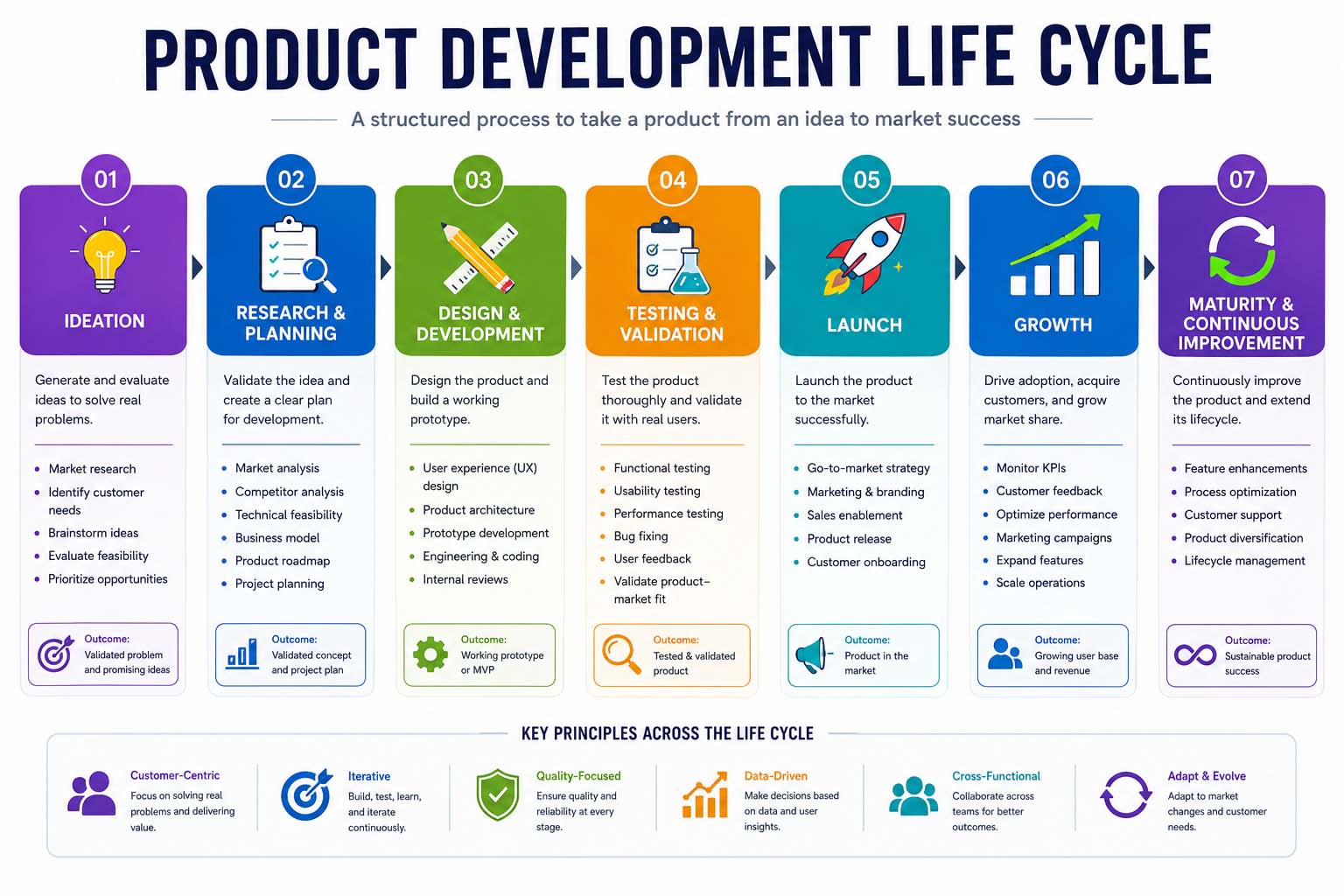
The product development life cycle stages help organizations manage projects in a systematic way. Each stage has a specific purpose and contributes to the overall success of the product.
The first stage is idea generation. During this phase, businesses brainstorm concepts and identify opportunities that address customer needs. Creative thinking and market research are combined to generate innovative product ideas.
The second stage is concept validation. Companies analyze the feasibility of the idea by studying customer demand, production costs, and competition. Market surveys and focus groups often provide valuable insights at this stage.
The third stage is product design and development. Engineers and designers create the technical structure, appearance, and functionality of the product. This stage often involves collaboration between multiple departments to ensure the product meets business goals and customer expectations.
The fourth stage is testing and quality assurance. Businesses evaluate the product for performance, usability, and reliability. Any issues discovered during testing are corrected before the official launch.
The fifth stage is product launch. Marketing campaigns, advertising, and promotional activities are implemented to introduce the product to customers. A successful launch can create strong market awareness and drive early sales.
The final stage is maintenance and improvement. Businesses monitor customer feedback, sales performance, and technical issues after release. Continuous updates and improvements help products remain competitive and relevant over time.
Software Product Development Life Cycle
The software is a specialized version of the general product development process focused on software applications and digital platforms. It helps software companies organize development tasks, improve efficiency, and deliver high-quality applications.
The process usually starts with requirement analysis. This stage ensures that the software solution aligns with customer expectations.
The next stage is system design. Developers create the architecture, interface, and workflow of the software application. A clear design structure makes coding and future updates easier.
Development and coding follow the design stage. Programmers write the actual code that powers the application. Teams often divide projects into smaller tasks to improve productivity and collaboration.
Testing is one of the most important parts of the software product development life cycle. Quality assurance teams identify bugs, performance issues, and security vulnerabilities before the software reaches users. Thorough testing improves reliability and customer satisfaction.
Agile Product Development Life Cycle
The agile product development life cycle has become extremely popular because it allows businesses to adapt quickly to changing customer needs and market conditions. Unlike traditional development methods, agile focuses on flexibility, collaboration, and continuous improvement.
In agile development, projects are divided into smaller cycles called sprints. Each sprint focuses on delivering a specific feature or improvement within a short period. Teams evaluate progress after every sprint and make adjustments as needed.
One major advantage of agile development is faster feedback. Customers and stakeholders can review product updates regularly, allowing developers to identify problems early and improve the final outcome.
Collaboration is another key feature of the agile product development life cycle. Developers, designers, marketers, and project managers work closely together throughout the process. This teamwork improves communication and reduces delays.
PDLC Product Development Life Cycle
The term PDLC refers to the complete framework businesses use to create and manage products from beginning to end. PDLC provides a structured approach that improves organization, efficiency, and product quality.
Companies use PDLC models to align development activities with business goals and customer expectations. By following a clear process, businesses reduce confusion and improve decision-making during product creation.
The PDLC product development life cycle also supports risk management. Identifying potential issues early in development helps companies avoid costly mistakes and delays. This structured process improves resource allocation and project planning.
Conclusion
The is an essential framework for creating successful products in today’s competitive market. From idea generation and design to testing, launch, and maintenance, every stage contributes to delivering value to customers.
Understanding product development life cycle stages helps businesses improve organization, reduce risks, and increase efficiency. The software provides specialized methods for digital applications, while the agile product development life cycle offers flexibility and continuous improvement.