Business Level Strategy: Definition, Types, Examples, and How to Build One
Every successful company needs a clear plan to compete in its market. While corporate focuses on the overall direction of an organization, a business level strategy focuses on how a specific unit creates value and gains a competitive advantage.
Whether you’re a business owner, entrepreneur, manager, or student, understanding -level strategy can help you make better decisions and improve long-term performance.
What Is a Business Level Strategy?
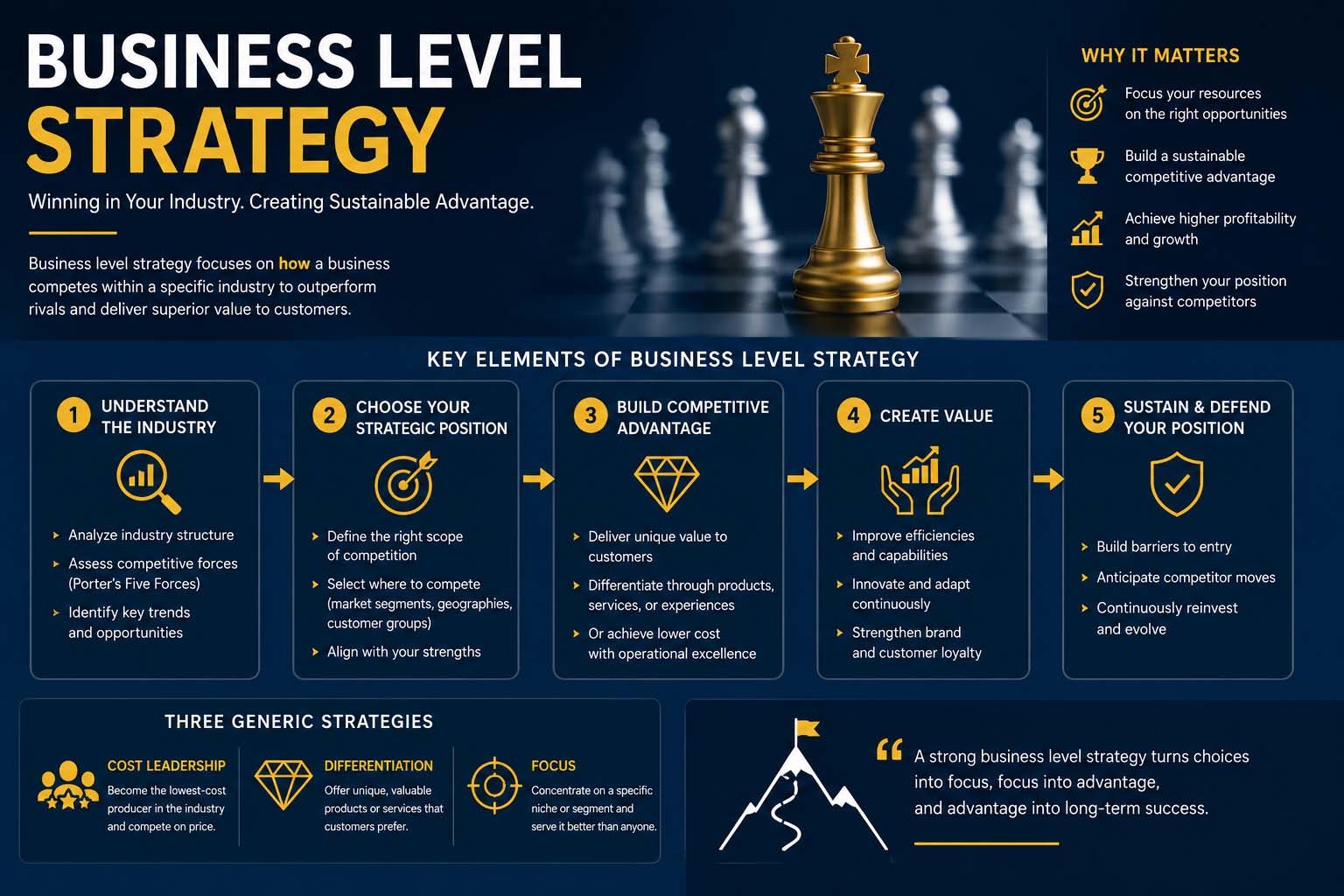
A business level strategy is a plan that explains how a company will compete successfully within a particular market or industry.
“How will this business attract customers and outperform competitors?”
Unlike corporate-, which focuses on the organization as a whole, business-level strategy focuses on a specific product line, brand, or unit.
What Is Business Level Strategy?
It is the set of actions and decisions a business uses to:
- Deliver value to customers
- Differentiate itself from competitors
- Increase market share
- Improve profitability
- Strengthen customer loyalty
A well-designed strategy helps businesses understand where they fit in the market and how they can serve customers better than their competitors.
Why Business Level Strategy Matters
Without a clear strategy, companies often struggle to stand out in competitive industries.
An effective business level strategy can help organizations:
Improve Competitive Position
Increase Profitability
A focused strategy often leads to better financial performance.
Support Growth
Clear strategic direction helps guide future expansion efforts.
Enhance Customer Satisfaction
Understanding customer needs leads to stronger products and services.
Allocate Resources Efficiently
Companies can invest time and money where it generates the greatest return.
Key Types of Business-Level Strategy
Most business strategies fall into several major categories.
Cost Leadership Strategy
A cost leadership strategy focuses on becoming the lowest-cost producer in the market.
Businesses achieve this by:
- Improving efficiency
- Reducing operational costs
- Optimizing supply chains
- Increasing productivity
Examples include companies known for affordable pricing and operational efficiency.
Differentiation Strategy
Businesses may differentiate through:
- Product quality
- Innovation
- Customer service
- Brand reputation
- Design
Focus Strategy
A focus strategy targets a specific market segment rather than a broad audience.
Businesses may focus on:
- Geographic markets
- Customer demographics
- Specialized industries
- Niche interests
This strategy allows companies to serve a particular group exceptionally well.
Integrated Cost Leadership and Differentiation
Some organizations attempt to combine affordability with unique value.
This approach aims to provide:
- Competitive pricing
- Strong product quality
- Excellent customer experience
Successfully balancing both elements can create a powerful competitive advantage.
Business Level Strategy Examples
Understanding real-world applications makes the concept easier to understand.
Example 1: Cost Leadership
A discount retailer may focus on reducing costs and offering lower prices than competitors.
Its strategy centers on operational efficiency and high sales volume.
Example 2: Differentiation
A luxury brand may emphasize premium materials, exclusive designs, and superior customer experiences.
Customers choose the brand because it offers something distinctive.
Example 3: Focus Strategy
A company that sells specialized software for dentists targets a very specific audience rather than serving all healthcare providers.
Its deep understanding of customer needs becomes a competitive advantage.
These examples show how different organizations compete successfully using different approaches.
Business-Level Strategy vs Corporate-Level Strategy
Many people confuse these two concepts.
Business-Level Strategy
Focuses on:
- Individual business units
- Specific markets
- Competitive positioning
Corporate-Level Strategy
Focuses on:
- Entire organizations
- Portfolio management
- Expansion decisions
- Mergers and acquisitions
Business-level determines how to compete, while corporate-determines where to compete.
How to Develop a Business Level Strategy
Step 1: Understand Your Market
Research:
- Customer needs
- Industry trends
- Competitor strengths
- Market opportunities
Understanding the environment is the foundation of strategic decision-making.
Step 2: Identify Your Competitive Advantage
Determine what makes your business unique.
Consider:
- Price
- Quality
- Innovation
- Expertise
- Customer service
Step 3: Define Your Target Audience
Clearly identify who your ideal customers are.
The more specific your audience, the easier it becomes to create value.
Step 4: Select Your Strategic Approach
- Cost leadership
- Differentiation
- Focus strategy
- Hybrid approaches
Step 5: Implement and Monitor
Execution is just as important as planning.
Track performance regularly and adjust your strategy when necessary.
Common Business Strategy Mistakes
Trying to Serve Everyone
Businesses often become less effective when they target overly broad audiences.
Ignoring Competitors
Understanding competitor strategies helps businesses identify opportunities and threats.
Failing to Adapt
Markets evolve constantly.
Companies must regularly review and update their strategies.
Lack of Clear Positioning
Customers should easily understand what makes a business different.
Benefits of a Strong Business Level Strategy
Organizations that implement effective strategies often experience:
- Increased customer loyalty
- Better brand recognition
- Higher profitability
- Improved operational efficiency
- Greater market share
A strong strategy provides direction and helps businesses navigate changing market conditions.
Business Strategy Trends in 2026
Modern business environments continue evolving rapidly.
Several trends influencing include:
Digital Transformation
Technology is becoming central to competitive advantage.
Customer Experience Focus
Data-Driven Decisions
Analytics help organizations understand customer behavior and market trends.
Sustainability Initiatives
Many consumers now prefer companies with responsible business practices.
Businesses that adapt to these trends may gain stronger competitive positions.
FAQ
What is a business level strategy?
A level strategy is a plan that explains how a company competes successfully within a specific market or industry.
Why is business-level strategy important?
It helps businesses create competitive advantages, attract customers, and improve profitability.
The primary types are cost leadership, differentiation, focus strategy, and integrated approaches.
What is the difference between corporate and business-level strategy?
Corporate focuses on the entire organization, while focuses on competing within a specific market.
Can small businesses use business level strategies?
Yes. Businesses of all sizes can benefit from developing clear competitive strategies.
Conclusion
A business strategy is one of the most important tools for achieving long-term success in competitive markets. By understanding customer needs, identifying competitive advantages, and choosing the right strategic approach, businesses can strengthen their market position and improve performance.