
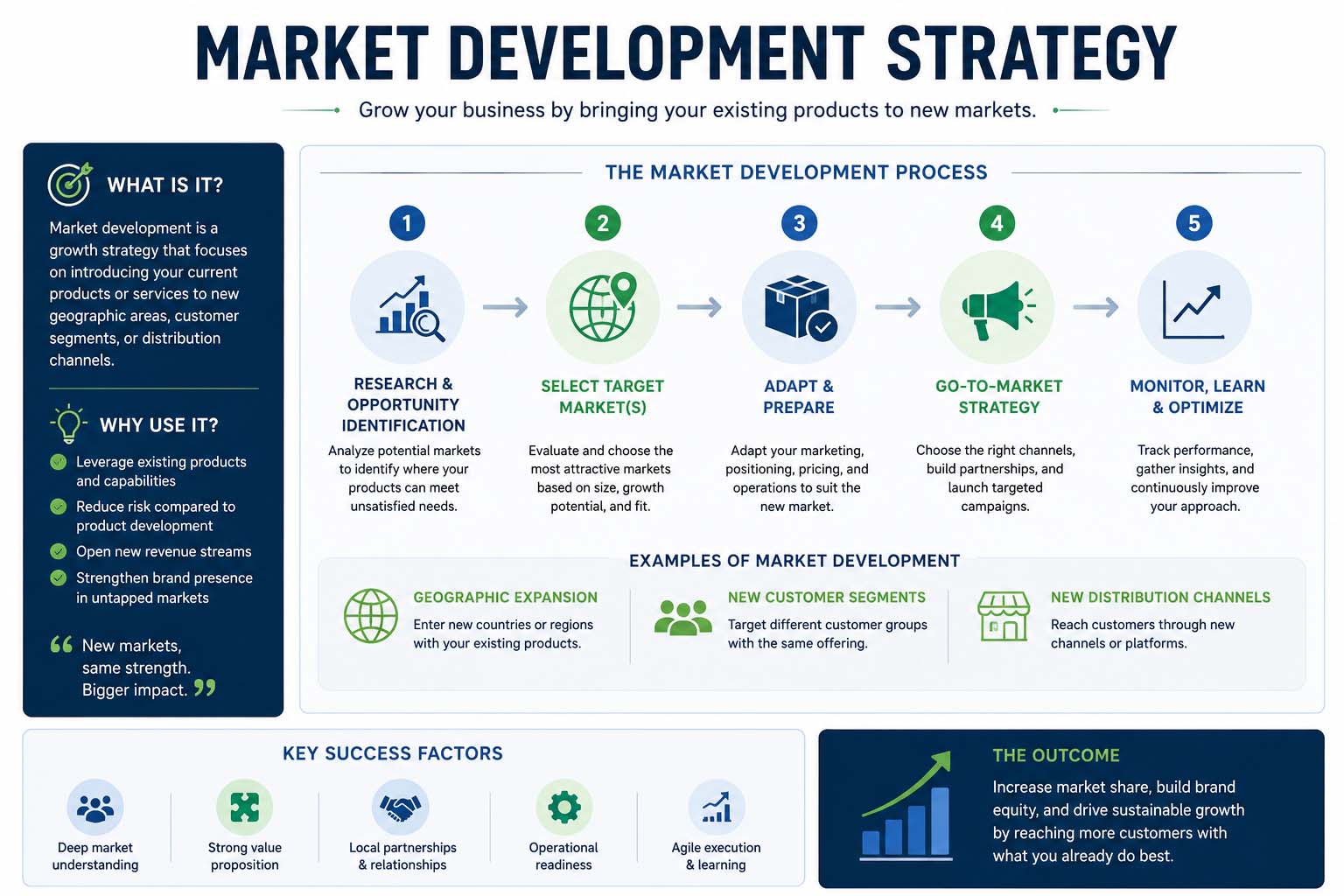
Market Development Strategy: A Complete Guide to Business Growth
Businesses that want to grow often face an important question: should they create new products or find new customers for existing products? A market development strategy focuses on the second option. It helps companies expand into new markets, reach new customer segments, and increase revenue without completely reinventing their product offerings.
Whether you run a startup, a small business, or a large corporation, understanding market development can help you unlock new growth opportunities and remain competitive in changing markets.
What Is Market Development Strategy?
A market development strategy is a business growth approach that involves selling existing products or services to new markets. These new markets may include different geographic locations, customer segments, industries, or demographic groups.
The concept comes from the well-known Ansoff Matrix, a strategic planning framework used to identify growth opportunities.
Instead of creating new products, businesses focus on expanding the reach of products they already offer.
For example:
- A local clothing brand expands nationally.
- A software company targets a new industry.
- A restaurant chain opens locations in new cities.
- An online retailer enters international markets.
Ultimately, market development allows organizations to leverage existing strengths while pursuing additional revenue streams.
Why Market Development Strategy Matters
Business growth rarely happens by accident. Companies that rely solely on existing customers may eventually experience slower sales growth.
A market development strategy helps businesses:
- Increase revenue opportunities
- Expand customer reach
- Reduce dependence on one market
- Improve brand visibility
- Gain competitive advantages
- Create long-term business sustainability
In today’s competitive environment, market expansion can be an effective way to maintain momentum and increase market share.
Market Development Growth Strategy Explained
A market development growth strategy focuses on finding new opportunities for existing products.
Unlike product development, where companies create something new, market development aims to maximize the value of products that are already successful.
Common Market Development Approaches
Geographic Expansion
Businesses enter new cities, regions, or countries.
For example:
A coffee shop chain expands from one state into neighboring states.
New Customer Segments
Companies target different age groups, professions, or industries.
For example:
A productivity software platform originally designed for freelancers begins marketing to small businesses.
Additionally, What Is a Target Market can help businesses define the specific customer groups they want to reach.
New Distribution Channels
Organizations reach customers through different sales channels.
For example:
- E-commerce platforms
- Retail partnerships
- Online marketplaces
- Mobile applications
International Expansion
Businesses enter overseas markets where demand exists for their products.
Overall, global expansion often represents one of the most powerful forms of market development.
A Market Development Strategy vs. Other Growth Strategies
Understanding how market development compares with other business growth methods can help organizations choose the right approach.
| Strategy | Existing Product | New Product | Existing Market | New Market |
|---|---|---|---|---|
| Market Penetration | Yes | No | Yes | No |
| Market Development | Yes | No | No | Yes |
| Product Development | No | Yes | Yes | No |
| Diversification | No | Yes | No | Yes |
Market development sits between low-risk market penetration and higher-risk diversification strategies.
Because companies already understand their product, the risk level is generally lower than launching an entirely new offering. In addition, a Business Level Strategy can help clarify how a company will compete within its chosen market.
Benefits of a Market Development Strategy
Increased Revenue Potential
Entering new markets creates additional sales opportunities without requiring major product redesigns.
Stronger Brand Presence
Expansion helps build recognition among larger audiences.
Reduced Market Risk
Businesses become less dependent on a single customer base or geographic region.
Better Resource Utilization
Existing products, processes, and expertise can often be leveraged in multiple markets.
Competitive Growth
Companies can establish a presence before competitors enter emerging markets.
Step-by-Step Guide to Developing a Market Development Strategy
Successful market expansion requires planning and research.
Step 1: Analyze Your Current Position
Review:
- Current customers
- Sales performance
- Competitive advantages
- Product strengths
After all, understanding your existing success factors provides a foundation for expansion.
Step 2: Identify New Market Opportunities
Research potential markets based on:
- Customer demand
- Population growth
- Industry trends
- Purchasing behavior
- Competitive landscape
Ultimately, look for markets where your product solves an existing problem.
Step 3: Conduct Market Research
Gather information about:
- Customer preferences
- Cultural differences
- Pricing expectations
- Regulations
- Local competitors
As a result, market research reduces uncertainty and improves decision-making.
Step 4: Develop a Market Entry Plan
For example, options include:
- Direct sales
- Partnerships
- Franchising
- Distributors
- E-commerce expansion
Each approach offers different advantages depending on business goals. Moreover, How to Start a Franchise can provide useful guidance when franchising is selected as an entry method.
Step 5: Adapt Marketing Efforts
Adjust marketing messages to fit the new audience.
This may involve:
- Localized advertising
- Different communication channels
- Updated branding strategies
- Targeted campaigns
Additionally, Digital Strategy Consulting can help companies align digital channels and technology with their expansion goals.
Step 6: Measure Results
Track performance indicators such as:
- Revenue growth
- Customer acquisition
- Conversion rates
- Market share
- Return on investment
Ultimately, continuous monitoring helps refine future expansion efforts.
Real-World Examples of Market Development
Netflix
Netflix initially focused on the United States market before expanding globally. The company entered new countries while continuing to offer its core streaming service.
Starbucks
Starbucks successfully entered international markets by adapting store experiences and product offerings while maintaining its brand identity.
Amazon
Amazon expanded from selling books online to serving customers in multiple countries using its established e-commerce platform.
Overall, these examples demonstrate how existing products can generate growth through market expansion.
Pharma Market Access Strategy Development
Pharmaceutical companies face unique challenges when entering new markets.
Market access strategies in healthcare focus on ensuring that medicines reach patients while meeting regulatory, reimbursement, and pricing requirements.
For example, key components include:
Regulatory Approval
Companies must comply with healthcare regulations in each target market.
Pricing Strategy
Appropriate pricing helps balance profitability and patient accessibility.
Stakeholder Engagement
Organizations collaborate with healthcare providers, insurers, and government agencies.
Evidence-Based Marketing
Clinical data and research support product adoption and market acceptance.
Ultimately, effective pharma market access strategy development can significantly influence commercial success in healthcare markets.
Common Market Development Challenges
Despite its advantages, market development can present challenges.
Lack of Market Knowledge
Entering unfamiliar markets increases uncertainty.
Regulatory Barriers
Different regions may have unique legal requirements.
Cultural Differences
Customer behavior can vary significantly between markets.
Increased Competition
New markets may already contain established competitors.
Resource Requirements
Expansion often requires investments in staffing, marketing, and infrastructure.
Therefore, proper planning helps reduce these risks.
Business Strategy Tips for Successful Market Development
Businesses can improve results by following several best practices.
Focus on Customer Needs
Understand what motivates customers in the new market.
Test Before Scaling
Pilot programs can reveal challenges before large-scale expansion.
Use Data-Driven Decisions
Research and analytics improve strategic planning.
Build Local Partnerships
Local expertise often accelerates market entry.
Stay Flexible
Markets evolve, and strategies should adapt accordingly.
Moreover, a Business Strategy Consultant can help companies evaluate opportunities and create practical expansion plans.
Ultimately, organizations that remain responsive to customer feedback typically achieve stronger long-term growth over time.
Frequently Asked Questions About Market Development Strategy
What Is Market Development Strategy?
Market development strategy involves selling existing products or services to new customer groups, regions, or markets to achieve business growth.
Why Is Market Development Important?
It helps businesses increase revenue, expand their customer base, and reduce dependence on existing markets.
How Does Market Development Differ From Product Development?
Market development targets new customers with existing products, while product development creates new products for existing customers.
Is Market Development Risky?
The risk is generally lower than launching entirely new products because the business already understands the product being offered.
What Industries Use Market Development Strategies?
Virtually every industry uses market development, including retail, technology, healthcare, manufacturing, education, and professional services.
Conclusion
A market development strategy is one of the most effective ways for businesses to achieve sustainable growth. By introducing existing products to new customer segments, geographic regions, or industries, organizations can unlock additional revenue opportunities while leveraging proven products and expertise.