
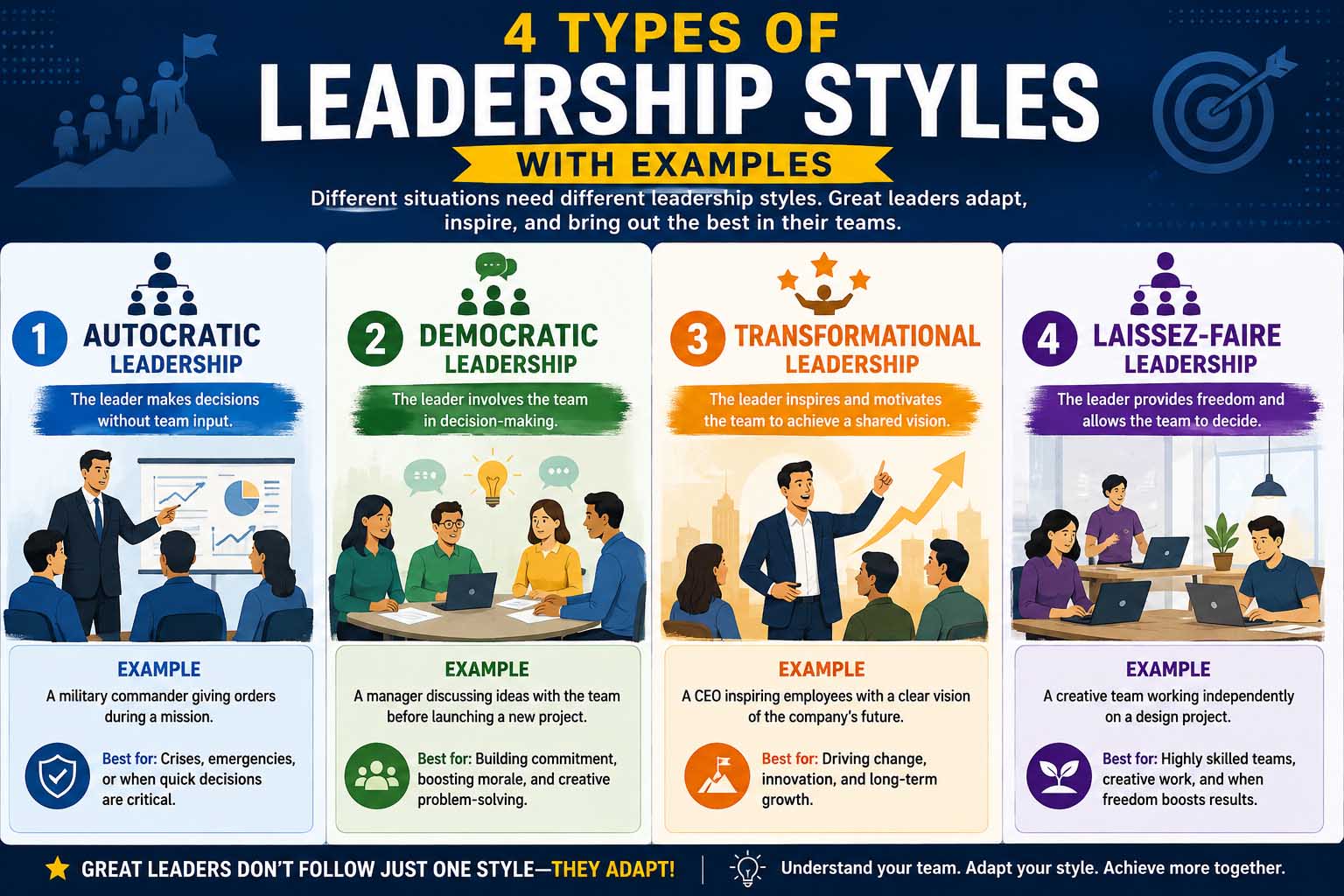
4 Types of Leadership Styles With Examples: Which One Works Best?
Two managers can lead equally talented teams and still get completely different results. Often, the difference comes down to how they communicate, make decisions, motivate people, and respond when problems appear. Understanding the 4 types of leadership styles with examples can help managers recognize their natural approach and learn when another style might work better.
Four widely discussed approaches are autocratic, democratic, transformational, and laissez-faire leadership. Autocratic leaders make decisions directly, democratic leaders involve the team, transformational leaders motivate people around change and shared goals, and laissez-faire leaders give capable employees greater independence.
None is automatically the best. Instead, effective leaders understand each approach and adjust according to the people, situation, risks, and goals involved.
What Is a Leadership Style?
A leadership style is the general approach a person uses to guide, influence, and support a group.
It affects everyday workplace decisions. For example, who gets involved before a decision is made? How closely does the leader supervise employees? How does the team respond to a sudden deadline?
Leadership style also affects communication, trust, motivation, accountability, and workplace culture.
However, leadership and management are not exactly the same thing. Anyone trying to understand what is the difference between leadership and management should think of management as being heavily concerned with planning, organizing, coordinating, and controlling work, while leadership focuses strongly on direction, influence, and motivating people. In practice, good managers often need both skill sets.
4 Types of Leadership Styles With Examples at a Glance
Before looking at each style closely, this comparison shows how they generally differ.
| Leadership Style | Decision-Making | Employee Freedom | Best Suited For | Main Risk |
|---|---|---|---|---|
| Autocratic | Leader-driven | Low | Urgent or highly controlled situations | Low employee involvement |
| Democratic | Shared | Moderate to high | Collaborative teams | Slower decisions |
| Transformational | Vision-driven | Moderate to high | Growth and organizational change | Unrealistic expectations |
| Laissez-faire | Highly delegated | Very high | Skilled, independent teams | Lack of direction |
The right choice can change from one situation to another. Therefore, a leader who normally prefers collaboration might temporarily become more directive during an emergency.
1. Autocratic Leadership
Autocratic leadership, sometimes called authoritarian leadership, places most decision-making authority with the leader.
The manager decides what needs to happen, assigns responsibilities, sets expectations, and closely controls execution. Employees may provide information, but the leader usually makes the final decision without relying on group agreement.
Example of Autocratic Leadership
Imagine a manufacturing facility discovers a serious safety problem during a shift.
Instead of organizing a long team discussion, the operations manager immediately stops production, assigns specific employees to secure equipment, tells supervisors how to account for staff, and establishes the steps required before work can resume.
In that situation, clear centralized authority can reduce confusion.
However, using the same approach for every ordinary decision could frustrate experienced employees who expect their knowledge to be valued.
Advantages
Autocratic leadership can produce fast decisions because fewer people need to approve them. Likewise, employees receive clear instructions and understand who has final responsibility.
This style can work well during emergencies, with inexperienced teams, or in environments where procedures must be followed closely.
Disadvantages
If leaders rely on it too heavily, employees may feel ignored.
Over time, that can reduce initiative because team members become accustomed to waiting for instructions rather than solving problems independently.
The effectiveness of this approach also depends on the workforce. Since organizations employ different types of employees, a highly experienced specialist may respond very differently to close supervision than a new employee who still needs detailed guidance.
2. Democratic Leadership
Democratic leadership, also called participative leadership, involves employees in the decision-making process.
The leader still has responsibility for the outcome, yet team members get opportunities to contribute ideas, concerns, experience, and possible solutions.
As a result, employees often feel that their opinions matter.
Example of Democratic Leadership
Suppose a marketing department wants to change its project-management process.
Instead of selecting new software alone, the manager asks designers, writers, analysts, and account managers where the existing process causes problems. The team compares several options and discusses how each one would affect its work.
After gathering that feedback, the manager chooses a solution that addresses the team’s most significant concerns.
Employees did not necessarily make the final decision, but they meaningfully influenced it.
Advantages
Democratic leadership can generate a wider range of ideas because people closest to the work contribute their experience.
It can also increase commitment. When employees understand why a decision was made and had a chance to participate, they may be more willing to support the result.
Meanwhile, open discussion can expose problems that senior managers might otherwise overlook.
Disadvantages
Collaboration takes time.
If every minor decision requires a lengthy discussion, work can slow down. Likewise, disagreements can become frustrating when a group cannot reach common ground.
Therefore, democratic leaders need to know when consultation adds value and when a simple decision is enough.
3. Transformational Leadership
Transformational leadership focuses on motivating people around a larger vision while encouraging growth, innovation, and change.
Rather than simply telling employees what tasks to complete, transformational leaders help them understand where the organization is going and why their work matters.
They often set ambitious goals and encourage employees to improve existing methods.
Example of Transformational Leadership
Consider a traditional retail company that wants to build a stronger online business.
A transformational leader might explain how customer behavior is changing, create a clear vision for an integrated digital operation, and encourage employees to rethink old processes.
Instead of treating the transition as just another technology project, the leader connects individual roles to the company’s future.
At the same time, employees may receive training and greater responsibility so they can contribute new ideas.
This approach can be especially effective in types of work environments where innovation, learning, and adaptability are central to business performance.
Advantages
Transformational leaders can create strong motivation when employees believe in the direction of the organization.
They can also encourage innovation because workers receive permission to question existing processes and suggest better approaches.
In growing organizations, this style may help people move beyond routine tasks and develop new capabilities.
Disadvantages
An inspiring vision still needs realistic execution.
If a leader constantly talks about ambitious goals without providing enough resources, timelines, or practical support, employees can become exhausted.
Transformational leadership can also struggle when routine consistency matters more than constant change.
For that reason, strong leaders combine inspiration with realistic planning and clear accountability.
4. Laissez-Faire Leadership
Laissez-faire leadership gives employees substantial independence over how they perform their work.
The leader establishes broad expectations but avoids unnecessary interference in daily decisions. Instead, employees decide how to organize tasks and solve many problems themselves.
However, laissez-faire leadership should not mean disappearing from the team.
Good leaders remain available, provide resources, clarify goals, and step in when necessary.
Example of Laissez-Faire Leadership
Imagine a small software company with experienced developers, product designers, and technical specialists.
The department head defines the outcome for a new product feature and sets the deadline. However, the specialists decide how to divide the technical work, which tools to use, and how to solve implementation challenges.
Because team members already understand their responsibilities, constant supervision would add little value.
Advantages
Experienced employees often appreciate autonomy.
Greater freedom can encourage ownership, creativity, and faster problem-solving because workers do not need management approval for every small decision.
This style can work especially well with specialists whose technical knowledge exceeds that of their manager in specific areas.
Disadvantages
Laissez-faire leadership can fail when responsibilities are unclear.
Without enough direction, employees may duplicate work, overlook tasks, or assume someone else is responsible for a decision.
New or struggling employees may also feel unsupported.
Therefore, autonomy works best when goals, responsibilities, deadlines, and accountability remain clear.
How Leadership Style Changes With Different Managers
Job title alone does not determine leadership style.
Organizations contain many types of managers, including frontline supervisors, project managers, functional managers, general managers, and senior executives. Each role creates different leadership demands.
For example, a frontline supervisor may need to give precise instructions to employees operating equipment. Meanwhile, a creative director may get better results by giving experienced designers more freedom.
Senior executives often need transformational skills because they communicate long-term organizational direction. However, they may use a more autocratic approach when an immediate crisis requires a fast decision.
Therefore, leadership should remain flexible rather than becoming a fixed personality label.
Choosing the Right Leadership Style
Start by considering the urgency of the situation.
When a decision must happen immediately, extensive consultation may not be practical. In contrast, when a decision will affect employees for years, gathering their input can reveal valuable information.
Next, consider employee experience.
New employees often need clearer instructions and regular feedback. Experienced specialists may perform better when given autonomy.
Risk matters as well. Decisions involving safety, legal requirements, financial controls, or strict operating procedures may require more direct oversight.
Finally, think about whether you need consistency or innovation. A transformational or democratic approach can encourage new ideas, while a more directive style may work better when employees must follow a proven process precisely.
Leadership Style and Workplace Communication
Leadership becomes visible through communication.
Autocratic leaders generally communicate decisions clearly from the top down. Democratic leaders create more two-way communication, while transformational leaders frequently connect everyday work to broader goals.
Laissez-faire leaders communicate less frequently about methods but still need to clarify outcomes.
The format also matters. Different types of meetings serve different purposes, so a leader might use a short briefing for urgent instructions, a workshop for collaborative problem-solving, or a one-to-one conversation for employee development.
Choosing the right communication format makes the leadership style more effective.
Common Leadership Mistakes
One of the biggest mistakes is using the same style in every situation.
A democratic manager may waste valuable time seeking consensus during an emergency. Meanwhile, an autocratic manager may discourage a talented creative team by controlling every detail.
Another mistake is confusing autonomy with lack of accountability. Giving employees freedom does not mean abandoning deadlines, performance standards, or feedback.
Leaders can also become too attached to labels. Someone may describe themselves as a “transformational leader” and then ignore situations that require direct instructions.
Instead, treat leadership styles as tools.
The question is not, “Which type am I?” A better question is, “Which approach will help this team succeed in this situation?”
Can You Combine Different Leadership Styles?
Yes. In fact, effective leaders frequently blend approaches.
A manager could use democratic leadership while developing a new strategy because employee input is valuable. Later, the same manager might switch to a more directive approach when implementing a time-sensitive compliance requirement.
Likewise, a transformational leader can give experienced employees considerable laissez-faire freedom while still maintaining a strong shared vision.
This flexibility is often called situational or adaptive leadership in broader leadership discussions. The central idea is simple: people and circumstances change, so leadership behavior sometimes needs to change too.
FAQs About the 4 Types of Leadership Styles With Examples
Which leadership style is best?
No single style works best everywhere. Democratic leadership can suit collaborative teams, transformational leadership can support change, autocratic leadership can help in urgent situations, and laissez-faire leadership can work with experienced independent professionals.
What is the easiest leadership style to use?
That depends on the manager and team. Giving instructions may initially seem easier than building consensus, but excessive control can create problems later. Likewise, delegation only works well when employees have enough skill and clarity.
Can a manager have more than one leadership style?
Yes. Strong managers often adjust their behavior based on employee experience, urgency, risk, organizational culture, and the task being completed.
Is autocratic leadership always bad?
No. It can be useful when rapid decisions, safety, or strict procedures matter. However, using it constantly can limit employee participation and initiative.
When does laissez-faire leadership work best?
It tends to work best with capable, self-motivated employees who understand their responsibilities and need little daily supervision. Clear goals and accountability should still remain in place.
Putting the Four Leadership Styles Into Practice
Learning the 4 types of leadership styles with examples becomes useful when you stop treating them as competing labels and start viewing them as practical management tools.
Use direct leadership when speed and clarity matter. Invite participation when employee knowledge can improve a decision. Use transformational leadership when people need direction and motivation through meaningful change.4 types of leadership styles with examples
A strong leader does not need to fit perfectly into one category. Instead, pay attention to your team’s experience, the risks involved, the decision you need to make, and the outcome you want. Then choose the leadership approach that fits the situation rather than expecting the situation to fit your preferred style.