What Is the Difference Between Leadership and Management?
Have you ever wondered what is the difference between leadership and management? The two terms are often used interchangeably, yet they describe different skills and responsibilities within an organization. A successful business needs both effective leaders and capable managers because each plays a unique role in helping teams achieve results.
Leadership focuses on inspiring people, setting a vision, and encouraging growth. Management emphasizes planning, organizing, coordinating, and ensuring work is completed efficiently. Understanding how these roles complement one another helps business owners, supervisors, and employees build stronger organizations.
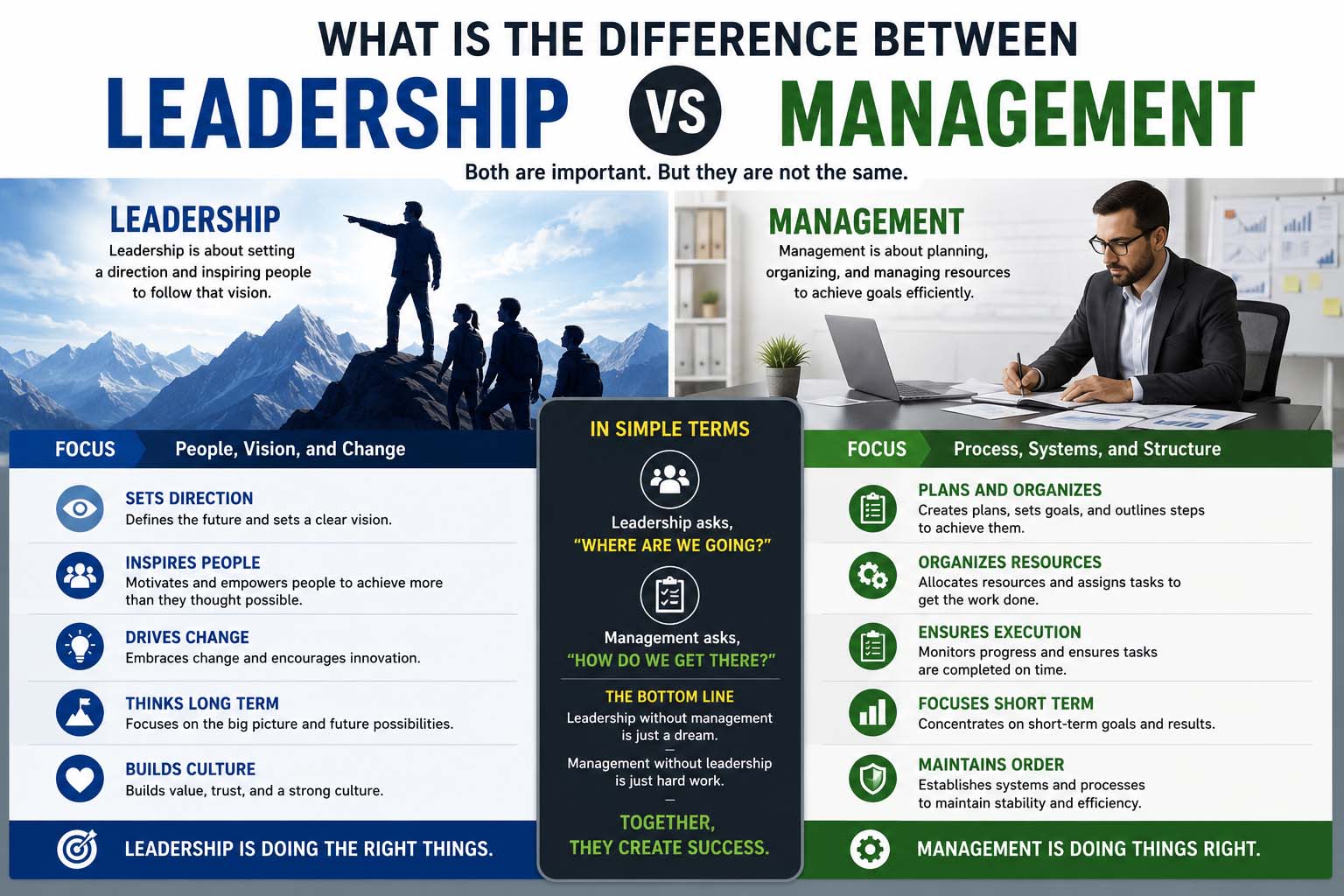
What Is the Difference Between Leadership and Management at a Glance?
Although leaders and managers often work toward the same organizational goals, their day-to-day priorities can be quite different.
| Leadership | Management |
|---|---|
| Creates vision | Executes plans |
| Inspires people | Organizes resources |
| Encourages innovation | Maintains stability |
| Focuses on long-term direction | Focuses on short-term objectives |
| Builds trust and motivation | Measures performance and productivity |
| Welcomes change | Manages processes |
The strongest organizations combine both approaches instead of relying on only one.
Defining Leadership
Leadership is the ability to influence, motivate, and guide people toward a shared goal.
A leader doesn’t necessarily need a management title. Anyone who inspires coworkers, encourages collaboration, or helps others grow can demonstrate leadership.
Great leaders focus on people as much as results. They communicate a clear vision, earn trust, and create an environment where employees feel motivated to perform at their best.
Common Leadership Responsibilities
Leadership often includes:
- Setting a long-term vision
- Motivating employees
- Building team culture
- Encouraging innovation
- Solving complex problems
- Supporting employee development
- Leading organizational change
Strong leadership becomes especially valuable during periods of uncertainty when employees need direction and confidence.
Understanding Management
Management centers on planning, organizing, and coordinating daily operations.
Managers ensure that projects stay on schedule, budgets remain under control, and teams meet performance expectations. While leadership inspires people, management creates the systems that help ideas become reality.
Successful managers balance resources, monitor progress, and solve operational challenges before they affect business performance.
Core Management Responsibilities
Managers commonly handle:
- Project planning
- Task delegation
- Budget oversight
- Performance monitoring
- Scheduling
- Process improvement
- Risk management
Without effective management, even the best ideas can struggle to produce meaningful results.
What Is the Difference Between Management and Leadership?
Many professionals ask what is the difference between management and leadership because the responsibilities often overlap.
The simplest explanation is this:
Leaders decide where the organization should go.
Managers determine how to get there efficiently.
For example, a leader may introduce a vision to expand into a new market over the next five years. A manager then creates project timelines, assigns responsibilities, tracks budgets, and monitors progress to turn that vision into measurable outcomes.
Both roles contribute to business success, but they approach problems from different perspectives.
Leadership and Management Work Best Together
Rather than competing, leadership and management complement one another.
A business with outstanding leadership but weak management may have exciting ideas that never become reality.
On the other hand, excellent management without strong leadership can create efficient processes while limiting innovation and long-term growth.
Organizations that combine both strengths are generally better prepared to adapt to changing markets and customer expectations.
For example, when developing a long-term Business Level Strategy, leadership defines the company’s competitive direction while management translates that strategy into actionable goals, budgets, and daily operations.
Real-World Business Example
Imagine a software company preparing to launch a new product.
The leadership team identifies an opportunity in the market, communicates the company’s vision, and inspires employees to pursue ambitious goals.
Managers break that vision into practical tasks by assigning responsibilities, monitoring deadlines, coordinating departments, and resolving operational issues.
Neither role succeeds without the other.
Leadership provides direction.
Management delivers execution.
Skills That Strong Leaders Develop
Although every leader has a unique style, several core skills consistently distinguish successful professionals across industries and organizations.
These include:
- Clear communication
- Emotional intelligence
- Strategic thinking
- Decision-making
- Adaptability
- Coaching and mentoring
- Conflict resolution
Many of these skills improve through experience, continuous learning, and regular feedback.
Skills That Effective Managers Need
Managers rely on a different—but equally valuable—set of abilities.
Key management skills include:
- Organization
- Planning
- Time management
- Delegation
- Budget management
- Performance evaluation
- Resource allocation
These practical skills help organizations operate efficiently while maintaining consistent quality and productivity.
Leadership vs. Management During Organizational Change
Periods of change highlight the differences between these two roles more clearly than almost any other situation.
Leaders explain why change is necessary, address employee concerns, and build confidence in the organization’s future.
Managers create implementation plans, assign responsibilities, establish timelines, and monitor progress to ensure the transition stays on track.
Together, they reduce uncertainty while helping employees adapt more effectively.
Building Strong Company Culture
Culture develops through both leadership and management.
Leaders shape values, encourage collaboration, and inspire shared purpose.
Managers reinforce those values through hiring practices, performance reviews, daily communication, and workplace expectations.
Company culture also varies across different types of work environments. Leadership may look different in a startup than in a large corporation, while management practices often adapt to match each organization’s structure and goals.
Can One Person Be Both a Leader and a Manager?
Absolutely.
Many business owners, department heads, and executives perform both roles every day.
A sales manager, for example, may motivate the team to exceed annual goals while also tracking sales metrics, approving budgets, and scheduling client meetings.
The most successful professionals know when to inspire people and when to focus on execution. Developing both leadership and management skills creates greater flexibility and prepares individuals for higher levels of responsibility.
What Is the Difference Between Leadership and Management With Examples?
One of the easiest ways to understand these concepts is to see them in action.
Imagine a retail company wants to improve customer satisfaction.
The leader identifies a long-term vision of becoming the most trusted brand in its market. They encourage employees to think creatively, improve service quality, and embrace new ideas.
The manager turns that vision into a practical plan. They schedule staff training, assign responsibilities, monitor customer feedback, and measure performance against specific goals.
Here’s another example in a manufacturing business:
- Leader: Encourages innovation to reduce production waste and improve sustainability.
- Manager: Creates production schedules, tracks inventory, and ensures quality standards are met every day.
These examples show that leadership focuses on direction, while management focuses on execution.
What Is the Difference Between Leadership and Management in Nursing?
Healthcare provides another excellent example because both roles are essential for patient care.
A nursing leader inspires staff, supports professional development, promotes collaboration, and helps create a positive workplace culture.
A nursing manager is responsible for staffing schedules, budgeting, regulatory compliance, resource allocation, and day-to-day operations within the department.
Hospitals perform best when these responsibilities work together. Strong leadership improves morale and encourages better patient care, while effective management keeps services organized and efficient.
Advantages of Strong Leadership
Organizations benefit from effective leadership in several ways.
Some of the biggest advantages include:
- Higher employee motivation
- Better communication
- Greater innovation
- Improved adaptability
- Stronger workplace culture
- Increased employee engagement
Employees are more likely to stay committed when they understand the organization’s purpose and feel valued by their leaders.
Advantages of Effective Management
Good management creates consistency across the organization.
Benefits include:
- Clear responsibilities
- Better resource planning
- Improved productivity
- Consistent quality
- Better financial control
- Reliable project delivery
These strengths help businesses achieve goals while minimizing unnecessary risks.
Common Mistakes Businesses Make
Some organizations assume leadership and management are interchangeable.
That misunderstanding can create problems.
Common mistakes include:
- Promoting strong technical employees without leadership training.
- Focusing only on daily operations while ignoring long-term strategy.
- Inspiring employees without providing clear processes.
- Managing tasks without communicating a meaningful vision.
- Measuring productivity but overlooking employee development.
Recognizing these challenges helps organizations create balanced leadership teams.
Best Practices for Balancing Leadership and Management
Businesses rarely succeed by emphasizing only one approach.
Instead, consider these practical strategies:
- Encourage managers to develop leadership skills.
- Provide leadership training at every career stage.
- Set clear goals while allowing room for innovation.
- Communicate regularly with employees.
- Measure both business results and employee engagement.
- Review leadership effectiveness alongside operational performance.
Organizations that invest in both areas often adapt more successfully to changing business conditions.
Leadership and Management in Strategic Planning
Leadership and management play different but equally valuable roles during strategic planning.
Leaders identify opportunities, evaluate industry trends, and establish long-term priorities.
Managers convert those priorities into measurable objectives, project schedules, budgets, and performance indicators.
For example, before launching a new product or service, leadership may define the company’s vision and competitive position. Managers then coordinate the Product Development Life Cycle by assigning responsibilities, monitoring milestones, and ensuring projects stay on schedule.
Likewise, business growth depends on understanding customers. Leadership helps define long-term goals, while marketing teams identify What Is a Target Market to ensure products and services reach the right audience.
Communication Is the Bridge Between Both Roles
Communication connects leadership and management more than any other skill.
Leaders communicate purpose, values, and future direction.
Managers communicate expectations, deadlines, priorities, and progress updates.
When both messages remain consistent, employees understand not only what they need to do but also why their work matters.
Clear communication reduces confusion, improves collaboration, and supports better decision-making across every department.
As organizations grow, leaders often reinforce company values through a well-defined vision. Many businesses begin that process by learning How to Write a Mission Statement, which helps communicate purpose to employees, customers, and stakeholders alike.
Frequently Asked Questions
Is leadership more important than management?
Neither role is more important than the other. Leadership provides direction and motivation, while management ensures work is completed efficiently. Most successful organizations need both.
Can a manager become a leader?
Yes. Leadership skills can be developed through experience, coaching, education, and practice. Many outstanding leaders began their careers in management positions.
Can someone be a leader without being a manager?
Absolutely. Employees at any level can demonstrate leadership by motivating coworkers, solving problems, and encouraging collaboration, even without formal authority.
Why do businesses need both leadership and management?
Leadership helps organizations adapt, innovate, and grow. Management keeps operations organized, productive, and aligned with business goals. Together, they create a stronger foundation for long-term success.
How can I improve both leadership and management skills?
Focus on communication, decision-making, emotional intelligence, planning, delegation, and continuous learning. Seeking feedback from colleagues and mentors also helps identify areas for improvement.
Key Takeaways for Future Leaders and Managers
Understanding what is the difference between leadership and management helps professionals appreciate the value of both roles rather than viewing them as competing responsibilities.
Leadership inspires people, builds trust, and creates a vision for the future. Management transforms that vision into practical action through planning, organization, and execution. Businesses that balance both approaches are often better equipped to navigate change, improve employee performance, and achieve sustainable growth.
Whether you’re leading a small team, managing daily operations, or preparing for a senior role, developing strengths in both leadership and management will make you a more effective professional and contribute to stronger business results.