
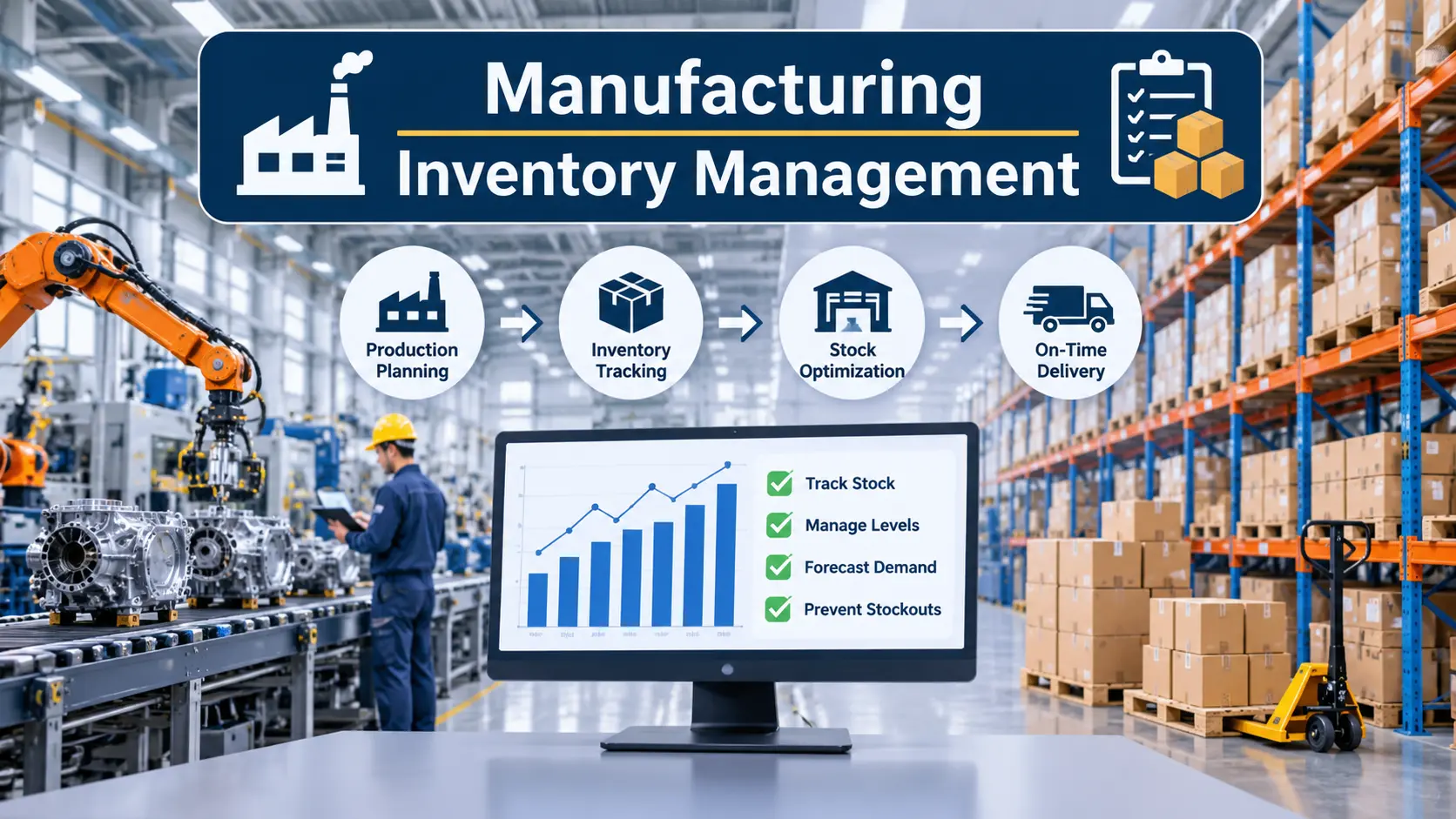
Manufacturing Inventory Management: How to Control Stock From Raw Materials to Finished Goods
Picture this: your production line stops on a Tuesday morning because you ran out of one small part. Meanwhile, your warehouse is full of finished products that nobody has ordered yet. That is what happens when manufacturing inventory management goes wrong. In short, it is the system you use to track, store and control every material and product that moves through your factory.
In this guide, you will learn how it works and which methods fit different factories. On top of that, you will see how software helps and which mistakes cost manufacturers the most money.
What Is Manufacturing Inventory Management?
Simply put, manufacturing inventory management means keeping the right amount of stock at every stage of production. Unlike a retail shop, a factory does not just buy and sell finished items. Instead, it turns raw materials into products, so stock changes form along the way.
Because of this, manufacturers juggle more moving parts than most businesses. For example, a furniture maker tracks lumber, screws and varnish. At the same time, it tracks half-built chairs and boxed chairs ready to ship.
According to Investopedia, inventory management covers the whole process of ordering, storing, using and selling a company’s inventory. In a factory, that whole process simply has more steps.
Four Inventory Types Every Manufacturing Inventory Management System Tracks
Before you can control stock, you need to know what you are counting. Most manufacturers work with four main types.
1. Raw Materials
First, there are raw materials. These are the basic inputs, such as steel, fabric, plastic pellets or flour. Since buying them well affects every later step, a quick read on what is procurement shows how purchasing choices shape your stock levels.
2. Work in Progress (WIP)
Next comes work in progress. This covers items that have started production but are not finished yet. For instance, a bike frame that still needs paint counts as WIP.
3. Finished Goods
After that, you have finished goods. These products are complete and ready to sell. However, they still tie up cash until a customer pays for them.
4. MRO Supplies
Finally, there are MRO items, which stands for maintenance, repair and operations. Think gloves, lubricants, spare machine parts and cleaning supplies. Although they never end up in the product, running out of them can still stop the line.
| Inventory Type | Example | Main Risk |
|---|---|---|
| Raw materials | Steel sheets | Shortages stop production |
| Work in progress | Unpainted frames | Bottlenecks and hidden waste |
| Finished goods | Boxed products | Overstock ties up cash |
| MRO supplies | Spare machine belts | Unplanned downtime |
Why Manufacturing Inventory Management Matters So Much
Put simply, inventory is money sitting on shelves. Too much of it means cash you cannot use elsewhere. On the other hand, too little means missed orders and idle workers.
Good control, therefore, brings several clear wins:
- Lower costs, because you pay less for storage, insurance and spoilage.
- Smoother production, since the right parts arrive on time.
- Happier customers, as orders ship when promised.
- Better cash flow, so you can invest in growth instead of extra stock.
Popular Manufacturing Inventory Management Methods
There is no single perfect method. Instead, most factories mix a few based on their products and demand.
Just-in-Time (JIT)
With JIT, materials arrive right before you need them. As a result, storage costs drop sharply. Still, this method depends on reliable suppliers, so one late truck can halt everything.
Material Requirements Planning (MRP)
MRP works backward from your production schedule. First, it looks at what you plan to build. Then, it calculates which materials you need and when. Because it relies on accurate data, it works best with software.
Economic Order Quantity (EOQ)
EOQ is a formula that finds the ideal order size. In other words, it balances ordering costs against holding costs. That way, you avoid ordering too often or too much.
FIFO and Stock Rotation
For materials that age or expire, rotation matters. If you work with resins, food ingredients or chemicals, understanding what is FIFO helps you use older stock first and cut waste.
ABC Analysis
Lastly, ABC analysis sorts items by value. Typically, “A” items are few but expensive, while “C” items are cheap and plentiful. Consequently, you spend most of your attention where the money is.
How to Set Up Manufacturing Inventory Management Step by Step
If you are starting from scratch, follow this simple order.
- Count everything. To begin, do a full physical count so your numbers start clean.
- Build a bill of materials (BOM). Next, list every part each product needs.
- Set reorder points. Then, decide the stock level that triggers a new order.
- Add safety stock. After that, keep a small buffer for delays or demand spikes.
- Track in real time. From there, record every receipt, use and shipment as it happens.
- Review monthly. Finally, check turnover rates and adjust your numbers.
Choosing Inventory Management Software for Manufacturing
Spreadsheets work for a while. Eventually, though, they break down as your product list grows. That is when manufacturing inventory management software starts to pay for itself.
Manufacturing Inventory Management Software Features Worth Looking For
Good inventory management software for manufacturing usually includes:
- Bill of materials and recipe tracking
- Real-time stock levels across locations
- Barcode or RFID scanning
- Automatic reorder alerts
- Batch and lot tracking for recalls
- Links to accounting and sales tools
Above all, software gives you a live view of stock across the whole factory. In fact, the benefits of inventory visibility go well beyond counting, because managers can spot slow-moving items and bottlenecks early.
Inventory Management Software for Small Manufacturing Business Owners
Not every shop needs a huge ERP system. Fortunately, inventory management software for small manufacturing business owners now comes in affordable cloud plans. For example, a small candle maker can track wax, wicks and jars without a big upfront cost.
When comparing inventory management software, manufacturing teams should also ask about setup time, training and support. After all, the best tool is the one your staff will actually use.
Common Manufacturing Inventory Management Mistakes
Even experienced manufacturers fall into these traps.
Ignoring Lead Times
Suppliers rarely deliver instantly. Yet many factories set reorder points without counting shipping time. As a result, customer orders pile up, and learning what is a backorder becomes a painful lesson instead of a planning tool.
Overstocking “Just in Case”
Buying extra feels safe. Still, extra stock can spoil, go out of date or simply sit there. Meanwhile, it eats cash and warehouse space.
Skipping Cycle Counts
Waiting for one big yearly count is risky. Instead, count small sections every week. That way, errors get caught before they grow.
Keeping Data in Silos
When purchasing, production and sales use separate systems, numbers drift apart. Because of this, one shared system usually saves more time than it costs.
Smart Strategies to Improve Manufacturing Inventory Management
Beyond daily tracking, a few bigger moves can make your inventory more stable.
Build Strong Supplier Relationships
Reliable suppliers make every method easier. So, share forecasts with them and agree on clear delivery windows. In return, you often get better prices and faster help during shortages.
Consider Owning More of the Chain
Some larger manufacturers take a bigger step. For instance, a carmaker might buy its battery supplier to secure parts. If you are weighing that kind of move, learning what is vertical integration helps you judge the costs and control it brings.
Forecast With Real Data
Gut feeling only goes so far. Rather, use past sales, seasonal patterns and customer orders to plan. Over time, your forecasts get sharper, and your safety stock can shrink.
Quick FAQs
What is the main goal of manufacturing inventory management?
Basically, the goal is to keep production running smoothly without holding more stock than you need.
Do small factories need manufacturing inventory management software?
Not always at the very start. However, once you track dozens of parts, software saves time and cuts costly errors.
How often should a manufacturer count inventory?
Ideally, use weekly cycle counts for key items and a full count once or twice a year.
What is the difference between inventory control and inventory management?
Generally, inventory control handles stock already on hand. By contrast, inventory management also covers planning, ordering and forecasting.
Your Next Moves
Start small, but start this week. First, sort your stock into the four types and run a clean count. Then, set reorder points for your ten most important items.
Once those basics feel steady, test a cloud tool built for manufacturers. In the end, strong inventory habits free up cash, keep machines running and help you deliver on every promise you make to customers.