
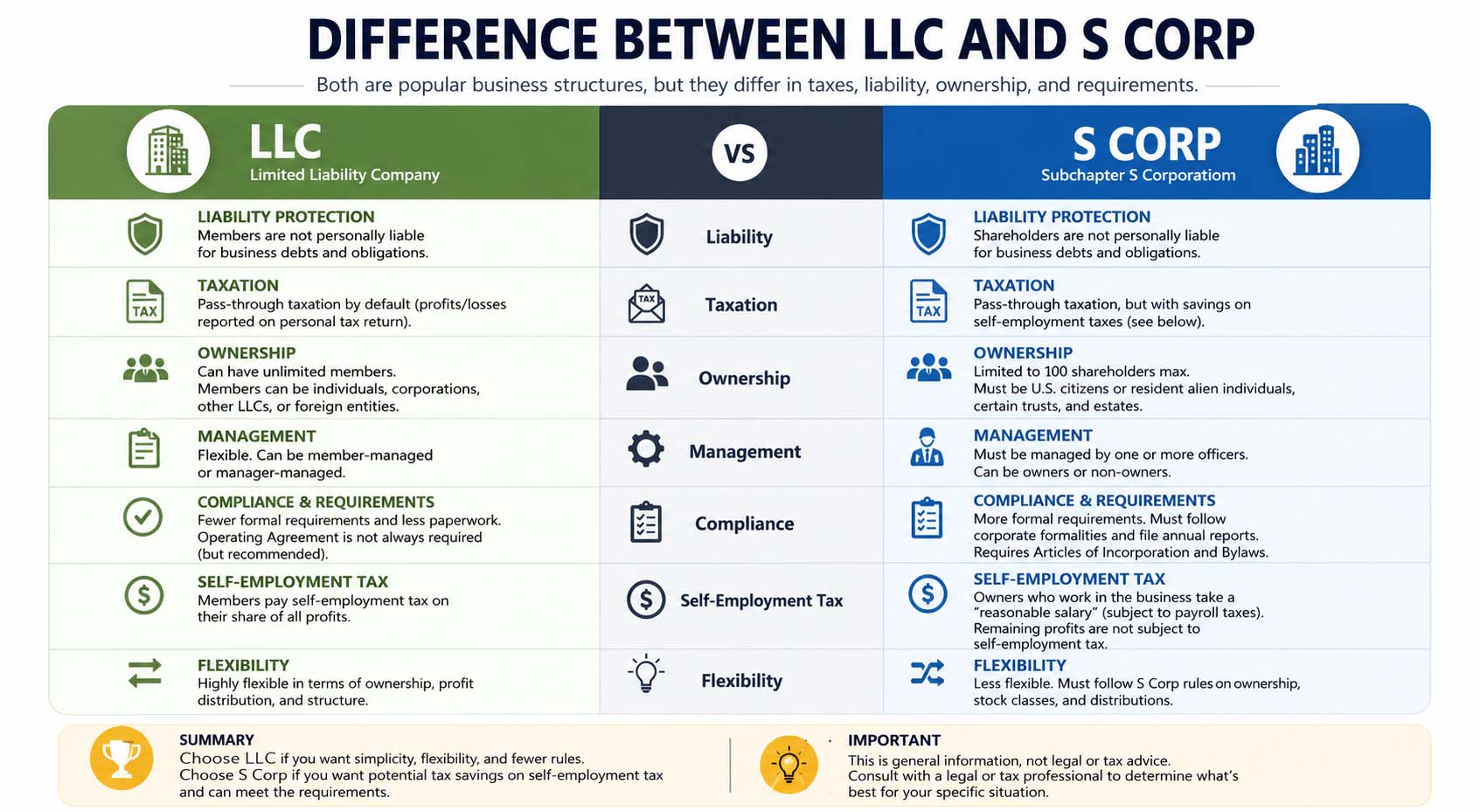
Difference Between LLC and S Corp
Starting a business often leads to one big question: what is the difference between LLC and S Corp? Choosing the right structure can affect your taxes, paperwork, and long-term business goals, so it’s worth understanding how each one works before you register your company.
While many entrepreneurs compare an LLC and an S corporation, it’s helpful to remember that an LLC is a business entity, whereas an S corporation is a tax election available to eligible businesses. That distinction explains why the decision can seem confusing at first.
Difference Between LLC and S Corp: Quick Comparison
The table below highlights the main differences.
| Feature | LLC | S Corp |
|---|---|---|
| Business Type | Legal business entity | Tax status for eligible businesses |
| Liability Protection | Yes | Yes |
| Taxation | Default pass-through taxation | Pass-through taxation with S Corp election |
| Self-Employment Tax | Generally applies to all profits | Salary subject to payroll tax, remaining distributions may not be |
| Ownership Restrictions | Flexible | IRS ownership limits apply |
| Management | Member-managed or manager-managed | Officers and directors required under corporate structure |
| Administrative Requirements | Usually simpler | More ongoing compliance |
Both structures protect personal assets, but they operate differently once taxes and compliance are considered.
What Is an LLC?
A Limited Liability Company (LLC) is one of the most popular business structures for small businesses because it offers personal liability protection, flexible management, and relatively simple tax and compliance requirements.
An LLC separates the owner’s personal assets from the company’s debts and legal obligations. If the business faces financial trouble, the owner’s home, savings, and other personal property are generally protected, provided legal requirements have been followed.
Another advantage is flexibility.
An LLC can have:
- One owner (single-member LLC)
- Multiple owners (multi-member LLC)
- Individual or business owners, depending on state rules
Many first-time entrepreneurs choose an LLC because it offers liability protection without many of the formal requirements associated with corporations.
When registering a new company, checking state records through a Pennsylvania Business Entity Search or a similar business registry in your state can help confirm that your preferred business name is available.
How LLC Taxation Works
By default:
- A single-member LLC is usually taxed like a sole proprietorship.
- A multi-member LLC is generally taxed like a partnership.
Instead of paying federal income tax as a separate business, profits usually “pass through” to the owners, who report the income on their personal tax returns.
An LLC may elect to be taxed as an S corporation if it meets the IRS eligibility requirements, allowing the business to keep its LLC legal structure while potentially benefiting from S corporation tax treatment.
What Is an S Corp?
An S corporation is not a separate type of business entity but a tax classification that eligible corporations and LLCs can elect for federal tax purposes.
Instead, it is a special tax classification approved by the Internal Revenue Service (IRS).
A corporation—or in many cases an eligible LLC—can elect S corporation status if it meets the IRS requirements.
The biggest reason business owners choose S corporation taxation is the potential tax savings.
Unlike a standard LLC, an S corporation allows owners who actively work in the business to receive:
- A reasonable salary
- Profit distributions
Only the salary portion is generally subject to payroll taxes, while qualifying distributions are treated differently under federal tax rules.
Because tax laws can change, business owners should consult a qualified tax professional before making an S corporation election.
Difference Between LLC and S Corp for Taxes
For many entrepreneurs, taxes are the deciding factor when comparing these structures.
The difference between LLC and S Corp becomes more noticeable as a business grows and generates consistent profits.
LLC Taxes
With a traditional LLC:
- Business profits pass directly to the owners.
- Owners generally pay self-employment taxes on business earnings.
- Tax filing is relatively straightforward.
This simplicity makes LLCs attractive for freelancers, consultants, and many small businesses.
S Corp Taxes
An S corporation follows pass-through taxation as well.
However, owners working in the business must receive reasonable compensation through payroll.
After paying that salary, remaining eligible profits may be distributed separately, which can reduce self-employment tax exposure in some situations.
Tax savings depend on factors such as income level, payroll requirements, and business expenses.
Ownership Rules
Ownership flexibility is another major distinction.
LLC Ownership
LLCs generally have fewer ownership restrictions.
Depending on state law, owners may include:
- Individuals
- Other LLCs
- Certain corporations
- Foreign owners
Operating agreements also provide flexibility by outlining how profits are distributed, defining management responsibilities, and establishing rules for decision-making among members.
S Corporation Ownership
The IRS imposes stricter rules.
Generally, an S corporation:
- Must meet shareholder eligibility requirements
- Has limits on the number of shareholders
- Can issue only one class of stock
These rules make S corporations less flexible than LLCs for businesses planning to raise investment from a wide variety of owners.
Management Structure
Another area where businesses compare the difference between S Corp and LLC is management.
An LLC offers flexibility.
Owners can manage daily operations themselves or appoint professional managers.
An S corporation follows the corporate model, which generally includes:
- Shareholders
- Directors
- Corporate officers
That formal structure often requires additional documentation, annual meetings where required by law, and detailed corporate records.
Liability Protection
One similarity often surprises new business owners.
Both LLCs and S corporations provide limited liability protection, helping separate personal assets from business liabilities when the business is properly formed and operated.
This means owners are generally not personally responsible for business debts simply because they own the company.
However, liability protection is not automatic.
Business owners should:
- Keep personal and business finances separate.
- Follow state filing requirements.
- Maintain accurate financial records.
- Comply with legal obligations.
Failing to follow these practices may weaken liability protection in certain situations.
Real-World Example
Imagine two graphic design agencies that each earn $180,000 annually.
The first owner operates as a standard LLC.
The second owner has elected S corporation taxation after consulting a tax advisor.
Both businesses generate similar revenue, but their tax treatment differs because the S corporation owner receives a reasonable salary and may take additional qualifying profit distributions.
The better choice depends on several factors, including annual profit, payroll costs, administrative responsibilities, and long-term growth plans rather than revenue alone.
Business structure decisions also depend on ownership goals. For entrepreneurs considering multiple owners, understanding the benefits of partnership can provide helpful context before deciding whether an LLC or another structure is the better fit.
Difference Between LLC S Corp and C Corp
Many entrepreneurs compare more than two business structures before making a decision. Understanding the difference between LLC S Corp and C Corp helps you choose the option that matches your goals, tax situation, and growth plans.
| Feature | LLC | S Corp | C Corp |
|---|---|---|---|
| Business Type | Legal entity | Tax election | Legal entity |
| Taxation | Pass-through by default | Pass-through | Corporate taxation |
| Ownership Restrictions | Very flexible | IRS limits apply | Few ownership restrictions |
| Stock Classes | Not applicable | One class of stock | Multiple classes allowed |
| Best For | Small businesses and startups | Profitable small businesses | Companies seeking outside investors |
An LLC focuses on simplicity and flexibility. An S corporation is often attractive for businesses with steady profits that may benefit from its tax treatment. A C corporation is commonly chosen by larger companies that plan to raise capital from investors.
Difference Between S Corp and C Corp and LLC
When people search for the difference between S Corp and C Corp and LLC, they are usually trying to balance taxes with long-term business goals.
An LLC is often the easiest option to manage because it has fewer formal requirements.
An S corporation offers potential payroll tax advantages for qualifying businesses, though it comes with stricter compliance rules.
A C corporation is often the preferred choice for businesses planning rapid expansion, issuing multiple classes of stock, or attracting venture capital.
Rather than asking which structure is “best,” it’s more useful to ask which one fits your current stage of business.
Advantages of an LLC
An LLC remains one of the most popular choices for new businesses for several reasons.
Benefits
- Limited liability protection
- Flexible ownership rules
- Pass-through taxation by default
- Fewer administrative requirements
- Flexible management structure
These advantages make LLCs suitable for freelancers, consultants, family businesses, and many local service companies.
Advantages of an S Corporation
Businesses that qualify for S corporation taxation may enjoy several benefits.
Benefits
- Pass-through taxation
- Potential payroll tax savings
- Professional business image
- Continued liability protection
- Suitable for profitable small businesses
The tax advantages depend on individual circumstances, so professional tax advice is always worthwhile before making an election.
If you’re comparing business structures more broadly, learning about corporation advantages and disadvantages can provide additional perspective on how corporations differ from other legal entities.
Potential Drawbacks
Every business structure has trade-offs.
LLC Challenges
- Owners may pay self-employment taxes on business profits.
- Raising investment can be more difficult than with corporations.
- State filing requirements vary.
S Corporation Challenges
- Stricter IRS eligibility rules
- Additional payroll responsibilities
- Greater recordkeeping requirements
- Ongoing compliance obligations
Choosing the simpler option isn’t always the right answer. Likewise, selecting the structure with potential tax savings may create extra administrative work.
How to Choose Between an LLC and an S Corporation
The right choice depends on your business rather than a universal rule.
An LLC may be a better fit if you:
- Are starting your first business
- Want straightforward administration
- Prefer management flexibility
- Expect modest profits during the early years
An S corporation may be worth considering if you:
- Operate a consistently profitable business
- Work actively in the company
- Can meet payroll requirements
- Are comfortable with additional compliance
Many business owners start as an LLC and later elect S corporation taxation as the business grows.
Common Mistakes to Avoid
Choosing a business structure without careful planning can lead to unnecessary costs.
Some common mistakes include:
Focusing Only on Taxes
Taxes matter, but they aren’t the only factor.
Liability protection, ownership flexibility, administrative work, and future growth should also influence your decision.
Ignoring State Requirements
Every state has its own filing rules, fees, and reporting requirements.
Understanding your local regulations before registering a company can prevent delays and penalties.
Many businesses also need specific types of business licenses depending on their industry and location, regardless of whether they operate as an LLC or an S corporation.
Choosing a Structure Too Early
Some entrepreneurs select a business structure before they fully understand their revenue model or long-term plans.
As a business grows, its legal and tax needs often change.
Does Your Business Model Matter?
Absolutely.
For example, someone opening a local consulting firm may have different priorities than someone building a nationwide franchise network.
An entrepreneur researching How to Start a Franchise may eventually discover that business structure decisions affect expansion, ownership, taxation, and ongoing compliance.
Thinking about future growth before registering your company can save time and money later.
Frequently Asked Questions
What is the difference between LLC and S Corp?
An LLC is a legal business entity that provides liability protection. An S corporation is a tax election available to eligible businesses, including many LLCs. The biggest differences involve taxation, ownership rules, and administrative requirements.
Can an LLC become an S corporation?
Yes. Many eligible LLCs elect S corporation tax treatment by filing the required paperwork with the IRS while remaining LLCs under state law.
Which is better for small businesses?
It depends on the business’s profits, ownership structure, growth plans, and tax situation. Many new businesses begin as LLCs because they are relatively simple to manage.
Does an S corporation provide better liability protection?
No. Both structures generally provide limited liability protection when owners follow legal and financial requirements.
Should I talk to a professional before choosing?
Yes. An accountant or business attorney can explain how each structure affects taxes, compliance, and long-term planning based on your specific circumstances.
Making the Right Choice
Understanding the difference between LLC and S Corp helps you choose a business structure that supports both your current needs and future goals.
An LLC offers flexibility, simpler administration, and strong liability protection, making it an excellent option for many new entrepreneurs. An S corporation can provide valuable tax advantages for qualifying businesses that generate consistent profits and are prepared for additional compliance requirements.
Before making a final decision, evaluate your expected income, ownership plans, administrative capacity, and growth strategy. Taking the time to compare your options today can help you build a stronger business foundation for years to come.