
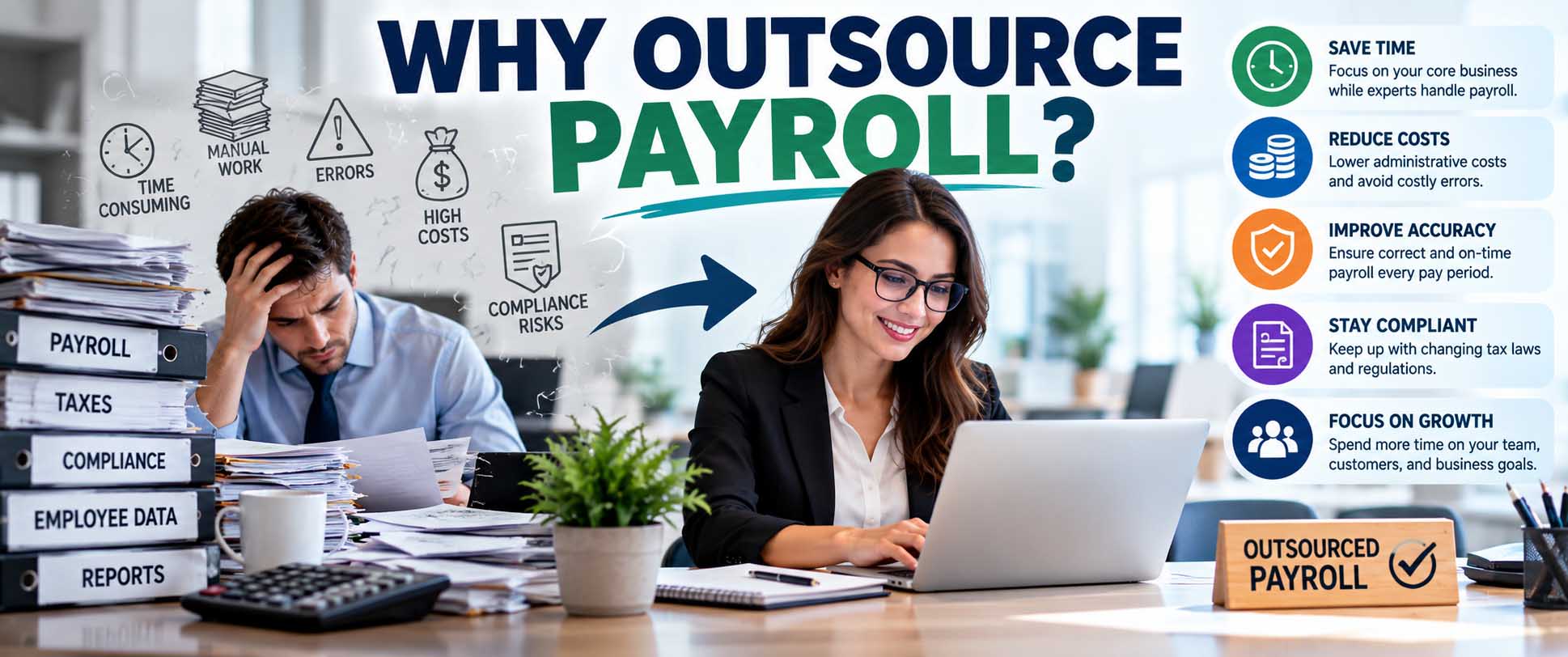
Why Outsource Payroll? Benefits, Risks, and How It Works
Running payroll may look simple when a business has only a few employees. However, as the company grows, calculating wages, tracking hours, handling deductions, maintaining records, and meeting tax deadlines can take significant time. So, why outsource payroll instead of continuing to manage everything internally? For many businesses, outsourcing reduces routine administrative work while providing access to specialized payroll systems and expertise.
A payroll provider can handle some or most of the payroll process on behalf of a company. Depending on the service, that may include wage calculations, tax-related processing, direct deposits, employee records, reports, and year-end documents.
However, outsourcing does not mean the employer can completely ignore payroll. The business still needs to provide accurate information, review reports, protect employee data, and monitor the provider.
Therefore, the real question is whether outsourcing makes payroll easier, more reliable, and more efficient for your particular business.
Why Outsource Payroll Instead of Managing It In-House?
Businesses usually outsource payroll because payroll takes time and requires consistent attention.
Even a relatively small payroll can involve employee hours, salaries, overtime, bonuses, deductions, taxes, paid leave, new hires, departing employees, and changes to personal information.
Before comparing outsourcing options, understanding what is payroll helps clarify how many separate tasks are actually involved in paying employees correctly.
When payroll remains in-house, someone must manage those responsibilities every pay period. In a small company, that person might be the owner, office manager, bookkeeper, accountant, or HR employee.
As the workforce expands, the process can become more demanding.
By outsourcing selected payroll tasks, businesses can shift much of that repetitive processing to a provider that already has payroll software, established procedures, and specialized staff.
Why Do Companies Outsource Payroll?
If you are wondering why do companies outsource payroll, the reasons usually involve a combination of time, expertise, technology, and risk management.
Payroll is repetitive, but it is also deadline-driven. Therefore, mistakes cannot simply wait until someone has spare time.
Employees expect accurate and timely pay. Meanwhile, businesses must maintain records and meet applicable reporting and tax obligations.
Outsourcing can help create a more structured process.
For example, imagine a company with 40 employees. An internal manager may spend hours collecting timesheets, checking changes, processing payroll, answering employee questions, and preparing reports.
If an outside provider handles the core processing, the manager can spend more time on hiring, employee development, operations, or other business priorities.
That does not eliminate internal responsibilities. However, it can change where the company spends its administrative time.
Payroll Outsourcing Can Save Internal Time
Time savings are among the most practical reasons to outsource.
Payroll involves recurring work every week, every two weeks, or every month, depending on the company’s pay schedule.
Although individual tasks may seem small, they add up.
Someone must gather payroll inputs, review employee changes, check hours, verify deductions, process payments, maintain records, and investigate discrepancies.
Meanwhile, growing businesses often have other HR tasks competing for attention.
This is why payroll is sometimes considered alongside broader Human Resources Outsourcing Services, especially when a business wants external support for several workforce-related administrative functions.
Still, a company does not have to outsource its entire HR function simply because it outsources payroll. Instead, it can choose the services that provide the most practical value.
Why Outsource Payroll Processing for Better Accuracy?
Another common question is why outsource payroll processing when software can already perform calculations.
Software certainly helps, but payroll accuracy depends on more than arithmetic.
The information entered into the system must also be correct. For instance, employee classifications, working hours, pay rates, bonuses, deductions, leave, and other payroll inputs need accurate handling.
Experienced providers generally use standardized workflows, automated calculations, validation procedures, and payroll-specific systems.
As a result, outsourcing may reduce certain manual administrative errors.
However, a provider cannot correct inaccurate information it never receives.
If a manager submits the wrong number of hours, for example, even a sophisticated payroll platform may calculate the wrong payment correctly based on the incorrect input.
Therefore, businesses still need a clear internal review process.
Supporting Payroll Compliance
Payroll rules can be complicated because employers may face tax, wage, recordkeeping, reporting, and employee-related requirements.
Those requirements also vary by country, state, province, municipality, worker type, and business circumstances.
A payroll provider may help businesses manage routine compliance-related payroll processes and keep payroll systems updated as supported requirements change.
That expertise can be especially useful for a growing business that lacks a dedicated payroll department.
However, outsourcing payroll does not automatically transfer every legal responsibility away from the employer.
Businesses should understand exactly what the provider handles and what remains their responsibility.
Therefore, companies should avoid choosing a payroll service based solely on claims that it will “handle everything.”
Instead, review the service agreement, responsibilities, supported jurisdictions, and escalation process carefully.
Different Types of Workers Can Complicate Payroll
A growing company may not have a completely uniform workforce.
For instance, businesses can employ full-time staff, part-time staff, temporary workers, seasonal employees, or other worker categories depending on applicable laws and business needs.
Understanding different types of employees can help business owners recognize why payroll procedures may vary across a workforce.
For example, employees may have different schedules, pay structures, benefits, leave arrangements, or overtime considerations.
As workforce complexity increases, payroll administration can become harder to manage with simple spreadsheets and manual processes.
A capable provider may offer systems designed to organize those variations more efficiently.
Still, employers must classify workers correctly under applicable rules rather than relying on payroll software to make legal classification decisions automatically.
Why Outsource Payroll Processing Services as a Business Grows?
The question why outsource payroll processing services becomes especially relevant when a company starts hiring quickly.
A payroll method that works for five employees may become inefficient at 50.
More employees usually mean more payroll changes, questions, records, approvals, and opportunities for errors.
Likewise, expansion into additional locations can introduce new requirements.
Outsourcing can make the payroll process more scalable because the business uses an established platform and service team rather than building every capability internally.
For example, a growing company might otherwise need to purchase new payroll software, create internal procedures, train employees, and assign additional administrative staff.
With outsourcing, some of that infrastructure already exists.
However, companies should confirm that the provider can support future growth before signing a long-term agreement.
Payroll Outsourcing vs In-House Payroll
Neither approach is automatically right for every business.
A simple comparison can help:
| Factor | In-House Payroll | Outsourced Payroll |
|---|---|---|
| Day-to-day control | High | Shared with provider |
| Internal workload | Usually higher | Usually lower |
| Payroll expertise | Must exist internally | Provider supplies payroll expertise |
| Software management | Business responsibility | Often provider-managed |
| Direct service cost | May appear lower initially | Recurring service fees |
| Scalability | Requires internal expansion | Often easier to scale |
| Provider dependency | Low | Higher |
| Data sharing | Mostly internal | Sensitive data shared externally |
Small businesses with straightforward payroll and experienced internal staff may prefer keeping the process in-house.
Meanwhile, growing companies or businesses with limited payroll expertise may find outsourcing more efficient.
Therefore, the decision should reflect workload, complexity, cost, internal skills, and risk rather than company size alone.
Payroll, Accounting, and Finance Are Not the Same
Payroll focuses on calculating and processing employee compensation and related records. Accounting, meanwhile, records and organizes financial transactions, including payroll expenses. Finance generally focuses more broadly on areas such as planning, funding, investment decisions, and financial strategy.
Understanding the difference between finance and accounting can help business owners assign payroll information to the right internal teams and avoid assuming one department automatically handles every financial responsibility.
For instance, an outsourced provider may process employee payments, while the company’s accounting team records payroll expenses in its books.
Clear responsibilities make that handoff easier.
Benefits of Outsourcing Beyond Payroll
Payroll outsourcing often introduces business owners to a wider question: which administrative functions should remain internal?
There is no universal answer.
Some businesses want direct internal control over recruitment, employee relations, benefits, and payroll. Others outsource selected administrative tasks while keeping strategic HR decisions inside the company.
Many of the benefits of hr outsourcing relate to accessing specialized expertise, reducing administrative workload, and allowing internal teams to focus on higher-value responsibilities.
However, outsourcing too many functions without clear oversight can create communication gaps.
Therefore, businesses should outsource deliberately rather than simply transferring every difficult process to a third party.
Potential Disadvantages of Payroll Outsourcing
Outsourcing has trade-offs.
First, businesses give up some direct control over day-to-day processing. If a payroll problem appears, internal employees may need to contact the provider rather than fixing it immediately themselves.
Second, payroll providers charge fees. Depending on the service, businesses may pay per payroll run, per employee, for additional features, or through a bundled subscription.
Third, switching providers can take work because employee records, historical payroll information, integrations, and processes may need to move.
Data security also deserves attention.
Payroll systems contain sensitive employee and financial information. Therefore, businesses should evaluate how a provider protects data, manages access, handles incidents, and controls third-party integrations.
These disadvantages do not make outsourcing a bad choice. Instead, they show why provider selection matters.
How to Choose a Payroll Outsourcing Provider
Start by defining exactly what you want the provider to handle.
For example, do you need basic payroll calculations and payments, or do you also need tax-related services, employee self-service tools, reporting, time tracking, or integrations?
Next, compare providers based on practical requirements rather than advertising claims.
Consider:
- Supported locations and jurisdictions
- Payroll processing features
- Pricing structure
- Customer support
- Data security practices
- Software integrations
- Employee self-service options
- Reporting capabilities
- Implementation support
- Contract and cancellation terms
- Procedures for correcting payroll errors
Also, ask what happens when something goes wrong.
A provider may perform well during normal payroll runs, yet the quality of support becomes much more noticeable when an employee receives an incorrect payment or a deadline is approaching.
Why Outsource Your Payroll — and When Should You Not?
If you are asking why outsource your payroll, look first at the problems your current process creates.
Are payroll tasks consuming too much staff time? Are errors becoming frequent? Is your workforce becoming more complex? Do you lack internal payroll expertise? Is your existing software difficult to manage?
If several answers are yes, outsourcing may be worth evaluating.
However, keeping payroll in-house may still make sense when the process is simple, your team has strong payroll knowledge, and existing systems work efficiently.
Likewise, outsourcing may offer little benefit if the provider simply adds another layer of communication without reducing workload.
The best decision comes from comparing the full cost and effort of both approaches.
Include internal staff time, software, training, administration, provider fees, implementation work, and ongoing oversight rather than comparing subscription prices alone.
Common Payroll Outsourcing Mistakes
One common mistake is selecting the cheapest provider without examining service quality.
Another is assuming outsourcing eliminates all internal payroll responsibilities.
Businesses still need someone to provide accurate information, approve payroll, communicate changes, and monitor the service.
Likewise, failing to plan the transition can cause unnecessary problems.
Before switching, confirm employee data, pay schedules, balances, deductions, bank details, historical records, and system integrations.
Finally, explain the change to employees.
Workers should know how they will access payslips, update information, report problems, and find answers after the new system goes live.
FAQs About Payroll Outsourcing
Is outsourcing payroll worth it for a small business?
It can be. A small company may benefit when payroll consumes significant owner or staff time, requires expertise the company lacks, or becomes difficult to manage consistently. However, businesses with very simple payroll may find an in-house system sufficient.
Does payroll outsourcing save money?
Sometimes, but savings are not guaranteed. Businesses should compare provider fees with internal labor, software, training, and administrative costs before deciding.
Can a company outsource only payroll?
Yes. A business can outsource payroll while keeping recruitment, employee management, accounting, and other functions internal.
Does outsourcing payroll remove employer responsibility?
No. A provider can perform agreed payroll services, but employers still need appropriate oversight and must understand their responsibilities under applicable rules.
Is payroll data safe with an outsourced provider?
Security depends on the provider and its practices. Therefore, businesses should review access controls, data protection measures, incident procedures, and other relevant security information before sharing sensitive payroll data.
Make the Payroll Decision Based on Your Business
The best answer to why outsource payroll depends on what your company actually needs.
If payroll consumes too much time, becomes increasingly complicated, or requires expertise your team does not have, a reliable provider can reduce administrative pressure and create a more structured process. At the same time, outsourcing can provide useful technology and support as the workforce grows.
However, outsourcing should not mean giving up oversight.
Define responsibilities clearly, compare providers carefully, review security and service terms, and keep an internal process for checking payroll information.
When those pieces are in place, payroll outsourcing can become a practical business decision rather