
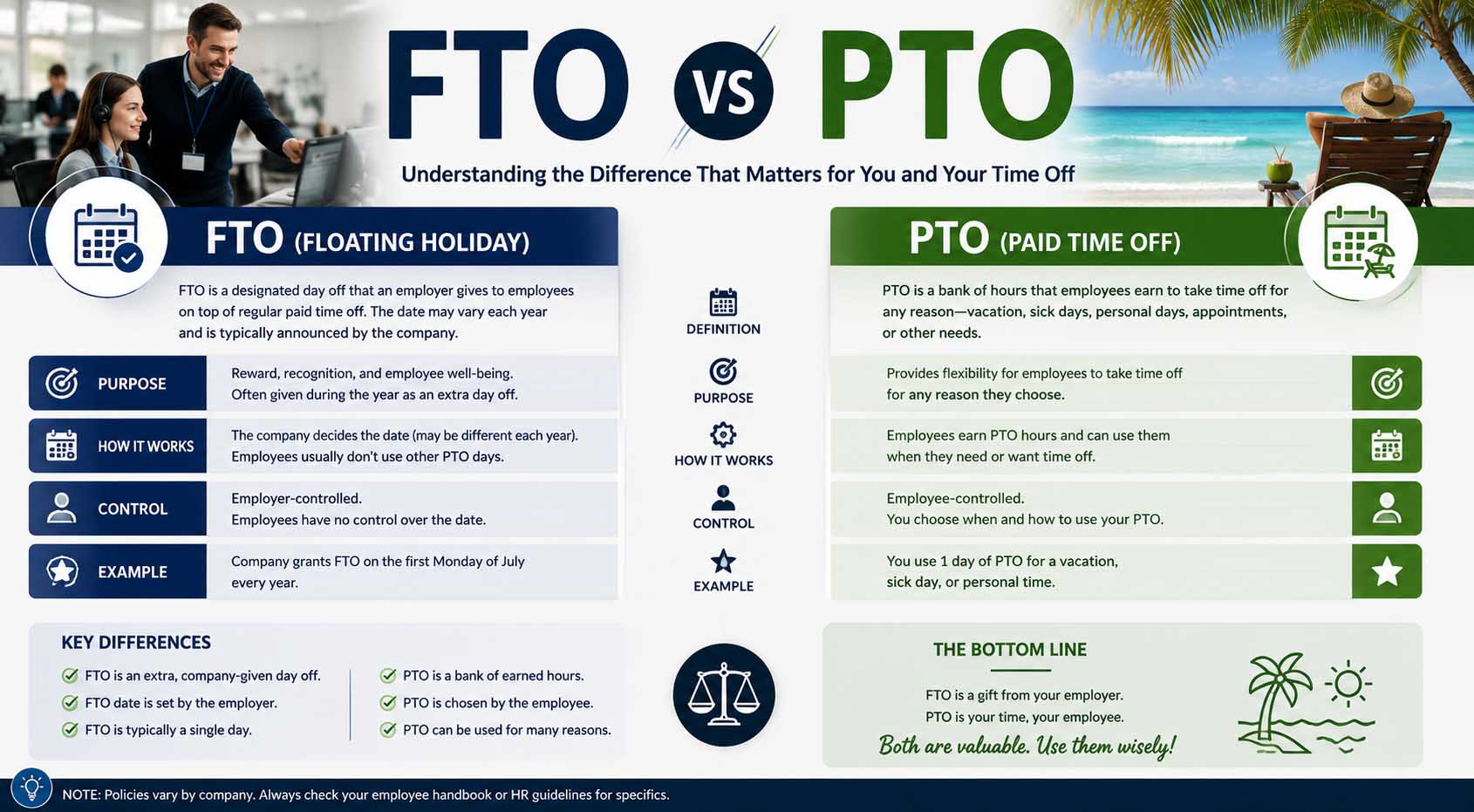
FTO vs PTO: What’s the Difference and Which Policy Works Better?
Time-off policies can become confusing when employers use terms such as PTO, FTO, flexible PTO, and unlimited leave. The basic FTO vs PTO difference usually comes down to how time off is structured: PTO often provides employees with a defined amount of paid leave, while FTO commonly refers to flexible time off without the same fixed bank of vacation days. However, companies do not always use “FTO” in exactly the same way, so the employer’s written policy matters more than the abbreviation alone.
For employees, understanding the difference can help when comparing job offers or planning vacation. Meanwhile, employers need policies that provide useful flexibility without creating uncertainty about when workers can take leave.
What Is FTO vs PTO?
When comparing these two time-off policies, start with their basic definitions.
PTO, or paid time off, is an employer-provided benefit that allows eligible workers to take approved time away from work while continuing to receive pay. Depending on the company, employees may earn PTO gradually or receive a set amount at the beginning of a benefit year.
FTO commonly means flexible time off. Under this approach, an employer may not assign employees a traditional fixed vacation balance. Instead, eligible employees request paid time away when needed, subject to the company’s rules and approval process.
However, terminology varies between employers. Some companies use FTO for flexible time off, while others may use different definitions. Therefore, employees should always read the actual policy rather than assuming the letters guarantee a specific benefit.
FTO vs PTO Meaning in Simple Terms
The easiest way to understand the difference is to imagine two employees.
Maria works for a company that gives her 18 PTO days each year. When she takes a five-day vacation, those five days are deducted from her available balance. She then has 13 days remaining, assuming no other adjustments.
David works for a company with an FTO policy. He does not have an 18-day vacation bank. Instead, he submits a request for five days away, and his manager reviews the request based on workload, staffing, deadlines, and company guidelines.
Both employees can potentially receive paid time away from work. However, the method for managing that leave differs.
If you are unfamiliar with the broader concept, understanding what does PTO stand for can help clarify why PTO policies often focus on a defined pool of paid leave.
FTO vs PTO Difference at a Glance
Although individual company policies vary, this comparison shows common differences.
| Feature | FTO | PTO |
|---|---|---|
| Common meaning | Flexible time off | Paid time off |
| Fixed annual balance | Often no | Commonly yes |
| Accrual system | Usually not traditional accrual | Often accrued or granted |
| Manager approval | Usually required | Usually required |
| Balance tracking | May be limited | Common |
| Carryover | Often not relevant | May be available |
| Unused balance | Usually no traditional bank | May remain unused |
| Separation payout | Depends on policy and law | Depends on policy and law |
| Main advantage | Flexibility | Clearly defined benefit |
| Main concern | Unclear usage expectations | Limited available days |
These are general patterns rather than universal rules. Consequently, two employers could both advertise FTO while operating their programs differently.
How Does Traditional PTO Work?
Traditional PTO usually starts with a defined allowance.
For instance, a company might provide 15 paid days annually. Alternatively, employees might earn several hours of PTO during each pay period.
When employees take approved time off, the employer deducts the hours or days from their available balance.
Anyone wondering how does PTO work should also check whether an employer combines vacation, personal days, and certain other absences into one PTO bank or maintains separate categories.
Some employers also allow unused PTO to carry into the next year, sometimes subject to a cap. In other workplaces, different rules apply based on company policy and applicable law.
As a result, PTO provides employees with a measurable benefit. They can usually see exactly how much paid discretionary time remains available.
How Flexible Time Off Usually Works
FTO takes a different approach.
Rather than giving an employee a fixed number of vacation days, the employer usually establishes guidelines for requesting reasonable paid time away.
An employee may submit a request through HR software or directly to a manager. Then, the manager evaluates factors such as team coverage, current projects, deadlines, and other scheduled absences.
For example, an employee requesting three days during a quiet period may receive quick approval. However, a two-week request during the company’s busiest season could require more planning or might be declined under the employer’s policy.
Therefore, flexible does not mean automatically approved.
PTO vs FTO: Which Gives Employees More Time Off?
At first glance, FTO appears to offer more time because employees may not have a fixed maximum balance.
In practice, though, the answer depends heavily on workplace culture.
A worker with 20 PTO days knows the employer has formally provided 20 days. As a result, that employee may feel comfortable using most or all of the allowance.
Under FTO, there may be no obvious number. One employee might take 20 days, while another takes only eight because they are unsure how much management considers reasonable.
This uncertainty is one reason companies need clear expectations. Otherwise, a policy designed to increase flexibility may cause employees to take less vacation.
Is FTO the Same as Unlimited PTO?
FTO and unlimited PTO can look very similar, and some companies effectively use the terms interchangeably.
However, you should not automatically assume they are identical.
A flexible time-off program might include internal guidelines, minimum service requirements, approval limits, or other boundaries. Meanwhile, an unlimited PTO policy may also include extensive approval rules despite its name.
Understanding what does unlimited PTO mean is therefore useful when comparing policies. In both cases, the real benefit depends on how easily employees can take reasonable time away, not simply whether the policy uses the words “flexible” or “unlimited.”
Job candidates should ask employers to explain how the program works in everyday situations.
Advantages of PTO
Traditional PTO offers several practical benefits.
Employees Know What They Have
A defined balance removes much of the uncertainty. If employees receive 15 days, they can plan around those 15 days.
Vacation Planning Can Be Easier
Workers can calculate how many days they have already used and how many remain available for future plans.
Accrued Leave May Have Value
Depending on the jurisdiction and employer’s policy, accrued unused PTO may sometimes carry over or require payout when employment ends.
However, rules differ significantly by location. Therefore, employers should make sure their policies comply with applicable labor and employment requirements.
For example, the U.S. Department of Labor’s vacation leave guidance explains that federal law generally does not require payment for time not worked, such as vacation. However, employment agreements and applicable state or local laws may establish additional requirements.
Expectations Are Clear
A defined allowance gives both managers and employees a starting point for planning absences.
Still, PTO is not perfect. Employees can run out of available days, and employers must track balances accurately.
Advantages of FTO
Flexible time off can also offer meaningful benefits when companies manage it well.
Greater Flexibility
Employees may not need to save vacation days for later in the year because they do not have the same fixed annual bank.
Less Focus on Balances
Workers can focus on requesting appropriate time rather than constantly calculating remaining vacation hours.
Potential Administrative Simplicity
Some employers may reduce the administrative burden associated with traditional vacation accruals, although they still need reliable systems for recording absences, managing coverage, and meeting legal requirements.
Attractive Recruiting Benefit
Flexible leave can appeal to candidates who value autonomy and work-life flexibility.
However, the benefit needs to function in practice. A generous-looking FTO policy provides little value if managers routinely discourage employees from using it.
Drawbacks Employers and Employees Should Consider
The biggest potential weakness of FTO is ambiguity.
Without a defined allowance, employees may ask, “How many days can I really take?”
Managers may also apply the policy inconsistently. One department might approve several vacations throughout the year, while another manager discourages almost every request.
Traditional PTO avoids some of this uncertainty, yet it creates different limitations. Employees can exhaust their available balance, while employers must administer accrual, carryover, and other policy rules.
Therefore, neither model automatically creates a better workplace. Clear communication and consistent management matter under either system.
How Other Types of Leave Fit In
FTO and PTO are only part of a company’s broader leave structure.
For example, employees may receive separate company holidays or special-purpose leave. Someone asking what is a floating holiday is usually referring to a paid day that employees can use on an eligible date rather than observing only a predetermined company holiday.
Employers may also maintain policies for family leave, jury duty, parental leave, military obligations, medical needs, and other absences.
Likewise, understanding what is bereavement leave can help employees distinguish time provided after the death of a family member or another covered person from ordinary vacation benefits.
Some of these categories may also be affected by federal, state, or local laws. For that reason, companies should avoid treating every absence as ordinary FTO or PTO.
What Job Seekers Should Ask About FTO vs PTO
A benefits summary rarely tells the whole story. Therefore, job candidates should ask practical questions before comparing offers.
Useful questions include:
- How is FTO or PTO requested?
- How far in advance should employees apply?
- How much vacation do employees typically take?
- Are there blackout or restricted periods?
- Can unused PTO carry forward?
- Does PTO accrue throughout the year?
- How are longer vacations handled?
- Are sick days separate?
- How consistently do managers approve reasonable requests?
These questions reveal how the policy works rather than simply how the company markets it.
Tips for Employers Designing Time-Off Policies
Employers choosing between FTO and PTO should start with their workforce and operational needs.
First, create written definitions. Employees should never have to guess what “flexible” means.
Next, establish a consistent approval process. Managers need guidance on legitimate reasons for approving, delaying, or denying discretionary vacation requests.
Then, plan for coverage. Employees are more likely to disconnect successfully when teams know who will handle urgent responsibilities.
Companies should also review usage patterns. If workers rarely take FTO, the organization may need to examine workloads or management expectations.
Finally, employers should have HR and qualified legal professionals review leave policies for compliance with applicable laws, especially when changing from an accrued PTO model to another system.
Frequently Asked Questions About FTO and PTO
What Is the Main FTO vs PTO Difference?
PTO commonly gives employees a defined bank of paid leave, while FTO often provides flexible paid leave without the same fixed balance. However, employer definitions vary.
Does FTO Mean Unlimited Vacation?
Not necessarily. FTO may have no traditional annual balance, but employees usually still follow approval rules and workplace expectations.
Is FTO Paid?
Flexible time off is often offered as paid leave to eligible employees, but the employer’s policy determines the exact terms.
Can an Employer Deny FTO?
Flexible leave generally remains subject to the company’s approval procedures. For example, employers may consider staffing or operational needs. However, legally protected leave may follow separate requirements.
Is PTO Better Than FTO?
PTO may suit employees who prefer a clearly defined benefit, while FTO may appeal to workers who value flexibility. The better option depends on the actual policy, workplace culture, and how readily employees can use the benefit.
Choosing Between FTO and PTO
The FTO vs PTO comparison is less about finding one universally better system and more about understanding how each employer manages time away from work. Traditional PTO offers a measurable balance and clear expectations, while FTO can provide greater flexibility without the same fixed vacation bank.
For employees, compare actual usage rules rather than benefit labels alone. Meanwhile, employers should create transparent policies, train managers to apply them consistently, and make reasonable time away genuinely usable. When those pieces are in place, either approach can become a practical part of a well-managed employee benefits program.