Nonprofit Business Plan: How to Build a Practical Plan for Your Organization
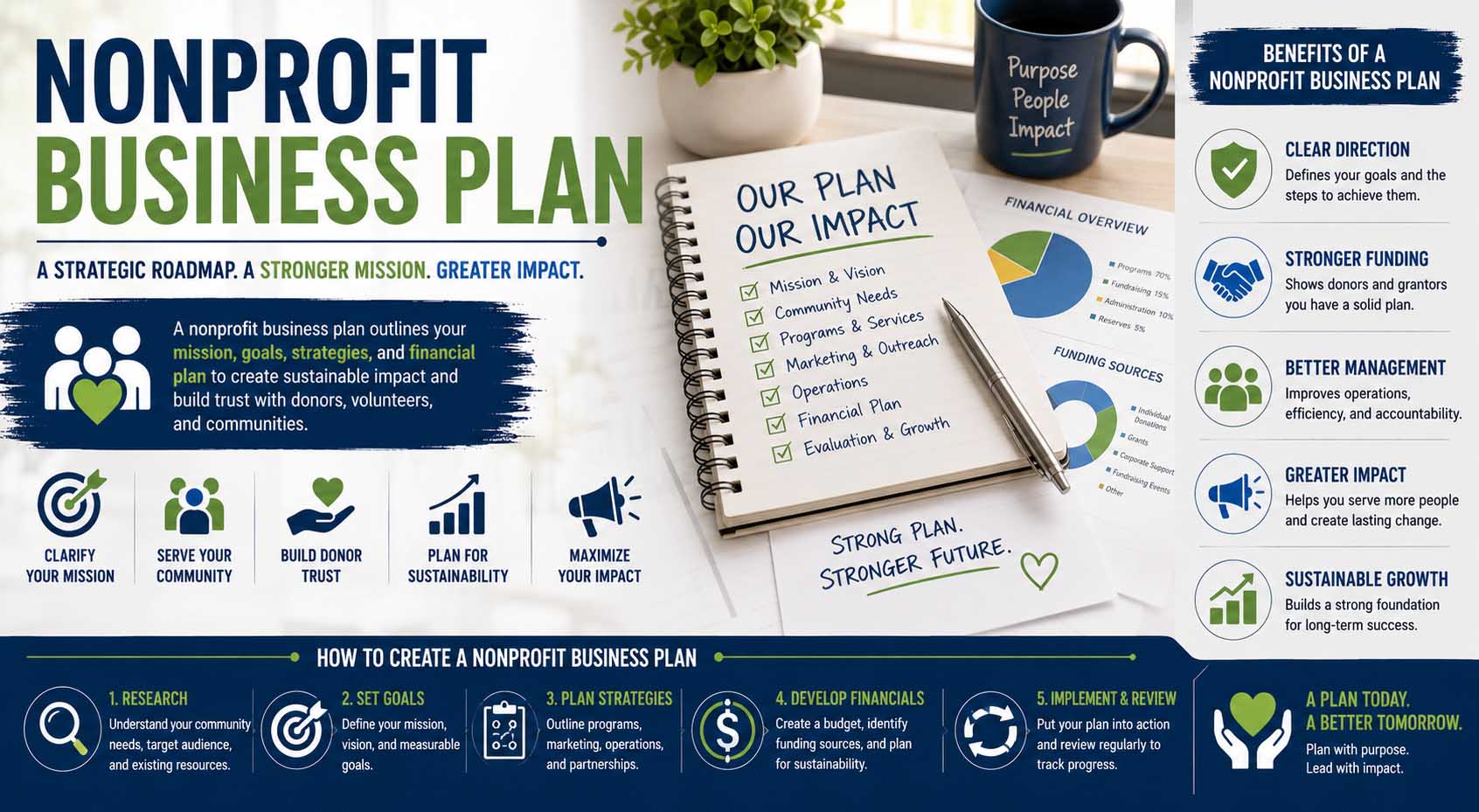
A nonprofit business plan turns a good cause into an organized, realistic strategy. Instead of focusing mainly on profit, it explains the problem your organization addresses, the people it serves, the programs it will provide, how those programs will be funded, and how you will measure progress. Whether you are forming a new nonprofit or improving an existing organization, a clear plan can guide decisions and help board members, donors, partners, and grantmakers understand where you are going.
You do not need a complicated 50-page document to get started. In fact, a useful plan should be clear enough that your team actually refers to it. The goal is to connect your mission with practical decisions about money, people, programs, outreach, and long-term sustainability.
What Is a Nonprofit Business Plan?
A nonprofit business plan is a written roadmap describing how a nonprofit intends to accomplish its mission while remaining financially and operationally sustainable.
Although nonprofit organizations do not distribute profits to owners, they still need revenue, budgets, staff or volunteers, marketing, management, and measurable objectives. Therefore, many planning principles used by conventional businesses remain useful.
However, the emphasis is different. A commercial business usually focuses heavily on customers, revenue, profitability, and returns for owners or investors. In contrast, a nonprofit focuses on mission impact, beneficiaries, funding sources, governance, programs, and responsible use of resources.
If you are still at the formation stage, understanding How to Start a Nonprofit can help you separate the legal setup process from the strategic planning covered in a business plan.
Why Bother Writing One?
A plan forces you to answer questions that enthusiasm alone cannot solve.
For example, how much will your first program cost? Who will manage it? Where will funding come from? How will potential beneficiaries discover your services? What happens if donations are lower than expected?
By addressing these questions early, you can spot weak assumptions before they become expensive problems.
What Should a Nonprofit Business Plan Include?
There is no single format that every organization must follow. However, most strong plans cover several core areas.
| Section | Main Question It Answers |
|---|---|
| Executive summary | What does the organization do? |
| Mission and vision | Why does it exist? |
| Community need | What problem are you addressing? |
| Programs | What services will you provide? |
| Audience | Who will benefit or participate? |
| Marketing and outreach | How will people find you? |
| Operations | How will the organization function? |
| Leadership and governance | Who is responsible? |
| Funding strategy | Where will money come from? |
| Financial plan | What will operations cost? |
| Impact measurement | How will you measure progress? |
While these sections provide a useful framework, adapt them to your organization. For instance, a small local animal rescue needs a different level of operational detail than a nonprofit planning programs across several states.
How to Create a Nonprofit Business Plan Step by Step
If you are wondering how to create nonprofit business plan documents without getting overwhelmed, begin with the mission and work outward. Each section should answer a practical question about how the organization will operate.
1. Start With Your Mission and Vision
Your mission should explain what the nonprofit does, whom it serves, and the purpose behind its work.
Keep it specific. For example, “help disadvantaged students” gives little direction because it does not clearly define the target population, specific need, desired outcome, or measurable way to evaluate progress. Meanwhile, “provide free after-school math tutoring to middle-school students in underserved neighborhoods” describes the work much more clearly.
If this part feels difficult, learning How to Write a Mission Statement can help you turn a broad cause into a focused statement that guides programs and decisions.
Your vision can look further ahead. It describes the change you hope to contribute to over time rather than listing daily activities.
2. Explain the Need You Plan to Address
Next, show why the organization should exist.
Use credible evidence whenever possible. Depending on your mission, that could include government statistics, community surveys, academic research, interviews, school data, or reports from established organizations.
However, do not use statistics simply to make the problem sound dramatic. Instead, connect evidence directly to your proposed programs.
For example, if your nonprofit plans to provide career training, explain the specific employment or skills gap in the community you intend to serve.
This section also helps demonstrate that you have researched existing services rather than assuming nobody else is addressing the issue.
3. Define the People You Serve
Every nonprofit needs a clear understanding of its beneficiaries, participants, supporters, or community.
Ask where they live, what needs they have, how they currently address those needs, and what might prevent them from using your services.
Although nonprofits are mission-driven, the principles behind What Is a Target Market can still be useful. Instead of trying to serve everyone, you identify the particular group your programs are designed to help and communicate with.
For example, an educational nonprofit might serve first-generation high school students in one county rather than vaguely targeting “young people.”
Build Programs Around the Mission
Once the need and audience are clear, describe exactly what your organization will do.
For each program, identify its purpose, expected participants, delivery method, staffing needs, approximate cost, schedule, and intended results.
Suppose you plan a weekend food distribution program. Your plan might explain where food comes from, where distribution happens, how volunteers are recruited, how many households the program can reasonably serve, and what resources are needed each month.
Starting with one or two focused programs is often easier than launching many services at once. As a result, you can test your approach, gather feedback, and improve operations before expanding.
Set Measurable Goals
A goal such as “make the community healthier” is difficult to evaluate.
Instead, use measures connected to your actual work. A food program might track households served, distribution frequency, volunteer participation, or another relevant program indicator.
Not every social outcome can be reduced to one number. Still, clear measures help your board and supporters see whether activities match the organization’s stated goals.
Create a Realistic Operating Plan
A good business plan for nonprofit organizations must explain how the work gets done behind the scenes.
Start by outlining roles. Who manages programs? Which decisions belong to staff, and which require board oversight?
Then, list the practical resources required. These could include office or program space, software, insurance, transportation, equipment, professional services, supplies, or technology.
You should also think about policies and procedures. As the nonprofit grows, documented processes for spending, data handling, volunteer management, conflicts of interest, and financial approvals can create consistency.
If you are considering a grantmaking entity rather than a traditional operating charity, How to Start a Foundation provides useful context because foundations can have different purposes, funding models, and operational considerations.
For organizations seeking federal tax-exempt recognition, the IRS guidance for charities and nonprofit organizations provides official information about federal tax requirements and responsibilities.
Develop a Funding Strategy That Is Not Based on Hope
One of the weakest approaches to nonprofit planning is writing “we will receive donations” without explaining how or from whom.
Instead, identify realistic funding channels.
These may include individual donations, grants, corporate sponsorships, fundraising events, membership fees, program-related earned revenue, or government funding where applicable.
However, not every funding source fits every organization. A new local nonprofit, for example, should not automatically assume it will secure large foundation grants during its first year.
Therefore, create several realistic scenarios. Estimate what you can operate with under conservative funding, expected funding, and stronger-than-expected funding.
Diversification can also reduce dependence on one donor or grant. Still, managing too many fundraising channels at the beginning can consume time that should go toward building effective programs.
Build the Financial Section of Your Nonprofit Business Plan
Your financial plan connects the mission to reality. After all, every program requires resources.
Begin with startup costs. Depending on the organization, these might include incorporation expenses, professional fees, insurance, a website, software, initial program supplies, and fundraising materials.
Then, estimate ongoing costs. Reviewing common types of expenses can help you separate recurring operating costs, program spending, administrative costs, and other financial commitments.
Next, prepare a simple revenue forecast. List each expected funding source and estimate how much it could realistically generate.
A basic three-year projection can be useful, although forecasts for a brand-new nonprofit will naturally contain assumptions. Therefore, document those assumptions rather than presenting uncertain figures as guaranteed results.
Leave Room for Unexpected Costs
A budget that uses every available dollar leaves little flexibility.
Equipment can break, program costs can rise, and funding can arrive later than expected. Consequently, your financial planning should consider reasonable reserves or contingency needs when feasible.
Plan Your Marketing and Community Outreach
Marketing is not only about asking people for money. For nonprofits, communication may need to reach beneficiaries, volunteers, donors, community partners, media organizations, and potential board members.
First, decide which groups matter most during your launch period.
Then, choose communication channels based on where those people can actually be reached. Depending on your organization, this might include email, community events, local partnerships, social media, search-friendly website content, public relations, or direct outreach.
Your message should remain consistent with the mission. Explain the problem, what your organization does, and how someone can participate.
Meanwhile, avoid relying only on emotional appeals. Showing clear programs, transparent goals, and evidence of responsible management can build credibility over time.
Use a Nonprofit Business Plan Template Without Becoming Generic
A nonprofit business plan template can save time, especially if this is your first plan. However, treat the template as a framework rather than a form that must be completed exactly as written.
For a small nonprofit, your first plan might include:
- Executive summary
- Mission and vision
- Community need
- Beneficiaries
- Programs and services
- Leadership and governance
- Marketing and outreach
- Fundraising strategy
- Operating plan
- Budget and financial projections
- Impact measures
- Short- and long-term goals
If a section does not apply, adapt it. Likewise, add sections when your organization has unusual operational, regulatory, partnership, or funding requirements.
The strongest plan reflects how your nonprofit will actually work rather than how a template says organizations should work.
Common Nonprofit Planning Mistakes
One common mistake is making projections too optimistic. If you assume every grant application succeeds and every fundraising event exceeds its target, your budget will provide little protection against normal setbacks.
Another problem is trying to serve too many people immediately. A narrow initial focus often makes it easier to design effective programs and understand costs.
Likewise, some founders spend too much time perfecting branding while giving little attention to governance and financial controls. A professional website helps, but it cannot replace a workable operating model.
Another mistake is failing to research similar organizations. Collaboration may sometimes produce more impact than competing for the same donors, volunteers, and beneficiaries.
Finally, avoid treating your plan as finished forever. Programs change, community needs evolve, and funding conditions shift. Therefore, review the document periodically and update assumptions when real-world experience gives you better information.
FAQs About Nonprofit Business Plans
Do Nonprofits Really Need a Business Plan?
Not every nonprofit is legally required to maintain a traditional business plan. However, a plan can help founders, directors, funders, and staff understand the organization’s strategy, finances, programs, and priorities.
How Many Pages Should a Nonprofit Business Plan Have?
There is no ideal length. A small startup may communicate its strategy effectively in 10 to 20 pages, while a larger organization may need much more detail. Clarity matters more than page count.
Is a Nonprofit Business Plan Different From a Strategic Plan?
Yes, although they can overlap. A business plan usually describes the overall operating model, programs, market or community need, funding, and finances. Meanwhile, a strategic plan often focuses more specifically on priorities and goals for a defined future period.
Can I Write a Nonprofit Business Plan Myself?
Yes. A founder or leadership team can prepare the first version. However, input from board members, program experts, accountants, community members, or other qualified advisers can improve sections where specialized knowledge is needed.
Does a Nonprofit Business Plan Need Financial Projections?
Financial projections are highly useful because they show whether planned programs have a realistic funding foundation. Still, projections should clearly identify assumptions, especially when the organization has little operating history.
Turn the Plan Into an Operating Tool
A business plan for a nonprofit becomes valuable when people actually use it. Therefore, do not write it only to satisfy a grant application, board request, or startup checklist.
Instead, review the plan when setting budgets, choosing programs, evaluating fundraising opportunities, recruiting staff, and measuring progress. Then, compare your assumptions with what actually happens.
As your organization gains experience, update the numbers and strategies accordingly. A nonprofit business plan should provide direction without becoming rigid. When your mission, programs, funding strategy, operations, and measurements support one another, the document becomes a practical roadmap for building a more sustainable organization.