How to Write a Mission Statement That Inspires and Defines Your Goals
Learning how to write a mission statement helps individuals, businesses, schools, and organizations define their purpose and communicate their goals clearly. A mission statement explains why someone or something exists, whom they serve, and what they aim to accomplish.
A strong mission statement provides direction for everyday decisions and long-term planning. Moreover, it helps people understand the values and priorities that guide an individual or organization.
Whether you are starting a business, planning your career, or developing an educational institution, a clear statement can help you stay focused on meaningful objectives.
Many organizations also develop their mission alongside a Business Level Strategy to ensure their activities support their broader objectives.
In this guide, you will learn the essential steps, see practical examples, and understand how to create effective mission and vision statements.
What Is a Mission Statement?
A mission statement is a short explanation of an individual’s or organization’s purpose, primary activities, and intended impact.
For businesses, it usually identifies what the company does, whom it serves, and the value it provides.
For individuals, it describes personal priorities, guiding values, and meaningful goals.
Schools and nonprofit organizations use mission statements to communicate their educational or social objectives.
Although the wording varies by purpose, effective statements share several characteristics. They are clear, relevant, authentic, and easy to understand.
Why a Clear Purpose Matters
A defined purpose helps people make consistent decisions.
For example, a company focused on affordable education can evaluate new products according to their accessibility and educational value.
Similarly, an individual who values lifelong learning can prioritize activities that support personal development.
As a result, a mission statement becomes more than a written declaration. It provides a practical reference for future choices.
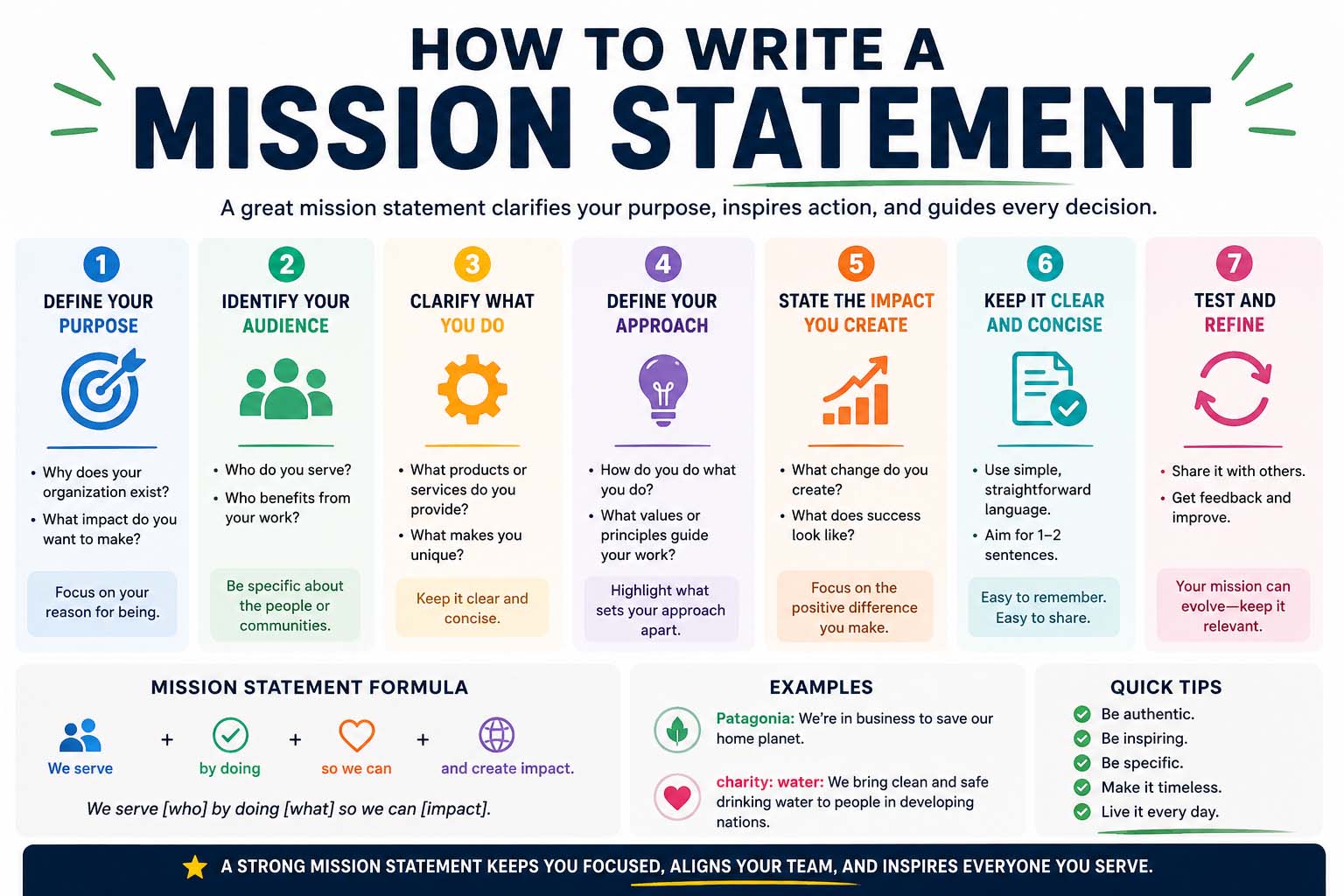
How to Write a Mission Statement Step by Step
Creating an effective statement requires more than combining inspirational words. Instead, begin by identifying your purpose, audience, and values.
The following process works for businesses, individuals, schools, and nonprofit organizations.
Step 1: Identify Your Main Purpose
Start by answering a simple question: Why does this person or organization exist?
For a business, the answer might involve solving a customer problem or providing a useful service.
For an individual, it could involve personal growth, family responsibilities, or professional development.
Write down your main purpose in one or two sentences before refining the wording.
Step 2: Define Who You Want to Serve
Next, identify the people who benefit from your actions.
A company might serve local customers, small businesses, or a particular professional community.
Meanwhile, an educational institution may focus on students, researchers, and the wider community.
Knowing your audience makes the statement more specific and meaningful.
Step 3: Choose Your Core Values
Core values describe the principles that guide your decisions and behavior.
Common examples include:
- Integrity and honesty
- Innovation and creativity
- Customer satisfaction
- Education and continuous learning
- Community service
- Sustainability and responsibility
However, avoid including values simply because they sound impressive.
Instead, select principles that genuinely influence your activities.
Step 4: Explain the Value You Provide
An effective mission should describe the difference you intend to make.
For example, a technology company might help small businesses simplify everyday operations.
A nonprofit organization may focus on improving access to educational resources.
The goal is to communicate a specific contribution rather than make vague promises.
Step 5: Write a Clear First Draft
Once you understand your purpose, audience, and values, combine them into a short statement.
You can use this simple mission statement formula:
Our mission is to [what we do] for [who we serve] by [how we create value].
For example:
Our mission is to help small businesses improve productivity by providing accessible digital tools and practical technology education.
This example explains the audience, activity, and intended benefit without unnecessary language.
Step 6: Review and Refine Your Statement
Read your first draft carefully.
Ask whether someone unfamiliar with your organization could understand it immediately.
Then remove repetitive phrases, vague promises, and unnecessary technical language.
A mission statement does not need a fixed word count. However, one or two clear sentences often work well.
Finally, share the draft with relevant employees, colleagues, or stakeholders to collect feedback.
How to Write a Personal Mission Statement
A personal mission statement describes your values, priorities, and the kind of contribution you want to make.
Unlike a business statement, it focuses on individual decisions and aspirations.
For example, someone interested in education may want to support lifelong learning. Another person might prioritize family, creativity, or professional leadership.
Identify Your Personal Priorities
Begin by considering the activities and responsibilities that matter most to you.
Think about your strengths, long-term ambitions, and the principles you want to follow.
Then identify two or three priorities that represent your personal direction.
For instance, a person who values education and community service might focus on sharing knowledge and supporting others.
Personal Mission Statement Examples
Here are three examples for different situations.
Student example:
My mission is to develop my knowledge, act with integrity, and use my education to contribute positively to my community.
Professional example:
My mission is to improve my skills, deliver dependable work, and help colleagues achieve meaningful results.
Personal development example:
My mission is to maintain strong relationships, continue learning, and make thoughtful decisions that support a balanced life.
These examples provide starting points rather than fixed templates.
Therefore, adapt the language to reflect your actual goals and circumstances.
How to Write a Vision and Mission Statement in Academia
Schools, colleges, and universities use mission and vision statements to explain their educational purpose and future direction.
A mission statement describes what the institution currently does for students and its community.
Meanwhile, a vision statement describes the future the institution hopes to create.
Both statements can support academic planning, institutional policies, and educational development.
Academic Mission Statement Example
An educational institution might use the following statement:
Our mission is to provide accessible, high-quality education that develops critical thinking, ethical leadership, and lifelong learning.
This example identifies the institution’s educational purpose and the qualities it wants students to develop.
However, actual institutions should adapt their wording to reflect their programs, communities, and responsibilities.
Academic Vision Statement Example
A corresponding vision statement could be:
Our vision is to become a welcoming learning community recognized for educational innovation, student achievement, and positive social impact.
The mission focuses on current responsibilities, while the vision communicates future aspirations.
Together, they can help administrators, teachers, and students understand the institution’s direction.
Mission Statement vs. Vision Statement
Although people often use these terms together, they serve different purposes.
A mission statement explains the present purpose of an organization. A vision statement describes the future it wants to achieve.
| Feature | Mission Statement | Vision Statement |
|---|---|---|
| Main focus | Present purpose | Future aspirations |
| Key question | Why do we exist? | What do we want to become? |
| Content | Activities, audience, and value | Long-term goals and desired impact |
| Main use | Guides current decisions | Guides future direction |
| Typical style | Clear and practical | Aspirational and forward-looking |
For example, a company might have a mission to provide affordable software solutions to small businesses.
Its vision could be to make useful digital technology accessible to entrepreneurs worldwide.
Although the statements differ, they should support the same organizational direction.
A clearly defined Market Development Strategy can also help businesses connect their long-term ambitions with realistic expansion opportunities.
How to Write a Good Mission Statement
An effective mission statement communicates purpose without confusing readers.
It should reflect real activities and values rather than rely on generic motivational language.
Keep the Message Specific
Avoid broad statements that could describe almost any organization.
For example:
Weak example: Our mission is to be the best company and achieve excellence.
Improved example: Our mission is to help local retailers manage inventory through affordable, easy-to-use software.
The improved statement identifies a target audience, service, and practical benefit.
As a result, readers can understand the organization’s purpose more easily.
Use Simple and Memorable Language
Complicated wording rarely makes a mission statement more effective.
Instead, use familiar words and direct sentences.
Avoid unnecessary jargon, exaggerated claims, and lengthy explanations.
Furthermore, choose wording that employees or team members can comfortably use when describing the organization.
Align Your Mission With Real Actions
A mission statement should reflect what an organization actually does.
For instance, a business that promises excellent customer service should support that promise through reliable communication and responsive assistance.
Similarly, an organization that emphasizes sustainability should consider how its operations support that commitment.
This alignment also helps professionals working as a Business Strategy Consultant connect organizational purpose with practical business decisions.
Business Mission Statement Examples
Business mission statements vary according to industry, audience, and organizational priorities.
The following original examples demonstrate different approaches.
Small Business Example
Our mission is to provide dependable home maintenance services that help local families maintain safe and comfortable living spaces.
This statement identifies the service, audience, and intended benefit.
Technology Company Example
Our mission is to simplify everyday business tasks through accessible software, practical innovation, and reliable customer support.
Here, the company emphasizes productivity and customer value.
Nonprofit Organization Example
Our mission is to improve access to educational resources for underserved communities through learning programs, partnerships, and volunteer support.
This example communicates a specific social purpose and the activities supporting it.
When presenting an organization’s purpose to potential investors or partners, clear communication is equally valuable. The guide What Is the Main Purpose of Developing a Business Pitch explains how businesses can communicate their ideas and objectives effectively.
Common Mistakes to Avoid
Even well-intentioned mission statements can become ineffective when they lack clarity or practical meaning.
Using Too Many Generic Words
Terms such as excellence, leadership, and innovation can be useful. However, they provide little information without context.
Instead, explain what your organization actually does and how it creates value.
Making the Statement Too Long
A lengthy mission statement can become difficult to remember.
Therefore, focus on the most important information and remove unnecessary details.
You can explain broader organizational goals in separate planning documents.
Confusing Mission With Vision
A mission statement should primarily describe your current purpose.
A vision statement, by contrast, describes your desired future.
Although the two should align, combining every long-term ambition into the mission can weaken its clarity.
Ignoring Your Audience
A statement that focuses only on organizational success may overlook the people it serves.
For example, a business mission should explain the benefit customers receive.
Likewise, a school should consider the educational needs of its students and community.
How Often Should You Review Your Mission Statement?
A mission statement should remain relevant as circumstances change.
For individuals, major career or personal changes may justify a review.
For businesses, significant changes in products, customers, or organizational direction can create a similar need.
However, avoid rewriting the statement whenever a short-term goal changes.
A stable mission provides continuity while allowing strategies and activities to evolve.
For additional guidance on connecting business purpose with planning, the U.S. Small Business Administration’s business planning resources explain important elements of developing a business plan.
Conclusion
Understanding how to write a mission statement helps individuals and organizations communicate their purpose, values, and intended impact.
Begin by identifying your main objective, defining your audience, and choosing meaningful values. Then write a concise statement that explains the contribution you want to make.
Whether you are developing a personal mission, creating an academic statement, or defining a business purpose, clarity and authenticity matter more than complicated language.
A well-written mission statement provides direction for everyday decisions while supporting meaningful long-term goals.