Margin vs Markup: Key Differences, Formulas, and Examples Explained
Setting the right price is one of the biggest challenges for any business. You need to cover your costs, stay competitive, and earn enough profit to keep growing. However, many business owners confuse two important pricing terms: margin vs markup.
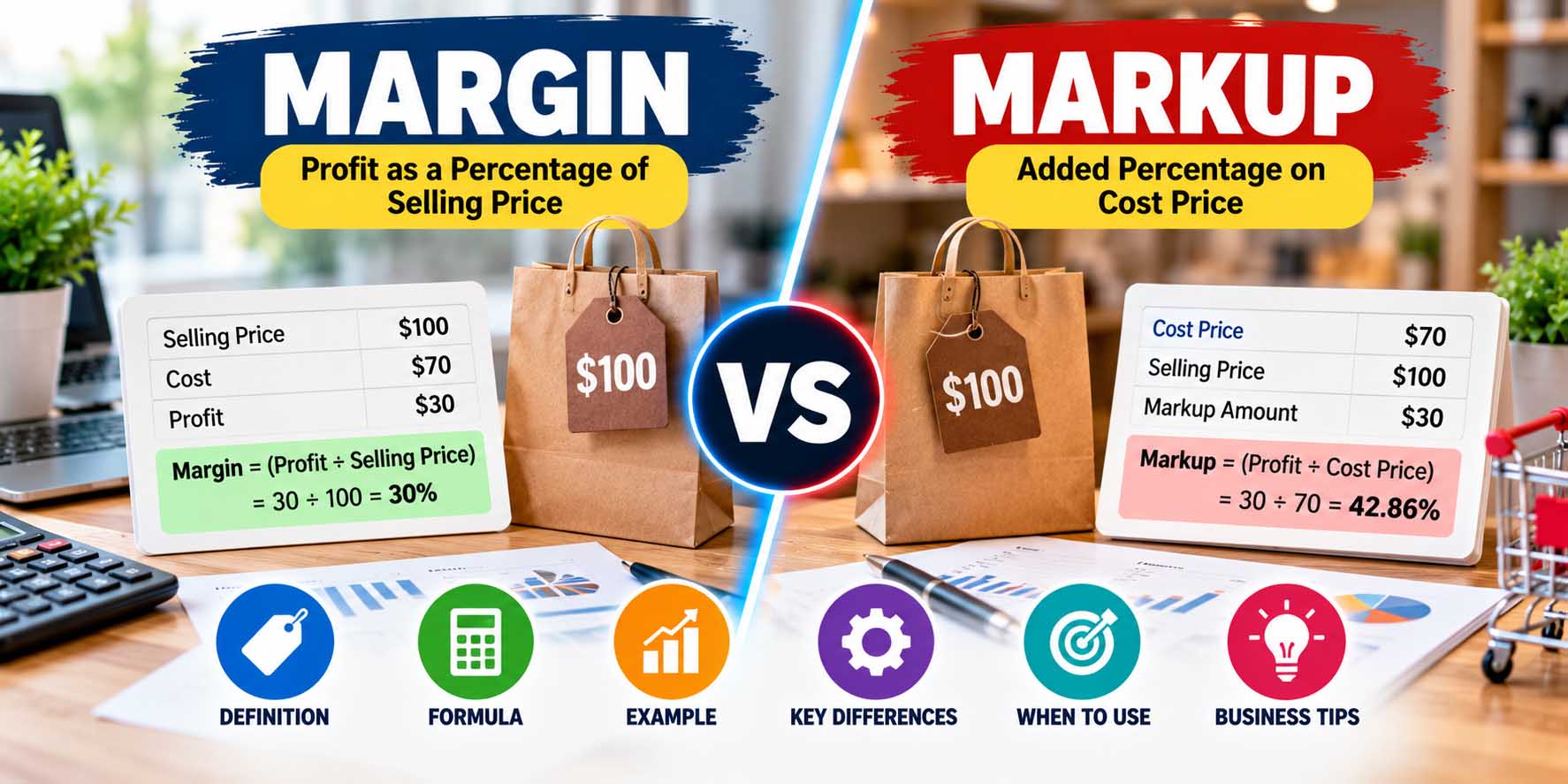
Although both measure profitability, they calculate it differently. Margin shows how much of your selling price remains after covering the cost of goods sold. Markup shows how much you increase the cost of a product to determine its selling price.
For example, buying a product for $60 and selling it for $100 creates a 40% gross margin but a 66.67% markup.
That difference matters because confusing the two can lead to incorrect prices and lower profits.
In this guide, you’ll learn how margin and markup work, how to calculate them, and when to use each one for smarter business decisions.
Margin vs Markup: What’s the Main Difference?
The biggest difference between margin and markup is the number used as the basis for the percentage.
Margin uses the selling price, while markup uses the cost.
Both calculations use the same dollar amount of gross profit, but they express it as a percentage of different values.
Margin vs Markup Comparison Table
| Feature | Margin | Markup |
|---|---|---|
| Meaning | Profit as a percentage of selling price | Profit as a percentage of cost |
| Calculation base | Selling price | Cost |
| Main purpose | Measure profitability | Set selling prices |
| Formula | (Price − Cost) ÷ Price × 100 | (Price − Cost) ÷ Cost × 100 |
| Example | 40% margin | 66.67% markup |
| Common users | Business owners, accountants, managers | Retailers, wholesalers, pricing teams |
For a profitable sale with a positive cost, markup is always higher than the corresponding gross margin percentage.
Therefore, you should never treat these percentages as interchangeable.
What Is Profit Margin?
Profit margin measures how much revenue remains after deducting certain expenses.
However, businesses use several types of profit margins, including gross, operating, and net profit margin.
When comparing markup vs margin for product pricing, the relevant measure is usually gross profit margin.
Gross Profit Margin Formula
Gross Profit Margin = (Selling Price − Cost of Goods Sold) ÷ Selling Price × 100
Suppose a clothing store purchases a jacket for $50 and sells it for $80.
The calculation is:
Gross Profit = $80 − $50 = $30
Gross Margin = ($30 ÷ $80) × 100 = 37.5%
Therefore, the business earns a 37.5% gross margin on that sale.
However, this doesn’t mean the company keeps $30 as net profit.
Rent, employee wages, marketing, and other operating costs may still reduce earnings.
Understanding the different types of expenses helps business owners see why gross profit and final business profit are not the same.
What Is Markup in Business?
Markup is the percentage added to a product’s cost to determine its selling price.
Businesses commonly use markup when setting prices for inventory, materials, and services.
For example, a retailer may apply a standard markup to certain product categories.
However, that markup should reflect market demand, operating costs, and the company’s profit goals.
Markup Formula
Markup = (Selling Price − Cost) ÷ Cost × 100
Let’s use the same jacket example.
Purchase Cost = $50
Selling Price = $80
Gross Profit = $30
Markup = ($30 ÷ $50) × 100 = 60%
Therefore, the jacket has a 60% markup but only a 37.5% gross margin.
Although the dollar profit remains $30, the percentages differ because the calculations use different starting points.
Margin vs Markup Formula: How to Calculate Both
Understanding the formulas becomes easier when you compare them using one example.
Suppose you operate a small electronics store.
You purchase wireless headphones for $40 and sell them for $70.
First, calculate the gross profit:
$70 − $40 = $30
Next, calculate the margin:
($30 ÷ $70) × 100 = 42.86%
Then, calculate the markup:
($30 ÷ $40) × 100 = 75%
As a result, your product has a 42.86% gross margin and a 75% markup.
Quick Pricing Comparison Chart
| Product Cost | Selling Price | Gross Profit | Margin | Markup |
|---|---|---|---|---|
| $20 | $30 | $10 | 33.33% | 50% |
| $40 | $60 | $20 | 33.33% | 50% |
| $50 | $100 | $50 | 50% | 100% |
| $80 | $120 | $40 | 33.33% | 50% |
| $100 | $150 | $50 | 33.33% | 50% |
Notice that products with different costs can have identical margin and markup percentages.
Therefore, the relationship depends on pricing ratios rather than product value alone.
How to Convert Margin Into Markup
Sometimes, you know your target profit margin but need to calculate the corresponding markup.
Fortunately, a simple formula makes this possible.
Markup % = Margin % ÷ (100 − Margin %) × 100
For example, suppose you want a 40% gross margin.
Markup = 40 ÷ (100 − 40) × 100
Markup = 66.67%
Therefore, achieving a 40% margin requires approximately a 66.67% markup on cost.
How to Convert Markup Into Margin
You can also reverse the calculation.
Margin % = Markup % ÷ (100 + Markup %) × 100
For example, a 50% markup produces:
Margin = 50 ÷ 150 × 100
Margin = 33.33%
This explains why adding 50% to your cost doesn’t create a 50% profit margin.
Margin vs Markup Calculator: Simple Pricing Examples
A margin vs markup calculator can help businesses avoid manual calculation errors.
However, you can also calculate selling prices using basic formulas.
Calculate Price From a Target Margin
Selling Price = Cost ÷ (1 − Target Margin as a Decimal)
Suppose your product costs $75 and you want a 40% gross margin.
Selling Price = $75 ÷ (1 − 0.40)
Selling Price = $125
Therefore, you must sell the product for $125 to achieve the target gross margin.
Calculate Price From a Target Markup
Selling Price = Cost × (1 + Markup as a Decimal)
Suppose your product costs $75 and you apply a 40% markup.
Selling Price = $75 × 1.40
Selling Price = $105
As you can see, the same 40% figure produces different selling prices.
A markup vs margin calculator is especially useful when comparing multiple products or updating prices after supplier cost changes.
Why Margin and Markup Matter in Retail
Retail businesses regularly purchase products at wholesale prices and resell them to customers.
Therefore, understanding both calculations helps retailers establish prices that support profitability.
If you’re learning What Is Retail, pricing is one of the most useful concepts to understand because even small mistakes can affect hundreds of transactions.
Example: Small Clothing Store
Imagine a clothing store purchasing 100 shirts for $15 each.
The owner sells each shirt for $25.
Gross Profit Per Shirt = $10
Gross Margin = 40%
Markup = 66.67%
If all 100 shirts sell at the full price, the store generates $2,500 in revenue and $1,000 in gross profit.
However, operating expenses and unsold inventory can affect the final financial results.
Therefore, retailers should review both gross margins and overall business expenses.
How Procurement Costs Affect Your Profit Margin
A business’s purchasing decisions directly influence its gross margin.
For example, negotiating better supplier prices can improve profitability without increasing customer prices.
This is why understanding What Is Procurement matters when building a pricing strategy.
Procurement involves sourcing and purchasing the goods or services a business needs.
Suppose your company purchases a product for $70 and sells it for $100.
Your gross margin is 30%.
However, if you negotiate the purchase cost down to $60 while maintaining the same selling price, your gross margin increases to 40%.
As a result, better purchasing decisions can improve profits even when sales remain unchanged.
How Vendors Influence Pricing Decisions
Suppliers affect product availability, purchasing costs, and overall business profitability.
Therefore, choosing reliable suppliers is an important part of maintaining healthy margins.
Understanding What Is a Vendor can help business owners distinguish suppliers from other participants in the purchasing process.
For example, two vendors may offer the same product at different prices.
However, the cheaper vendor may charge higher shipping fees or have less reliable delivery times.
As a result, businesses should calculate the full relevant acquisition cost rather than comparing purchase prices alone.
Profit Margin vs Markup: Which One Should You Use?
Both calculations are useful, but they serve different purposes.
Use Margin to Measure Profitability
Gross margin helps you understand how much revenue remains after covering the cost of goods sold.
Therefore, it works well for:
- Comparing product profitability
- Evaluating pricing performance
- Monitoring cost changes
- Setting gross profit targets
- Reviewing business financial results
For a broader understanding of financial planning, the U.S. Small Business Administration’s guidance on managing business finances explains why accurate financial records and financial management matter.
Use Markup to Set Selling Prices
Markup helps businesses establish prices based on product costs.
For example, a retailer might apply different markup percentages to different categories.
However, relying only on markup can create problems when operating expenses or customer demand change.
Therefore, many businesses use markup to calculate initial prices and margin to evaluate profitability.
Common Margin and Markup Mistakes
Even experienced business owners can make pricing mistakes.
However, most problems are preventable with consistent calculations.
Confusing a 50% Markup With a 50% Margin
A 50% markup creates a 33.33% gross margin, not 50%.
Therefore, confusing the two can cause businesses to underestimate the selling price required to meet profit targets.
Ignoring Product Costs
Businesses sometimes calculate margins using only the supplier’s listed price.
However, relevant freight, import duties, and other inventory acquisition costs may also affect the cost of goods sold.
Consequently, incomplete cost calculations can overstate profitability.
Forgetting Discounts and Returns
A product may have a healthy margin at its original selling price.
However, discounts reduce revenue and can lower the actual margin.
Returns and refunds can also affect financial performance.
Therefore, review realized selling prices rather than relying only on advertised prices.
Using the Same Markup for Every Product
Different products face different competition, demand, and cost structures.
As a result, applying one markup percentage across every category may create uncompetitive prices or weak margins.
How to Improve Your Business Profit Margins
Improving margins doesn’t always require increasing prices.
Instead, businesses can focus on several practical strategies.
Review Supplier Agreements
Negotiate purchasing terms, compare suppliers, and reduce unnecessary acquisition costs.
However, avoid sacrificing product quality simply to secure a lower price.
Reduce Waste and Inventory Loss
Damaged products, expired inventory, and poor stock management can increase costs.
Therefore, better inventory tracking can protect profitability.
Adjust Prices Carefully
Review customer demand, competitor pricing, and product value before making changes.
For example, premium products may support higher prices when customers recognize their quality or benefits.
Focus on Profitable Products
Some products generate strong sales but relatively low margins.
Meanwhile, other products may sell less frequently but contribute more gross profit per unit.
When researching Most Profitable Businesses, remember that profitability depends on cost control, pricing, operating efficiency, and demand rather than revenue alone.
Frequently Asked Questions About Margin and Markup
Is a 30% Margin the Same as a 30% Markup?
No. A 30% margin requires approximately a 42.86% markup.
Meanwhile, a 30% markup produces approximately a 23.08% margin.
What Is a Good Profit Margin?
A good margin depends on your industry, business model, operating costs, and competition.
Therefore, compare your performance with relevant industry benchmarks rather than assuming one percentage works for every business.
Can Markup Be Higher Than 100%?
Yes. For example, purchasing an item for $20 and selling it for $50 creates a 150% markup.
However, the gross margin is 60%.
Can Gross Margin Be Negative?
Yes. If the cost of goods sold exceeds sales revenue, gross margin becomes negative.
For example, selling a product for $40 when its cost is $50 creates a negative gross margin of 25%.
Is Margin or Markup Better for Pricing?
Markup is convenient for calculating selling prices from costs.
However, margin is better for measuring the percentage of revenue remaining after the cost of goods sold.
Therefore, using both gives businesses a clearer understanding of pricing performance.
Making Smarter Pricing Decisions
Understanding margin vs markup helps business owners avoid pricing mistakes and make better financial decisions.
Margin measures gross profit as a percentage of selling price, while markup measures gross profit as a percentage of cost.
Although both use the same dollar profit, they produce different percentages.
For practical business management, use markup when calculating initial selling prices and margin when evaluating profitability.
Then, review supplier costs, operating expenses, customer demand, and competitive pricing regularly.
By combining accurate calculations with a thoughtful pricing strategy, you can protect profitability while keeping your products attractive to customers.