How Much Does It Cost to Start an LLC? Complete Cost Guide
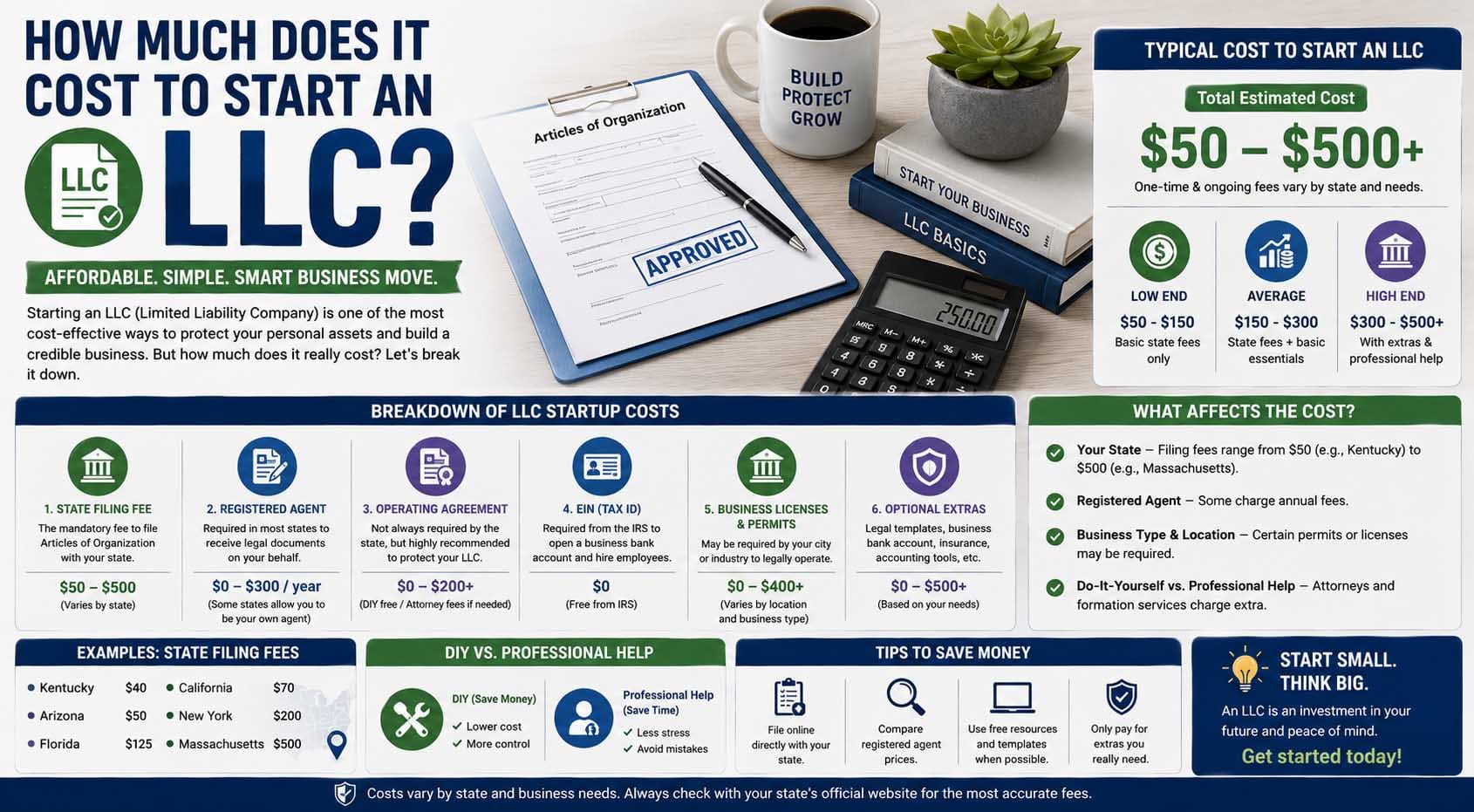
If you are planning a new business, one of your first questions may be: how much does it cost to start an LLC? The answer depends mainly on the state where you form the company and whether you handle the paperwork yourself or pay for professional services. At minimum, you generally need to budget for your state’s LLC formation fee. However, registered agent services, business licenses, name reservations, local permits, annual reports, and other requirements can increase the total cost.
For many entrepreneurs, separating required costs from optional services is the best way to build an accurate startup budget. You do not necessarily need an expensive formation package, yet choosing the cheapest possible approach without understanding your obligations can create problems later.
What Costs Are Involved in Starting an LLC?
An LLC, or limited liability company, is a legal business structure created under state law. Therefore, there is no single nationwide LLC formation price.
Each state establishes its own filing procedures and fees.
Before calculating your budget, it helps to understand what is an LLC and how does it work, because formation costs make more sense once you know what the business structure actually provides.
Typical LLC expenses can include:
- state formation filing fee
- business name reservation, when used
- registered agent expenses
- operating agreement preparation
- business licenses and permits
- publication requirements in certain states
- annual or periodic state fees
- professional legal or accounting assistance
Some of these expenses are required, while others depend on your business and the way you choose to form it.
How Much Does It Cost to Start an LLC in General?
The core expense is usually the state fee for filing the LLC’s formation document, often called Articles of Organization or a Certificate of Formation.
However, filing fees vary substantially among states and can change over time. Consequently, you should verify the current amount through your state’s official business-filing agency immediately before submitting an application.
A simple startup budget might look like this:
| Expense | Required? | Typical situation |
|---|---|---|
| State formation fee | Usually | Required to create the LLC |
| Name reservation | Sometimes | Optional or required in certain circumstances |
| Registered agent | Agent required; paid service optional | You may qualify to act as your own |
| Operating agreement | Depends on state/legal needs | Strongly useful for documenting ownership rules |
| Business licenses | Depends on activity/location | May be state, county, or city based |
| EIN | Often useful or required | IRS issues EINs directly without a fee |
| Formation service | Optional | Convenience service |
| Attorney/accountant | Optional in many cases | Helpful for complex situations |
| Annual/periodic fees | State dependent | Ongoing rather than initial formation cost |
Therefore, asking only about the initial filing fee can underestimate the actual amount needed to get a business legally ready to operate.
State Filing Fees Are Usually the Starting Point
Every LLC must be formed under the law of a particular state. As a result, the state filing charge is generally the first unavoidable cost.
If you form the LLC yourself, you can often submit the formation paperwork directly through the state’s official filing system. In that case, you avoid the service charge that commercial formation companies add on top of government fees.
However, saving money should not mean guessing your way through the application.
Incorrect business information, choosing the wrong management structure, or overlooking another requirement can cause delays or require corrections.
One of the benefits of an LLC is the potential separation between the company’s liabilities and the owner’s personal assets in many circumstances. Still, owners need to operate the entity properly rather than treating formation paperwork as the only step that matters.
Registered Agent Costs: Free or Paid?
A registered agent receives official legal and government documents on behalf of the business. Depending on state rules, an eligible owner or another individual may be able to serve in this role.
Therefore, you may not need to pay for a commercial registered agent.
However, paid registered agent services can be useful if you do not want your qualifying address publicly associated with the filing, you are frequently unavailable during normal business hours, or you operate outside the state where the company is registered.
Commercial service prices vary by provider and included features. Therefore, compare renewal prices as well as introductory offers before signing up.
A cheap first year can become significantly more expensive later.
Business Licenses and Permits Can Increase the Budget
Forming an LLC does not automatically give you permission to conduct every type of business.
Depending on your industry and location, you might need state, county, municipal, or professional approvals.
For example, restaurants, contractors, childcare providers, salons, healthcare businesses, and many other regulated operations may face requirements beyond basic LLC registration.
Understanding the types of business licenses relevant to your industry can help you identify expenses that do not appear on the LLC formation application itself.
Therefore, check licensing requirements before committing your entire startup budget to formation.
Do You Need to Pay for an Operating Agreement?
An operating agreement describes how an LLC will be managed. It can cover ownership percentages, voting rights, distributions, responsibilities, decision-making procedures, and what happens when an owner leaves.
Requirements vary by state, but even where a written operating agreement is not legally mandated, having one can be valuable.
A single-member LLC may use a relatively straightforward agreement. Meanwhile, a multi-member LLC often needs more detailed provisions because disagreements between owners can become expensive.
You can prepare an agreement yourself, use a template, purchase a customized service, or hire an attorney.
However, a generic template may not address complicated ownership arrangements. Therefore, legal advice may be worth the cost when multiple owners, significant investments, intellectual property, or unusual management arrangements are involved.
How Much Does It Cost to Start an LLC in Texas?
People asking how much does it cost to start an LLC in Texas should begin with the Texas Secretary of State’s current LLC filing fee and requirements.
Texas uses a Certificate of Formation for creating a domestic LLC. Beyond formation, businesses may also have Texas tax and reporting obligations, depending on their circumstances.
Therefore, do not budget only for the initial state filing.
You may also need to consider registered agent arrangements, licenses, local permits, assumed-name filings when applicable, and professional services.
Because government fees and requirements can change, confirm the current amounts through official Texas sources when you are ready to file.
How Much Does It Cost to Start an LLC in Florida?
If you are researching how much does it cost to start an LLC in Florida, the same budgeting principle applies.
Florida requires a state filing to create an LLC, and the business generally has ongoing annual reporting obligations.
Consequently, calculate both the startup expense and what you will need to spend to keep the company in good standing.
Depending on the business, county or city licensing requirements may also apply.
Therefore, a Florida entrepreneur opening a physical retail shop may have a different total startup cost from a freelance consultant working from home, even if their basic LLC formation charge is the same.
How Much Does It Cost to Start an LLC in Illinois?
The answer to how much does it cost to start an LLC in Illinois starts with the state’s current Articles of Organization filing fee.
However, Illinois LLC owners should also investigate ongoing reporting obligations and any licenses required for their particular activities.
If you plan to hire employees, sell regulated products, operate from commercial premises, or provide licensed professional services, other registrations may become necessary.
As a result, the government formation fee represents only one line in a complete startup budget.
Before filing, check the current requirements with the Illinois Secretary of State and the appropriate state and local agencies.
How Much Does It Cost to Start an LLC in Maryland?
Entrepreneurs researching how much does it cost to start an LLC in Maryland should likewise verify the current formation fee directly with the state’s official business registration system.
Maryland businesses may also have ongoing filing, tax, licensing, and local obligations depending on their activities.
Optional expedited processing can also affect what you pay when available.
Therefore, avoid relying on an old blog post or social-media graphic for exact costs. Government fees can change, while optional services can make two entrepreneurs’ total formation expenses very different.
LLC vs Sole Proprietorship: Is the Extra Cost Worth It?
A sole proprietorship usually requires less entity-formation paperwork because there is no separate state-created entity simply from operating as a sole proprietor.
That can make it inexpensive to begin.
However, cost should not be your only consideration.
Understanding the difference between sole proprietor and LLC helps explain why someone may willingly pay LLC formation and maintenance expenses. An LLC generally creates a separate legal entity and can provide limited liability for its owners, subject to applicable law and circumstances.
A sole proprietorship does not provide that same entity-level separation between the owner and business.
Still, an LLC is not automatically right for everyone. Consider risk, business activities, contracts, financing, administrative responsibilities, and professional advice when necessary.
LLC Tax Treatment and Possible Extra Costs
Another common misunderstanding is that LLCs all pay taxes in exactly the same way.
For federal income tax purposes, an LLC can receive different treatment depending on the number of owners and elections made.
For example, a single-member LLC is generally disregarded as an entity separate from its owner for federal income tax purposes unless it elects another classification. Meanwhile, a domestic multi-member LLC is generally treated as a partnership unless it makes a different eligible election.
Some eligible LLC owners consider S corporation tax treatment as the business grows.
If you are comparing those options, understanding the difference between LLC and S Corp can clarify the distinction between an LLC’s state-law entity structure and an S corporation tax election.
However, tax decisions should be based on your actual financial circumstances. Accounting, payroll, tax preparation, and compliance expenses may increase under more complicated arrangements.
Hidden and Optional LLC Startup Costs
Not every expense is printed on the state formation form.
For instance, you may spend money on:
Business Name and DBA Filings
If you want to operate under a name different from the LLC’s legal name, you may need an assumed-name or DBA filing, depending on local rules.
Professional Services
Attorneys and accountants can increase startup costs, but they may provide valuable guidance when ownership, contracts, taxes, or regulatory issues are complicated.
Formation Companies
Online formation services can prepare and submit documents for you. However, their service fee is separate from government filing charges.
Watch for subscription services, automatic renewals, registered agent charges, and optional upgrades during checkout.
Banking and Financial Setup
Business checking accounts may have fees or minimum balance requirements. Meanwhile, accounting software, bookkeeping services, payroll systems, and payment processors can create ongoing costs.
Insurance
LLC status does not replace appropriate business insurance. Depending on your activities, you may consider general liability, professional liability, commercial property, workers’ compensation, commercial auto, or other coverage.
Can You Start an LLC for Free?
You may see advertisements offering “free LLC formation.”
Usually, this does not mean the entire process costs nothing.
A company may waive its own basic service charge while you still pay the mandatory state filing fee and any other government charges. Optional subscriptions or services may also cost extra.
Therefore, read the full pricing details before entering payment information.
The IRS itself does not charge a fee for obtaining an Employer Identification Number directly from the agency. Consequently, be cautious about confusing a third party’s EIN service charge with an IRS fee.
How to Keep LLC Formation Costs Under Control
You can often reduce unnecessary startup spending without cutting essential legal or administrative steps.
First, use your state’s official business website to identify the exact mandatory filing requirements.
Next, decide whether you genuinely need a paid registered agent or formation service.
Then, research licenses before launching. Discovering an expensive permit after spending the entire budget elsewhere can disrupt your plans.
After that, separate one-time formation costs from annual expenses.
Finally, avoid buying every optional upgrade offered during an online formation checkout. Some services may be useful, but others may duplicate tasks you can handle yourself.
Common Cost Mistakes New LLC Owners Make
One common mistake is budgeting only for the Articles of Organization or Certificate of Formation.
Annual reports, state fees, licenses, insurance, bookkeeping, and tax preparation may matter just as much over time.
Another mistake is forming an LLC in a supposedly “business-friendly” state without considering where the company actually operates. Forming outside your home state can sometimes create foreign-registration requirements and extra fees.
Likewise, paying for professional help is not always unnecessary. A complicated multi-owner business may benefit far more from customized advice than a straightforward single-owner operation.
Finally, do not assume LLC formation automatically handles taxes, permits, insurance, contracts, and banking. Each of those areas may require separate action.
FAQs About the Cost of Starting an LLC
What is the cheapest way to start an LLC?
For a straightforward business, filing directly with your state’s official agency can eliminate commercial formation-service charges. However, you still need to pay mandatory government fees and meet all applicable requirements.
Do I have to pay an LLC fee every year?
It depends on the state. Some states require annual or periodic reports, taxes, or fees, while others follow different schedules.
Is a registered agent included in the LLC filing fee?
Generally, the filing fee does not pay for a commercial registered agent service. However, an eligible owner or other qualifying person may sometimes serve as the registered agent without hiring a commercial provider.
Does an LLC need a business license?
An LLC may need licenses or permits based on its location and activities. Forming the entity does not automatically satisfy industry-specific or local licensing requirements.
Do I need an attorney to start an LLC?
Many straightforward LLCs can be formed without hiring an attorney. However, legal advice can be useful for multi-member companies, complex ownership arrangements, regulated businesses, major investments, or customized operating agreements.
Is the LLC formation fee tax deductible?
Certain business startup and organizational costs may receive specific federal tax treatment, but the rules depend on the expense and circumstances. A qualified tax professional can help determine how your particular costs should be handled.
Build a Budget Beyond the Filing Fee
So, how much does it cost to start an LLC? There is no single nationwide figure because state filing fees and business requirements vary. Your actual budget may include the formation fee, registered agent expenses, licenses, operating-agreement preparation, insurance, professional advice, and ongoing compliance costs.
Start by checking your state’s current official filing requirements. Then identify which additional expenses genuinely apply to your business instead of buying a bundled formation package automatically.
Most of all, plan beyond day one. Knowing both your startup and recurring costs gives you a much clearer picture of whether an LLC fits your budget and helps you launch the company without unexpected administrative expenses.