
What Is PTO in Work? Meaning, How It Works, and Examples
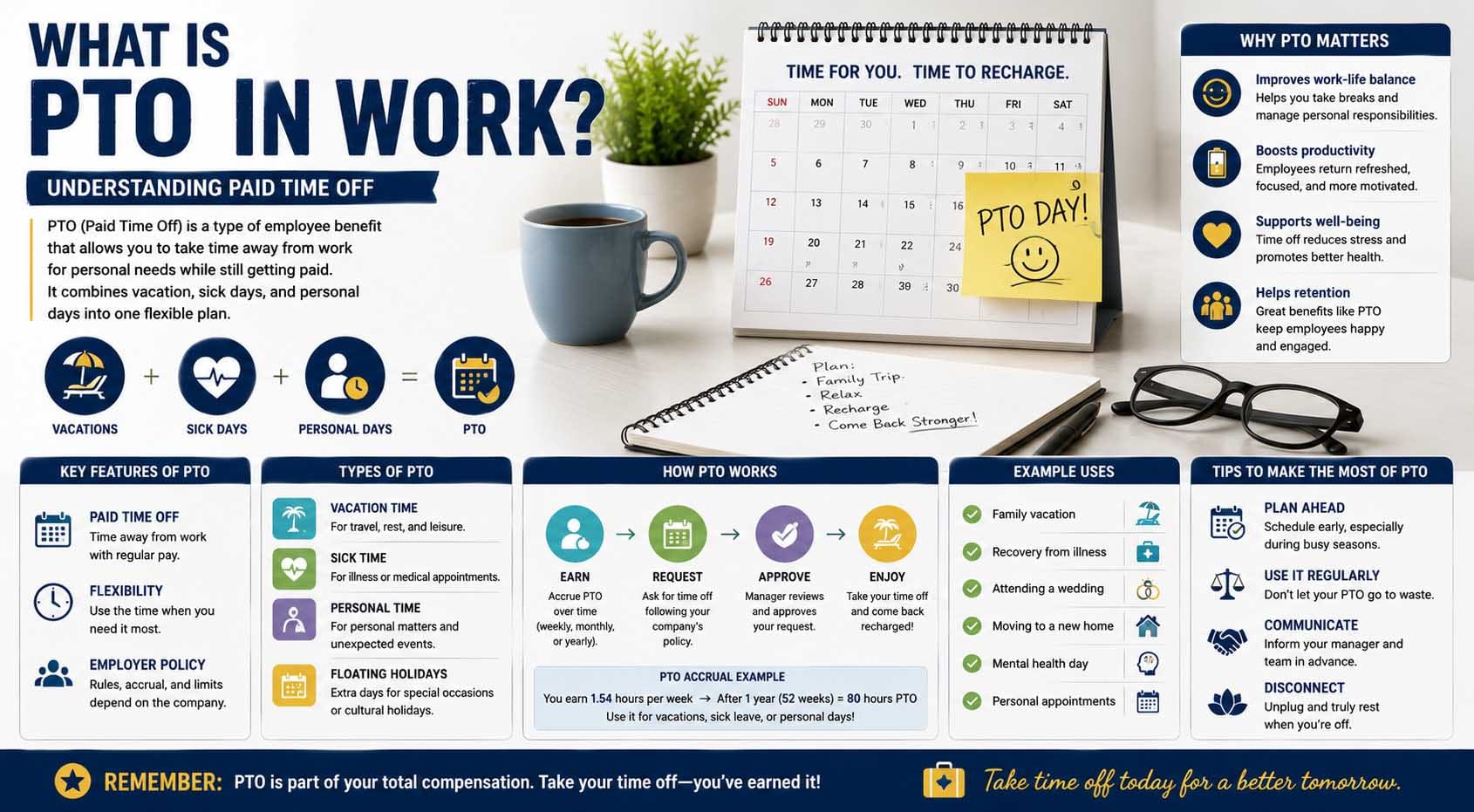
If your employer says you have 15 days of PTO, you may wonder exactly what those days can be used for. So, what is PTO in work? PTO usually means paid time off, which is employer-provided time away from work during which an employee continues to receive eligible pay. Depending on the company’s policy, employees may use PTO for vacations, personal days, illness, appointments, family needs, or other approved absences.
However, PTO policies can differ widely between employers. One company may combine several types of leave into one PTO balance, while another may keep vacation and sick leave separate. Likewise, employees may receive their full yearly allowance at once or earn hours gradually throughout the year.
Because of these differences, understanding your employer’s actual policy matters more than assuming every workplace handles PTO the same way.
What Is PTO in Work and What Does It Cover?
PTO is a workplace benefit that allows eligible employees to take approved time away from their jobs while still receiving pay, subject to the employer’s policy and applicable law.
If you are asking what is a PTO in work, it usually does not refer to a special type of job or position. Instead, PTO is a bank of paid leave available to an employee.
For example, imagine an employee has 120 hours of PTO each year. If that employee normally works eight-hour days, 120 hours represents the equivalent of 15 eight-hour workdays.
The employee might use some of that time for a summer vacation, another day for an appointment, and several days when personal circumstances require time away.
However, employers decide how their PTO programs operate within applicable employment laws. Therefore, employees should review their handbook, employment agreement, HR portal, or official leave policy before making plans.
What Does PTO Stand for at Work?
People sometimes search what is PTO stand for in work, but the common workplace meaning is simply “paid time off.”
Understanding what does PTO stand for is only the starting point, though. The bigger question is what the employer includes within that paid-time-off program.
For instance, one employer might offer:
- 10 vacation days
- 5 sick days
- 2 personal days
Another employer could combine those categories into a single bank of 17 PTO days.
The second approach gives employees more flexibility because they may not need to classify every absence as vacation, sickness, or personal leave. Still, the exact rules depend on company policy.
Meanwhile, some employers maintain separate leave categories because different rules or legal requirements may apply to certain types of leave.
How Does PTO Work in a Typical Workplace?
Although company policies vary, the basic process is usually straightforward.
An employee receives or earns a certain amount of paid leave. Then, when the employee takes approved time away from work, the employer deducts the appropriate hours or days from the available PTO balance.
For example, suppose Maria has 80 PTO hours available. She takes two eight-hour workdays off for a short trip. Consequently, her employer deducts 16 hours, leaving her with 64 hours.
However, understanding how does PTO work also means checking how leave is earned, requested, approved, carried forward, and treated when employment ends.
These details can have a major effect on the real value and flexibility of a PTO benefit.
How Employees Earn PTO
Employers generally structure paid time off in a few common ways.
PTO Accrual
Under an accrual system, employees earn PTO gradually as they work.
For example, an employee might earn a set number of PTO hours during each pay period. Consequently, the available balance increases throughout the year.
This approach can encourage employees to earn time before using it. However, some employers allow workers to use accrued leave only after an introductory or waiting period.
Front-Loaded PTO
With front-loaded PTO, an employer provides a larger amount of leave at the beginning of a benefit year or another defined period.
For instance, an employee could receive 15 days on January 1 rather than accumulating those days throughout the year.
As a result, the employee may have greater flexibility earlier in the year. Still, the company may have rules covering new hires, midyear departures, or employees who have already used much of their allowance.
PTO Based on Tenure
Some businesses increase paid leave as employees remain with the organization longer.
For example, a company could provide 10 days during the first few years, then 15 days after a certain service milestone.
Therefore, two employees doing similar jobs may have different PTO allowances because they have different lengths of service.
What Is PTO in Work Mean for Your Pay?
When eligible PTO is used according to company policy, an employee generally receives eligible pay for the approved time away rather than taking that time completely unpaid.
However, the exact calculation can depend on the employee’s classification, normal schedule, compensation structure, company policy, and local law.
For a straightforward example, consider an employee who normally works Monday through Friday for eight hours each day. If the employee takes one full approved PTO day, the company may deduct eight hours from the PTO balance while paying the employee according to its normal PTO rules.
PTO should not automatically be confused with every type of paid leave. For example, an employer may separately provide holidays, parental leave, bereavement leave, jury-duty leave, or other benefits.
Therefore, employees should check which absences actually reduce their PTO balance.
PTO vs. Paid Holidays
Paid holidays and PTO can look similar because employees may receive pay while not working. However, companies often handle them differently.
A paid holiday usually occurs on a date recognized by the employer, such as a company-designated public holiday. In contrast, employees generally request PTO based on their own needs and the employer’s approval process.
Some employers also offer flexible holidays. If you encounter that benefit, understanding what is a floating holiday can help clarify why it may be separate from a standard PTO balance. A floating holiday commonly gives eligible employees greater choice over when to take a designated paid day off, although employer rules vary.
Therefore, employees should not assume that taking a company holiday automatically reduces their PTO.
Vacation, Sick Leave, and PTO: What’s the Difference?
Traditional leave programs often divide time off into separate categories.
For example, an employee might receive vacation time for planned breaks and sick leave for illness or medical needs. Meanwhile, a PTO program may combine several categories into one flexible balance.
Consider two employees who each receive 15 total paid days away from work.
Employee B may have greater freedom to decide how to use the available days. On the other hand, separate sick leave can protect vacation time when someone becomes ill.
Neither structure is automatically better. Instead, employees should compare the total leave available, restrictions, approval requirements, carryover rules, and any legally protected leave that applies.
What Does Unlimited PTO Mean?
Some employers have moved away from fixed PTO balances and instead offer unlimited or flexible time-off policies.
So, what does unlimited PTO mean in practice? Generally, employees do not receive a traditional fixed bank such as 10 or 20 days. Instead, they may request paid time away when needed, provided they follow company rules and meet performance, staffing, and approval requirements.
However, “unlimited” does not necessarily mean employees can take any amount of leave whenever they want.
Employers may still require advance notice, manager approval, adequate staffing, and completion of essential responsibilities. Likewise, the policy may contain rules about extended absences.
Employees considering a job with unlimited PTO should therefore look beyond the word “unlimited” and examine how the benefit actually works within the organization.
FTO vs. PTO: Are They the Same?
Some companies use other terms for flexible leave programs, which can create confusion.
For example, FTO vs PTO may refer to flexible time off compared with a more traditional paid-time-off system. However, employers do not always use these terms consistently.
A traditional PTO program commonly gives employees a measurable balance that they earn or receive. Meanwhile, an FTO program may operate without a fixed accrued balance and instead allow employees to request time away according to company guidelines.
Because terminology varies, the policy document matters more than the label.
Before comparing job offers, employees should ask how much leave people actually take, whether manager approval is required, whether leave accrues, and what happens to unused time.
Can Unused PTO Carry Over?
Unused PTO does not always disappear at the end of the year. However, carryover rules depend on employer policy and applicable law.
A company might allow all unused hours to move into the following year. Alternatively, it may permit carryover only up to a specified limit.
Other employers may use different approaches where legally permitted.
For example, suppose an employee finishes the year with 48 unused PTO hours. If the company allows a maximum carryover of 40 hours, its policy will explain what happens to the remaining eight hours, subject to applicable law.
Therefore, employees should check carryover rules well before the end of the benefit year rather than discovering restrictions too late.
What Happens to PTO When You Leave a Job?
Employees often assume that unused PTO will automatically appear in their final paycheck. However, that is not universally true.
Whether unused PTO must be paid out can depend on the employer’s policy, how the benefit is structured, the employment agreement, and the laws that apply where the employee works.
For that reason, employees who resign, retire, or otherwise leave a company should review the written policy and applicable rules instead of relying on assumptions.
The same caution applies to unlimited PTO programs. Since employees may not accumulate a traditional balance, there may be no bank of unused hours to address when employment ends, subject to the policy and relevant law.
Why Businesses Offer PTO
PTO is not only useful for employees. A well-designed policy can also support workforce management.
Employees occasionally need genuine time away from work. Therefore, providing a clear process for requesting leave can help managers plan staffing rather than dealing with unpredictable absences.
Paid time away can also allow workers to rest, handle personal responsibilities, or recover from short-term needs without automatically losing eligible income.
From a management perspective, however, the policy needs clear expectations. Managers should understand how requests are reviewed, how competing requests are handled, and when HR needs to become involved.
Consistency matters as well. If employees believe one manager approves leave easily while another rarely does, the benefit may feel unfair even when the written policy looks generous.
Common PTO Mistakes Employees Should Avoid
One frequent mistake is booking travel before receiving required PTO approval. Even when an employee has enough hours available, the company may need to consider deadlines, staffing, or other approved absences.
Another mistake is ignoring the remaining PTO balance. Therefore, employees should check available hours before submitting longer requests.
Likewise, workers sometimes assume that every absence falls under normal PTO. Yet certain situations may involve separate employer benefits or legally protected leave.
Employees should also avoid waiting until the final weeks of the year to investigate carryover rules. If many coworkers try to use remaining leave simultaneously, managers may have limited scheduling flexibility.
Finally, read the actual company policy. Advice from coworkers may be useful, but it should not replace official information from HR or the employer.
PTO Quick-Reference Guide
| PTO Question | Typical Answer |
|---|---|
| What does PTO mean? | Paid time off |
| Is PTO paid? | Generally yes, when eligible leave is used under the policy |
| Can PTO include vacation? | Often, depending on the employer |
| Can PTO include sick time? | Sometimes, although sick leave may be separate |
| Does PTO expire? | It depends on policy and applicable law |
| Can PTO carry over? | Some employers allow it, sometimes with limits |
| Is unlimited PTO truly unlimited? | It still usually operates under company rules and approval processes |
| Is unused PTO paid when leaving? | Policy and applicable law determine the answer |
FAQs About PTO at Work
Is PTO the same as vacation time?
Not always. Vacation time may be one separate category, while PTO can combine vacation, personal time, and sometimes sick leave into one balance.
Can an employer deny a PTO request?
PTO requests may be subject to company approval procedures, staffing requirements, blackout periods, and applicable employment laws. Therefore, having available PTO does not necessarily guarantee approval for every requested date.
Can part-time employees receive PTO?
Yes, some employers provide PTO to part-time workers. However, eligibility and accrual rates vary by company policy and applicable law.
How much PTO is normal?
There is no single amount that applies to every employer or worker. PTO can vary based on company policy, location, industry, employee classification, and length of service.
Can you use PTO for personal reasons?
Many PTO programs allow employees to use available leave for personal reasons. Still, employees should follow their company’s request procedures and check whether certain types of absence use separate leave categories.
Make Your PTO Benefit Work for You
Understanding what is PTO in work becomes much easier once you separate the basic definition from the employer-specific rules. PTO generally provides eligible paid time away from work, but companies can differ in how employees earn it, request it, carry it over, and use it.
Therefore, check your available balance, read your company’s written leave policy, understand approval requirements, and plan requests early when possible. Also, pay attention to separate benefits such as holidays or protected leave.
Most of all, do not judge a PTO benefit only by the number of days advertised. A clear, flexible policy that employees can realistically use may be more valuable than a larger allowance surrounded by difficult restrictions.