
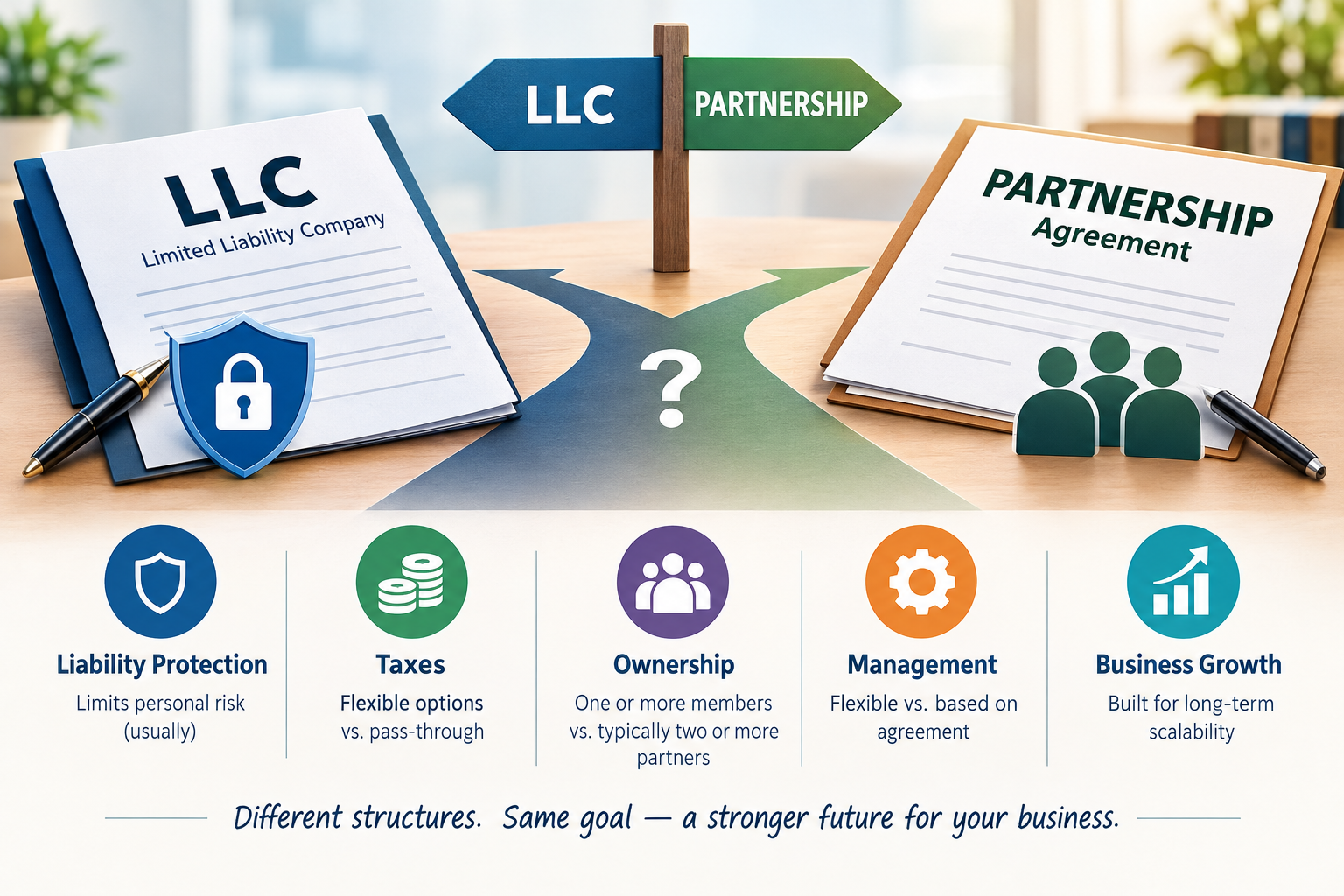
LLC vs Partnership: Key Differences, Costs, Taxes, and How to Choose
Choosing a business structure can shape how owners share profits, pay taxes, manage the company, and handle financial risk. For many entrepreneurs, the choice comes down to llc vs partnership. Both structures can work well for a small business, but they create different legal, tax, and management responsibilities.
A partnership can offer a straightforward way for two or more people to run a business together. An LLC, or limited liability company, can provide liability protection while still allowing flexible management and tax treatment. The right choice depends on the owners, business activities, risk level, and long-term plans.
LLC vs Partnership: What Do These Structures Mean?
Before comparing the two, it helps to understand what each structure does.
A partnership is a business owned by two or more people who agree to operate a business and share its profits. Depending on the type of partnership, owners may have different levels of responsibility and liability.
One person can own an LLC, or several owners, known as members, can share ownership. An LLC generally separates the business’s legal obligations from the personal assets of its owners, although that protection has limits.
For a new business owner, the biggest distinction is often the balance between simplicity and liability protection.
An entrepreneur researching the basics may also find it useful to understand what is an llc and how does it work, especially before deciding whether this structure fits the business.
LLC vs Partnership: Key Differences at a Glance
Although both structures can support privately owned businesses, they differ in several areas.
| Factor | LLC | Partnership |
|---|---|---|
| Number of owners | One or more members | Generally two or more partners |
| Liability | Usually limited to business assets, subject to exceptions | Depends on partnership type |
| Management | Flexible | Based on partnership agreement and applicable law |
| Tax treatment | Flexible options | Usually pass-through taxation |
| Formation | State filing generally required | May be formed through agreement, depending on state law |
| Operating agreement | Commonly recommended | Partnership agreement is recommended |
| Ownership transfer | Governed by operating agreement and state law | Governed by agreement and partnership rules |
| Administrative requirements | Vary by state | Often simpler for general partnerships |
These differences can affect everyday decisions, from opening a business bank account to bringing in a new owner.
Liability Protection and Personal Risk
One of the biggest reasons entrepreneurs consider an LLC is liability protection.
When properly maintained, an LLC generally treats the company as a separate legal entity from its members. As a result, business debts and legal claims usually do not become personal obligations of the members simply because they own the company.
However, an LLC does not create unlimited protection. For example, personal guarantees, certain taxes, fraud, wrongful conduct, or failure to maintain the separation between personal and business affairs can create personal exposure.
General partnerships work differently. In a traditional general partnership, partners can have personal liability for partnership obligations. State laws vary, and limited partnerships and limited liability partnerships can provide different protections.
Therefore, business owners should consider the level of financial and legal risk involved rather than choosing a structure based only on formation costs.
Ownership, Management, and Decision-Making
Management is another major difference in the partnership vs llc discussion.
An LLC can be member-managed or manager-managed. In a member-managed LLC, owners participate directly in running the business. In a manager-managed LLC, designated managers handle daily operations.
This flexibility can help when owners have different roles. For example, one member might handle operations while another focuses on sales and finance.
Partnerships can also divide responsibilities between owners. However, the partnership agreement needs to clearly establish who can make decisions, sign contracts, borrow money, hire employees, or make other commitments for the business.
Without clear rules, disagreements can become costly. A written agreement can reduce confusion by defining voting rights, profit distributions, ownership percentages, and procedures for resolving disputes.
How Taxes Work for an LLC and Partnership
Tax treatment often makes business structure decisions seem complicated. The key point is that an LLC does not have just one federal tax treatment.
A single-member LLC is generally treated as a disregarded entity for federal income tax purposes unless it elects another classification. A multi-member LLC is generally treated as a partnership unless it makes a different election.
A partnership typically passes business income, deductions, gains, and losses through to its partners. The business generally files an informational return, while individual partners report their allocated share on their personal tax returns.
An LLC may also have access to different federal tax classifications, including corporate taxation in certain circumstances.
Because state and federal rules can differ, owners should evaluate the complete tax picture instead of assuming that one structure will always produce lower taxes.
Multi Member LLC vs Partnership
The comparison becomes especially useful when several people plan to own the company.
A multi member llc vs partnership decision often involves two closely held businesses that could operate in similar ways. Both can divide profits among multiple owners and use an agreement to establish responsibilities.
The LLC, however, may offer a clearer legal structure for owners who want liability protection. It can also provide flexibility in how management and economic interests are organized.
A partnership may appeal to owners who want a relatively simple structure and have a strong working relationship. In either case, the owners should establish written rules before significant money enters the business.
Consider a marketing agency founded by three professionals. They may agree to split profits based on ownership percentages while assigning one person responsibility for sales, another for client delivery, and another for administration.
With either structure, those arrangements should be documented rather than left to informal conversations.
Limited Partnership vs LLC: What Changes?
The limited partnership vs llc comparison is slightly different from a general partnership.
The general partner traditionally carries greater responsibility for management and liability, while limited partners generally have more limited involvement and liability under applicable law.
An LLC does not normally require this general-partner/limited-partner division. Members can participate in management while retaining the liability protections associated with the LLC structure, subject to applicable exceptions.
For that reason, an entrepreneur bringing together passive investors and active operators may need to look closely at how ownership and control will work under each structure.
State law also matters, so a business should not rely solely on a general comparison when forming the entity.
LLC vs Partnership: Advantages and Disadvantages
Every business structure involves trade-offs.
Potential Advantages of an LLC
An LLC can provide:
- Personal liability protection for members in many situations
- Flexible management arrangements
- Flexible federal tax classification
- A formal legal structure for multiple owners
- An operating agreement that can establish customized business rules
- A structure that can work for both small and growing companies
For many owners, the separation between business and personal affairs is a major consideration.
The broader benefits of an llc can also help explain why entrepreneurs choose this structure for businesses with contracts, employees, inventory, or greater exposure to customer claims.
Potential Disadvantages of an LLC
An LLC can also involve:
- State formation fees
- Annual or periodic reporting requirements
- State-specific taxes or fees
- More administrative work than an informal partnership
- Costs for professional legal or tax advice
The exact requirements vary considerably by state.
Potential Advantages of a Partnership
A partnership can offer:
- A straightforward ownership arrangement
- Shared financial contributions
- Shared management responsibilities
- Pass-through federal taxation in typical partnership arrangements
- Flexibility through a partnership agreement
The benefits of partnership can be particularly relevant when owners trust one another and want to combine skills, capital, and business contacts.
Potential Disadvantages of a Partnership
A general partnership may expose partners to significant personal liability. Also, one partner’s actions can create obligations for the partnership under applicable law.
Disagreements can present another challenge. Without clear rules, owners may struggle over spending, hiring, profit distributions, or business strategy.
LLC Partnership vs S Corp: Why the Comparison Gets Confusing
Some business owners search for llc partnership vs s corp as though these are three identical types of legal entities. They are not.
An LLC is a state-law business structure. A partnership is also a business ownership structure governed by applicable law. An S corporation, by contrast, is a federal tax election available to qualifying businesses, including certain corporations and LLCs.
As a result, an LLC can potentially elect to be taxed as an S corporation if it meets the applicable requirements.
This distinction matters because the legal structure and tax classification are separate decisions in many cases. A business owner should therefore consider both questions rather than treating them as one choice.
How to Choose Between an LLC and Partnership
Instead of focusing only on formation costs, work through several practical questions.
1. How Many Owners Will There Be?
If you are operating alone, an LLC can provide a straightforward structure. A traditional partnership requires multiple owners.
If several people will own the business, both an LLC and partnership may be possible.
2. How Much Liability Exposure Does the Business Have?
A business that works with customers, employees, physical property, valuable equipment, or significant contracts may face greater legal and financial exposure.
In such cases, liability protection deserves careful consideration.
3. How Will Owners Share Profits?
Do owners plan to divide profits equally? Will distributions follow ownership percentages? Will some owners receive compensation for specific responsibilities?
These questions should be addressed in the governing agreement.
4. Who Will Control Daily Operations?
Decide whether all owners will participate in management or whether certain people will run daily operations.
Clear authority can prevent disputes later.
5. What Are the Long-Term Plans?
Think beyond the first year. The structure may need to accommodate new owners, investors, business expansion, or a future sale.
A structure that works for a two-person consulting business may not be ideal once the company has dozens of employees and significant assets.
Common Mistakes Business Owners Make
Several mistakes appear repeatedly when entrepreneurs choose a structure.
Choosing based only on the cheapest filing fee: Formation cost is only one part of the financial picture.
Using a vague ownership agreement: Verbal agreements can become difficult to enforce or interpret when circumstances change.
Mixing personal and business finances: Separate bank accounts and accurate records help maintain the distinction between the owner and the business.
Ignoring state requirements: Registration, reporting, taxes, and fees vary by state.
Assuming liability protection is absolute: An LLC can reduce certain risks, but it does not protect owners from every personal obligation.
Choosing a tax structure without professional advice: Tax consequences can depend on income, owner compensation, state rules, and other factors.
A Simple Decision Framework
Use this quick framework as a starting point:
Multiple owners → Compare LLC and partnership structures.
Higher liability concerns → Examine liability protection carefully.
Need flexible management → Review LLC operating options and partnership agreement terms.
Simple owner relationship → A partnership may be worth evaluating.
Plans for growth or ownership changes → Review how each structure handles new members, transfers, and governance.
Tax concerns → Compare the available federal and state tax treatments with a qualified professional.
This is not a substitute for legal or tax advice, but it can help organize the questions you need to answer before filing.
Frequently Asked Questions
Is an LLC better than a partnership?
There is no universal answer. An LLC and partnership serve different business needs, and the appropriate choice depends on factors such as liability exposure, ownership, management, taxes, and growth plans.
Can an LLC have multiple owners?
Yes. An LLC can have multiple members. A multi-member LLC can establish ownership percentages, management responsibilities, voting rights, and profit distributions through its operating agreement, subject to applicable law.
Is an LLC taxed like a partnership?
A multi-member LLC is generally treated as a partnership for federal income tax purposes unless it elects another classification. Tax treatment can vary based on elections and circumstances.
Does a partnership protect personal assets?
A general partnership generally does not provide the same liability protection associated with an LLC. Limited partnerships and other partnership structures can have different rules.
Can an LLC become an S corporation?
A qualifying LLC can generally elect S corporation tax treatment at the federal level. The LLC remains an LLC under state law while using the S corporation tax classification, provided it meets applicable requirements.
Making the Choice With Confidence
The llc vs partnership decision should start with how you actually plan to operate the business. Look at ownership, personal liability, taxes, management, costs, and future growth together rather than focusing on one feature.
For a business with multiple owners, a written agreement is especially valuable. It should address contributions, ownership, decision-making, profit distributions, departures, transfers, and dispute procedures.
Also, remember that the best structure for a new business may change as the company grows. Before registering, review your state’s requirements and consider speaking with a qualified attorney or tax professional who understands your business circumstances.
A thoughtful structure can give owners clearer expectations from the beginning and reduce avoidable problems as the company develops.