
What Is a Registered Agent for LLC? Duties, Requirements, and Costs
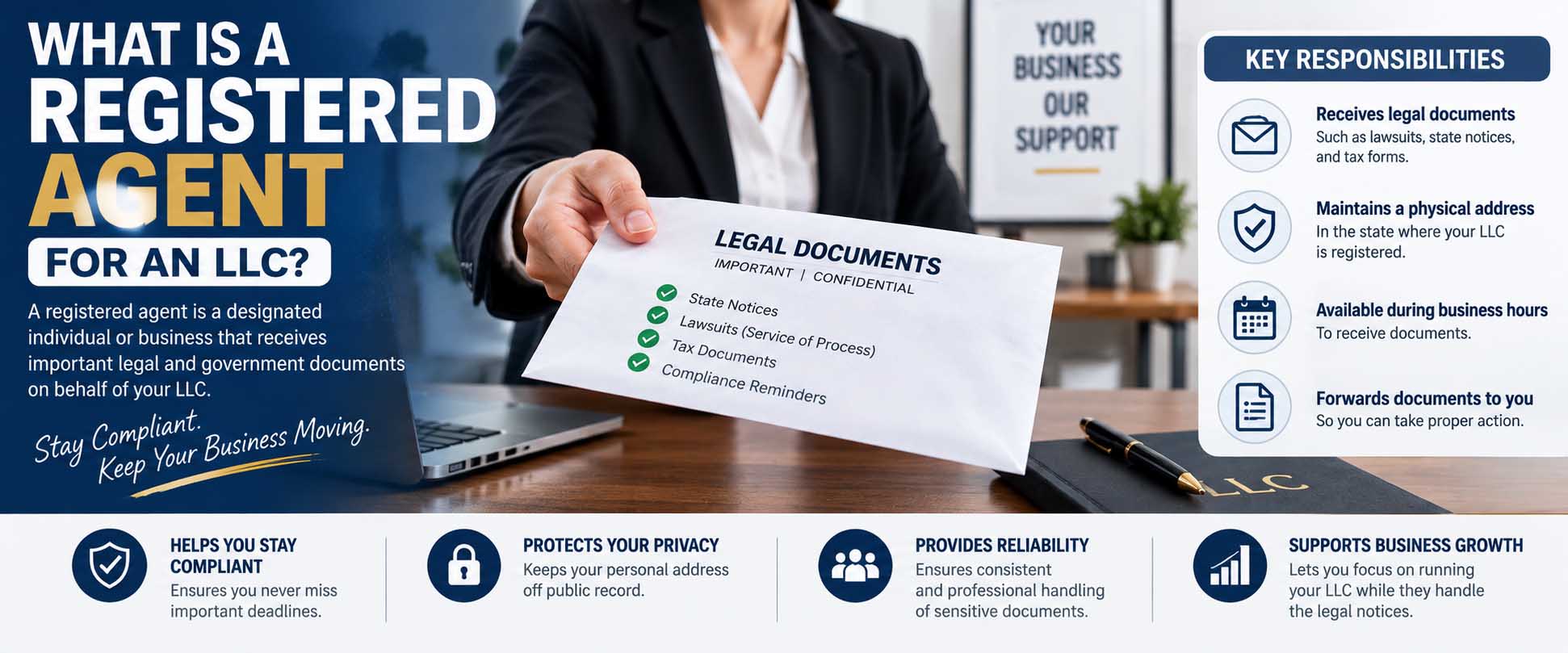
If you are forming a limited liability company, you may wonder what is a registered agent for LLC and why your state asks you to name one. A registered agent is generally a person or business designated to receive official legal and government documents on behalf of an LLC. In most states, an LLC must maintain a registered agent or equivalent registered-office arrangement so the state and other parties have a reliable way to deliver important notices.
The concept is fairly simple, yet choosing the wrong agent can create problems. Therefore, business owners should understand the agent’s responsibilities, eligibility requirements, privacy considerations, and potential costs before filing LLC formation documents.
What Is a Registered Agent for LLC?
A registered agent acts as an official point of contact for an LLC. Depending on the state, you may also see terms such as statutory agent, resident agent, or agent for service of process.
One of the agent’s main responsibilities is accepting service of process. These are legal documents that may notify the company about a lawsuit or other legal proceeding. The agent may also receive certain government correspondence and compliance notices.
After receiving a document, the registered agent should promptly forward it to the appropriate person within the company.
This role makes more sense once you understand what is an llc and how does it work, because an LLC exists separately from its owners under state law. As a result, states need reliable contact information for the entity itself.
Why Does an LLC Need a Registered Agent?
Businesses can move, owners can travel, and employees can change. However, courts and government agencies still need a dependable way to contact a registered company.
That is where the registered agent comes in.
Generally, the agent maintains a physical address in the state where the LLC is registered and remains available there during normal business hours, subject to that state’s specific requirements.
For example, imagine a landscaping LLC is sued while its owner is away on a two-week vacation. If the business uses a professional registered agent, the agent can receive the legal documents and notify the owner.
That reliability is one reason the requirement exists. Without a dependable recipient, a business could miss notices that require action within a limited period.
What Is a Registered Agent for an LLC Responsible For?
If you are asking what is a registered agent for an LLC, it helps to separate the agent’s actual duties from broader business-management responsibilities.
A registered agent does not automatically manage your LLC, handle accounting, make sales, or run daily operations.
Instead, typical responsibilities include:
- maintaining an eligible physical address in the required state
- being available as required during normal business hours
- receiving service of process
- accepting certain official state communications
- forwarding documents to the LLC promptly
- keeping registered-agent information current
Exact duties and terminology vary by state. Therefore, always review the rules in the state where you form or register your LLC.
Can You Be Your Own Registered Agent?
In many states, an eligible LLC owner can act as the company’s registered agent.
At first, this option may seem ideal. After all, you avoid paying a commercial registered-agent service each year.
However, the decision involves more than price.
If you serve as your own agent, the registered address generally becomes part of the state’s public business records. Therefore, owners who operate from home may prefer not to use their home address when another lawful option is available.
Availability can also become an issue. If state rules require the registered agent to be available at the registered address during normal business hours, frequent travel or working away from that location may make self-service inconvenient.
Still, handling the role yourself can work well for a small owner-operated company with a stable business address.
The flexibility to manage an LLC in this way is one of many benefits of an llc, although owners still need to follow their state’s formation and compliance rules.
Individual vs. Professional Registered Agent
Choosing between yourself and a registered-agent company depends on how your business operates.
| Factor | Acting as Your Own Agent | Professional Service |
|---|---|---|
| Annual service fee | Usually none | Usually required |
| Privacy | Registered address may be public | Can improve address privacy in some situations |
| Business-hour availability | Your responsibility | Service handles availability |
| Document forwarding | You manage it | Usually included |
| Multi-state expansion | Can become difficult | Often easier |
| Convenience | Lower for frequent travelers | Generally higher |
Neither option is automatically best.
For a local owner who works from the same commercial office every weekday, self-service may be practical. Meanwhile, a remote entrepreneur, frequent traveler, home-based owner, or multi-state company may find a professional service more convenient.
What Is a Registered Agent for a LLC When You Work From Home?
Home-based entrepreneurs often have the most questions about registered agents.
If your state allows you to act as your own agent, you may be able to use an eligible physical home address. However, that address can become publicly searchable through state business records.
For some entrepreneurs, this is acceptable. Others prefer greater separation between their personal residence and public business information.
Before deciding, consider how often you are home during business hours, whether you expect customers to search your company records, and whether you plan to move soon.
Likewise, think about the difference between sole proprietor and llc when choosing a business structure. Creating an LLC introduces formal state requirements that a basic sole proprietorship may not have, and maintaining an eligible registered agent is commonly one of them.
How Do You Choose a Good Registered Agent?
Start with legal eligibility. The person or company must satisfy the requirements of the state where your LLC is registered.
Next, consider reliability.
Legal notices can carry deadlines, so an agent needs a dependable process for receiving and forwarding documents. A cheap service offers little value if it fails to alert you promptly.
Privacy is another consideration. If avoiding the public use of your home address matters to you, review exactly what address information the service allows you to use and what information the state still requires separately.
Also, examine renewal pricing. Some providers advertise a low introductory rate that rises later.
Finally, consider whether you need coverage in several states. A company expanding nationally may prefer one registered-agent provider capable of supporting multiple jurisdictions.
How Much Does a Registered Agent Cost?
There is no universal price.
Serving as your own registered agent generally does not create a separate registered-agent service fee. However, you still pay the normal costs associated with creating and maintaining your LLC.
Commercial services commonly charge an annual fee, and prices vary significantly based on the provider and included features.
For example, a basic package may simply receive and scan official documents. A more expensive package may offer compliance reminders, online document storage, multi-state support, or other administrative tools.
Therefore, include agent fees when estimating how much does it cost to start an llc. Formation fees are only one part of the overall budget, especially if you choose paid compliance or registered-agent services.
Can You Change Your Registered Agent?
Yes, states generally provide a process for changing an LLC’s registered agent.
You might make a change because your current agent is retiring, your business is moving, you want better privacy, or you are switching service providers.
Usually, the LLC must file the appropriate change with the state’s business filing agency and may need to pay a fee. The exact process varies by jurisdiction.
Do not simply stop using the previous agent without updating the official state record. Otherwise, legal documents could continue going to an old address or provider.
Similarly, if your agent changes address, make sure the state receives any required update.
What Is a Registered Agent for LLC in Florida?
People researching what is a registered agent for LLC in Florida should pay attention to Florida-specific requirements rather than relying solely on general LLC advice.
Florida LLCs must have a registered agent with a registered office that meets state requirements. The registered agent accepts service of process and other official notices for the company.
The registered office must be a physical street address in Florida rather than simply a P.O. box.
An individual who meets Florida’s requirements may serve in the role, while qualifying business entities can also provide registered-agent services.
Because state forms and procedures can change, confirm the current requirements through Florida’s official Division of Corporations before filing.
What Is a Registered Agent for LLC in Texas?
Likewise, entrepreneurs asking what is a registered agent for LLC in Texas need to follow Texas rules.
Texas requires filing entities such as LLCs to maintain a registered agent and registered office in the state. The registered agent may be an eligible individual Texas resident or an organization permitted to serve in that capacity.
Texas also requires the registered office to be a physical street address where process may be personally served during normal business hours. A mailbox service or telephone answering service alone does not satisfy that function.
Another key point is consent. Texas requires a registered agent to have consented to serve in the role.
Therefore, do not name a person or company without making sure the arrangement meets current Texas requirements.
Does a Registered Agent Affect LLC Taxation?
A registered agent does not determine how an LLC is taxed.
Tax treatment and registered-agent requirements are separate issues.
For instance, an eligible LLC may choose or qualify for different federal tax classifications while still maintaining the registered agent required under state law.
That distinction also matters when examining the difference between llc and s corp. An LLC is a state-law entity type, while S corporation status is a federal tax election available to qualifying entities.
Therefore, changing registered-agent providers does not itself change your federal tax classification.
Common Registered Agent Mistakes
A common mistake is choosing an address where nobody is reliably available. While the address may initially satisfy a filing form, missed legal documents can cause serious trouble later.
Another mistake is forgetting to update state records after the registered agent resigns or changes.
Meanwhile, some home-based owners discover too late that their registered address appears publicly. Checking the state’s public-record system before filing can prevent that surprise.
Business owners may also confuse a registered agent with an attorney. A commercial registered-agent service receives documents, but that does not mean it automatically provides legal representation or advice.
Finally, avoid choosing a service solely because it offers the lowest introductory price. Review renewal rates, forwarding procedures, cancellation terms, and the provider’s reliability first.
Frequently Asked Questions
Is a registered agent the owner of an LLC?
Not necessarily. An owner may serve as registered agent when state law permits, but a separate individual or professional service can also fill the role.
Do all LLCs need a registered agent?
LLCs generally must maintain a registered agent or the equivalent required under the law of their formation or registration state. However, terminology and specific rules differ between jurisdictions.
Can a family member be my registered agent?
Potentially, yes, if the family member satisfies all applicable state requirements and agrees to perform the role. Availability and address requirements still apply.
Can I use a P.O. box as my registered-agent address?
Generally, states require an actual physical address for service of process rather than only a P.O. box. Check your state’s specific registered-office rules before filing.
Is a registered agent the same as an LLC organizer?
No. An organizer is involved in filing documents to form an LLC, while a registered agent serves as the official recipient for service of process and certain notices. One person may sometimes perform both roles, but the functions are different.
Choose Based on Reliability, Not Just Price
Once you understand what is a registered agent for LLC, choosing one becomes much easier. The core job is straightforward: provide a dependable point of contact where legal and official documents can reach your company.
If you have a stable eligible address and can reliably remain available, acting as your own agent may be practical. On the other hand, a professional service can make sense when privacy, travel, multi-state operations, or convenience matter more.
Whichever route you choose, verify the current requirements with your state’s official business filing agency. Then keep the agent’s information accurate for as long as your LLC remains active.