
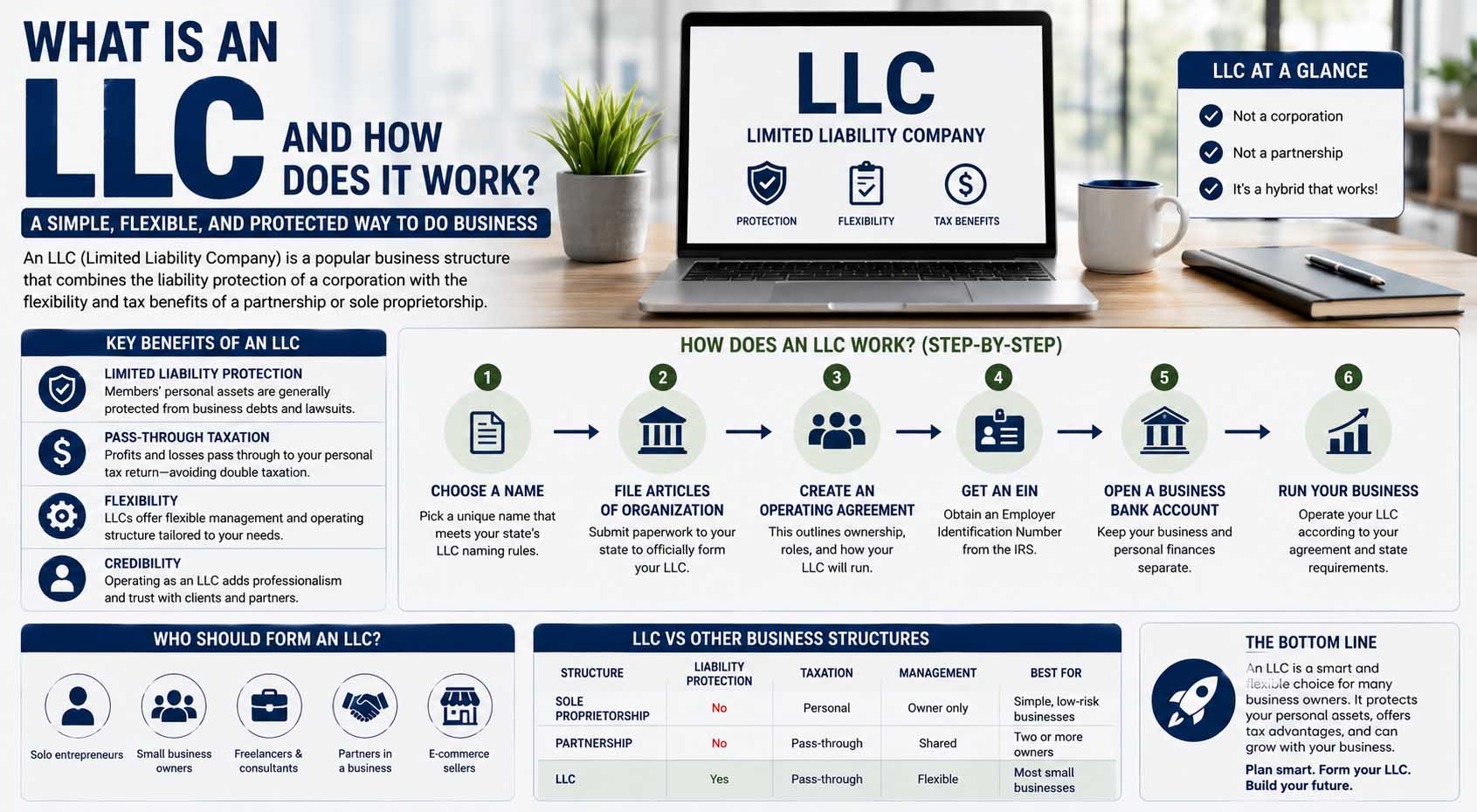
What Is an LLC and How Does It Work? A Beginner-Friendly Guide
If you are starting a business, you may be wondering what is an LLC and how does it work before deciding whether to create one. An LLC, or Limited Liability Company, is a business entity formed under state law that can separate certain business liabilities from the owner’s personal finances while offering flexible management and federal tax options. However, an LLC is not automatically the right structure for every entrepreneur, so understanding ownership, taxes, costs, and ongoing responsibilities is essential before filing.
For many small-business owners, the appeal comes from combining a formal business structure with relatively flexible operating rules. Still, forming an LLC involves more than submitting one document. You must follow your state’s requirements and continue maintaining the company after formation.
What Is an LLC and How Does It Work in Simple Terms?
A Limited Liability Company is a legal entity established according to the laws of a state. The people or entities that own an LLC are generally called members.
A single-member LLC has one owner, while a multi-member LLC has two or more members. Depending on state law and the company’s operating agreement, members may manage the business themselves or appoint managers.
The LLC can enter contracts, hold business assets, maintain bank accounts, and incur obligations in its own name. As a result, qualifying business debts generally belong to the company rather than automatically becoming the personal debts of its members.
However, limited liability is not absolute. An owner may still face personal responsibility for their own wrongful acts, personal guarantees, certain tax obligations, or situations where legal protections do not apply.
Understanding these distinctions helps explain many of the benefits of an llc, especially for entrepreneurs who want a clearer legal separation between personal and business activities.
How Does an LLC Protect Its Owners?
Limited liability protection is one of the main reasons entrepreneurs consider forming an LLC.
Imagine that a small design company operates through a properly formed and maintained LLC. If the company owes money to a vendor, the owner’s personal property is generally not available to satisfy that company debt simply because the person owns the LLC.
Still, several exceptions matter.
For example, if an owner personally guarantees a business loan, that guarantee can make the owner responsible for repayment. Likewise, forming an LLC does not protect someone from liability for their own fraud or other wrongful conduct.
Courts may also disregard an entity’s liability protection in certain exceptional circumstances, depending on applicable law and the facts.
Therefore, owners should treat the LLC as a genuine business entity rather than simply adding “LLC” to a company name.
LLC vs Sole Proprietorship
A sole proprietorship is the default form for many individuals who start doing business without creating a separate legal entity.
Suppose someone starts offering freelance design services under their own name without forming another entity. In many circumstances, that person operates as a sole proprietor.
An LLC works differently because the owner creates a separate entity under state law. Therefore, the difference between sole proprietor and llc becomes especially relevant when comparing liability, formation requirements, administration, and taxation.
A sole proprietorship is generally simpler and cheaper to start. However, it does not provide the same entity-based separation between personal and business liabilities.
An LLC requires state formation and usually involves fees and ongoing compliance. In return, it can provide liability protection for qualifying business obligations.
How Do You Form an LLC?
Exact requirements vary by state, but the general process follows several common steps.
1. Choose a Business Name
Your LLC needs a name that complies with state rules. Typically, the name must be distinguishable from existing registered entities and include an approved designation such as “LLC” or “Limited Liability Company.”
Before creating branding materials, check name availability through the relevant state filing authority.
2. Select a Registered Agent
This person or company receives certain official and legal documents for the business.
The registered agent generally needs a physical address in the state and must meet state-specific requirements.
3. File Formation Documents
You usually create the LLC by filing Articles of Organization, a Certificate of Formation, or a similarly named document with the state.
You will typically provide basic information such as the LLC’s name, registered agent, and other details required by that jurisdiction.
4. Create an Operating Agreement
An operating agreement establishes internal rules for the company.
For a multi-member LLC, it can explain ownership percentages, voting rights, management responsibilities, profit distributions, transfers of interests, and procedures for an owner’s departure.
Even single-member LLC owners may find an operating agreement useful for documenting how the company operates.
5. Handle Tax and Licensing Requirements
Depending on the business, you may need an Employer Identification Number from the IRS as well as state or local registrations.
Formation also does not automatically provide permission to conduct every type of business. Therefore, researching relevant types of business licenses can help owners identify separate permits or professional approvals they may need.
How Is an LLC Taxed?
One of the most useful things to understand about LLCs is that an LLC is a state-law business structure, while federal tax classification is a separate matter.
By default, a domestic single-member LLC is generally disregarded as separate from its owner for federal income tax purposes unless it elects another eligible classification.
Meanwhile, a domestic LLC with two or more members is generally treated as a partnership for federal income tax purposes unless it elects to be treated as a corporation.
An eligible LLC can also elect corporate taxation. If it meets applicable requirements, it may elect S corporation tax status.
Because state taxes can work differently, owners should not assume that federal tax treatment tells the whole story.
LLC vs S Corporation: What Changes?
People often treat LLC and S corporation as competing business structures, but they describe different concepts.
An LLC is created under state law. In contrast, S corporation status refers to a federal tax election available to qualifying entities.
Therefore, an LLC may potentially remain an LLC under state law while electing S corporation taxation.
The difference between llc and s corp becomes easier to understand once you separate legal entity structure from federal tax treatment.
An S corporation election may make sense in certain situations, but it introduces requirements involving eligibility, payroll, owner compensation, and tax filings. Consequently, business owners should discuss their specific circumstances with a qualified tax professional rather than making an election solely because another entrepreneur recommends it.
What Is Maintaining an LLC and How Does It Work After Formation?
Creating the company is only the first stage. So, what is maintaining an LLC and how does it work after the state approves your formation documents?
First, keep business finances appropriately separated from personal finances. Opening a dedicated business bank account can make transactions easier to document and helps maintain cleaner records.
Next, complete required state filings.what is an LLC and how does it work Depending on your jurisdiction, the LLC may need annual or biennial reports and related fees.
You should also maintain an active registered agent and update the state when required information changes.
Likewise, renew business licenses and permits as needed. Some licenses expire annually, while others operate on different schedules.
Finally, keep accounting and tax records organized. Accurate bookkeeping makes tax preparation, financial management, and business decision-making easier.
LLC vs LLP: How Are They Different?
An LLP, or Limited Liability Partnership, is another business structure that may be available to certain businesses or professionals depending on state law.
While LLCs can generally accommodate a broad range of businesses, LLP laws often relate closely to partnerships and may be particularly relevant to professional practices.
The llp vs llc comparison should consider ownership rules, liability, management, taxation, professional licensing, and state availability.
For example, some professional groups may prefer or be required to use a particular structure under their state’s licensing rules.
Therefore, lawyers, accountants, healthcare professionals, architects, and other licensed professionals should check both state business law and professional-board requirements before selecting an entity.
Major Advantages of an LLC
LLCs have become popular partly because they can provide several useful features without requiring the traditional governance structure associated with corporations.
Liability Protection
Members generally receive protection from personal responsibility for qualifying company debts and obligations.
This feature can be especially valuable when a business signs leases, enters contracts, purchases inventory, hires employees, or takes on other commercial obligations.
Flexible Management
LLCs can generally be member-managed or manager-managed, subject to state law and the company’s governing documents.
This flexibility allows owners to design a management structure that matches the business.
Tax Classification Options
Depending on its ownership and elections, an LLC may be treated as a disregarded entity, partnership, C corporation, or potentially an S corporation for federal income tax purposes.
However, each classification carries different requirements and consequences.
Flexible Ownership
LLCs can often accommodate one or multiple owners. Depending on applicable law, members may include individuals and certain other entities.
Still, ownership and tax rules can become more complicated when members include foreign persons or particular entity types.
What Are Drawbacks of an LLC and How Does It Work in Practice?
If you are researching what is drawbacks of an LLC and how does it work, the main point is that LLC status comes with costs and responsibilities.
First, formation generally requires a state filing fee. Some states also impose annual fees, franchise taxes, minimum taxes, or other ongoing charges.
Second, compliance requirements vary by state. Missing reports, fees, or registered-agent obligations can create problems with the company’s good standing.
Third, LLC ownership interests are not necessarily as easy to transfer as publicly traded corporate shares. An operating agreement or state law may restrict ownership changes.
Taxation can also become complicated, particularly for multi-member companies or businesses making tax elections.
Finally, an LLC cannot eliminate every form of personal liability. Personal guarantees and an owner’s own wrongful acts can still create personal exposure.
A Practical Example of How an LLC Works
Suppose Maya starts a home-organizing business.
Initially, she operates as a sole proprietor. As the company grows, she signs larger contracts, buys equipment, and hires workers.
Maya then forms an LLC according to her state’s requirements. She obtains any required tax identification numbers, creates a business bank account, and signs new business contracts through the LLC.
She also maintains separate bookkeeping and follows state filing requirements.
The LLC does not guarantee that Maya will never face personal liability. However, it creates a formal entity through which the business can operate and can protect her from personal responsibility for qualifying company obligations.
This example shows why the value of an LLC comes not only from filing paperwork but also from operating the company appropriately afterward.
Common LLC Mistakes to Avoid
One frequent mistake is mixing personal and business finances. Although an occasional bookkeeping error does not automatically destroy liability protection, consistently treating company money as personal money can create legal and accounting problems.
Another mistake is assuming LLC formation automatically covers licenses and permits. It does not. A restaurant, construction company, professional practice, or home-based business may have separate regulatory requirements.
Some owners also forget annual reports or state fees. Therefore, create a compliance calendar immediately after formation.
Likewise, multi-member companies sometimes skip the operating agreement. This can become a serious problem when owners disagree about money, management, or leaving the business.
Finally, avoid assuming that forming an LLC automatically creates the most favorable tax arrangement. Tax decisions should reflect the company’s actual financial circumstances.
FAQs About LLCs
Can one person own an LLC?
Yes. State law generally permits single-member LLCs. For federal income tax purposes, a domestic single-member LLC is typically disregarded as separate from its owner unless it elects another eligible classification.
Do I need an attorney to start an LLC?
State requirements vary, and many states allow owners to file formation documents themselves. However, professional legal advice may be useful for complex ownership arrangements, regulated businesses, investment structures, or customized operating agreements.
Does an LLC automatically reduce taxes?
No. LLC formation does not guarantee lower taxes. Tax results depend on classification, income, expenses, state rules, elections, and the owner’s individual circumstances.
Can an LLC hire employees?
Yes. An LLC can generally hire employees. However, the company must comply with applicable payroll, tax, employment, insurance, and reporting requirements.
Do LLC owners receive a salary?
It depends on the LLC’s tax classification and the owner’s role. For example, rules for owners of an LLC taxed as a partnership differ from rules that may apply when an LLC elects S corporation taxation.
Does an LLC last forever?
Many LLCs can continue indefinitely unless their governing documents, state law, or a later event results in dissolution. However, owners must continue satisfying applicable state requirements to maintain the company properly.
Deciding Whether an LLC Fits Your Business
Understanding what is an LLC and how does it work becomes easier when you separate the decision into four areas: liability, ownership, taxation, and ongoing compliance.
An LLC can be a practical structure for freelancers, what is an LLC and how does it work consultants, retailers, service businesses, real estate ventures, and many other companies. Still, the best structure depends on the business itself, its owners, the state where it operates, and future plans.
Before filing, check your state’s current formation rules, calculate both initial and ongoing costs, determine which licenses apply, and consider how the business will be taxed. If ownership, tax, or liability issues are complex, getting advice from qualified legal and tax professionals can help you make a more informed choice.