
Difference Between Sole Proprietor and LLC
Starting a business often begins with one of the most common questions entrepreneurs ask: What is the difference between sole proprietor and LLC? Both structures are popular for small businesses, freelancers, and side hustles, yet they differ in legal protection, taxes, paperwork, and long-term flexibility.
Choosing the right business structure affects how you pay taxes, protect your personal assets, and grow your company. Understanding these differences before registering your business can help you avoid costly mistakes later.
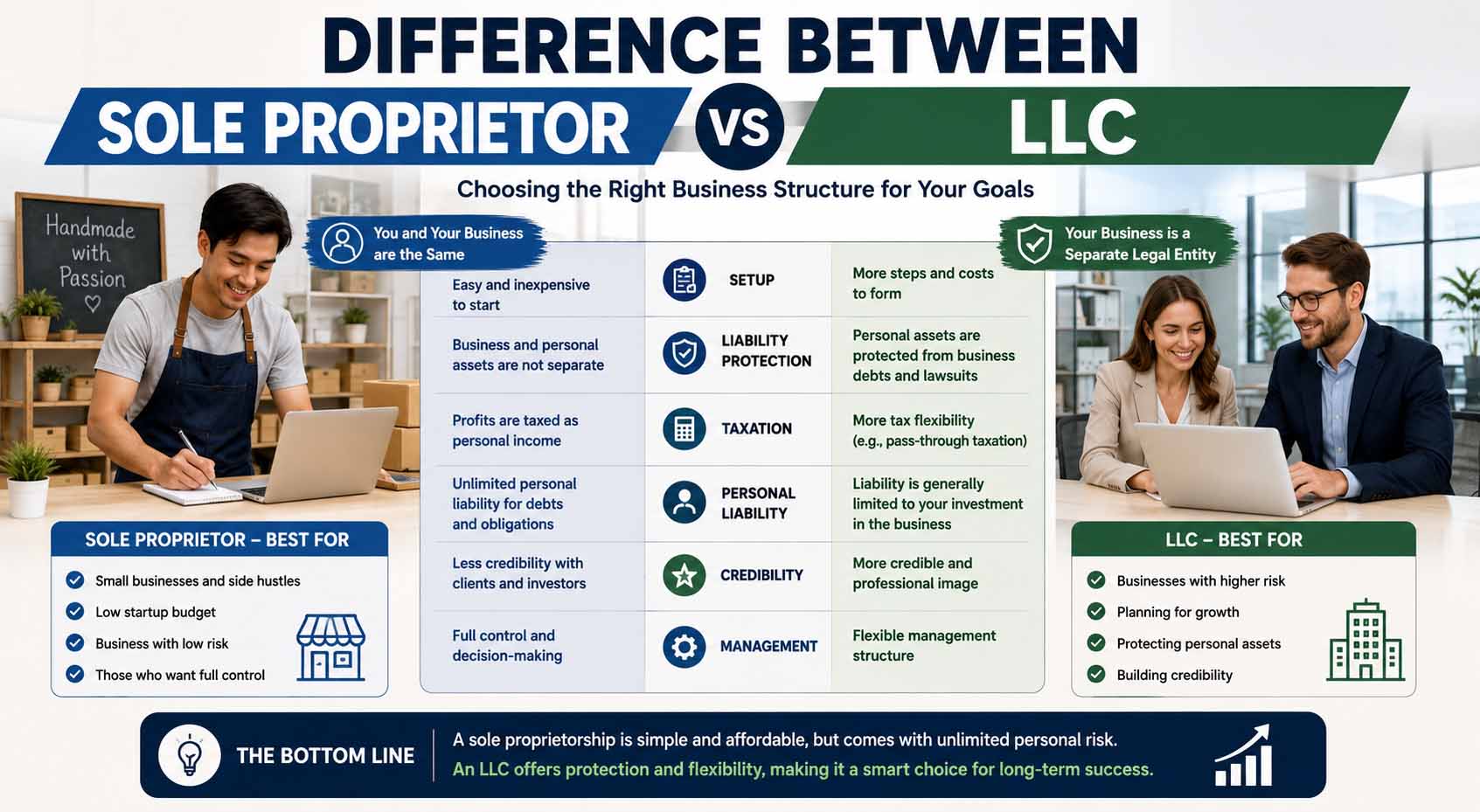
Difference Between Sole Proprietor and LLC at a Glance
Here’s a quick comparison of the difference between sole proprietor and LLC.
| Feature | Sole Proprietorship | Limited Liability Company (LLC) |
|---|---|---|
| Legal status | Not separate from the owner | Separate legal entity under state law |
| Personal liability | Unlimited | Limited in most situations |
| Startup cost | Usually very low | Filing fees apply |
| Paperwork | Minimal | Moderate |
| Taxation | Personal tax return | Pass-through by default, with other tax options available |
| Business credibility | Moderate | Often viewed as more established |
| Ownership | One owner | One or multiple owners depending on state rules |
For many new entrepreneurs, the decision comes down to finding the right balance between simplicity, ease of management, and the level of personal liability protection their business structure provides.
What Is a Sole Proprietorship?
A sole proprietorship is the simplest business structure available.
A business automatically becomes a sole proprietorship when one person starts operating without forming another legal entity.
Examples include:
- Freelance writers
- Consultants
- Graphic designers
- Lawn care businesses
- Online sellers
- Local service providers
There is no legal separation between the owner and the business, meaning the owner is personally responsible for the business’s debts, obligations, and liabilities.
That means business income is reported on the owner’s personal tax return, but the owner is also personally responsible for business debts and legal claims.
What Is an LLC?
A Limited Liability Company, commonly called an LLC, is a legal business structure created by filing formation documents with a state.
Unlike a sole proprietorship, an LLC generally separates the owner’s personal assets from business liabilities.
Many businesses choose an LLC because it combines:
- Liability protection
- Flexible taxation
- Relatively simple management
- Fewer formalities than many corporations
LLCs have become one of the most popular choices for small businesses across the United States.
Difference Between Sole Proprietor and LLC: Key Areas to Compare
Understanding the major differences helps you choose the structure that fits your goals.
Liability Protection
The biggest distinction is personal liability.
With a sole proprietorship:
- Business debts belong to the owner.
- Personal savings and property may be at risk if the business is sued or cannot pay its obligations.
With an LLC:
- The business is generally treated as a separate legal entity.
- Personal assets usually receive protection from business liabilities, provided legal requirements are followed.
Although an LLC offers valuable protection, owners can still become personally liable in certain situations, such as fraud, personal guarantees, or failing to maintain proper business practices.
Startup Costs
A sole proprietorship is usually inexpensive to start.
Depending on your location, you may only need:
- Local permits
- Industry licenses
- Business name registration if required
An LLC requires filing formation documents with the state and paying filing fees.
Costs vary by state and may also include annual reports or franchise taxes.
Taxes
Many people assume LLCs pay different taxes, but that’s not always true.
A single-member LLC is generally taxed similarly to a sole proprietorship unless another tax classification is chosen.
Both structures often use pass-through taxation, meaning profits pass directly to the owner’s personal tax return.
As a business grows, an LLC may elect different tax treatment if it becomes financially beneficial.
If you’re comparing entity options beyond an LLC, our guide on the difference between LLC and S Corp explains how tax elections can affect growing businesses.
Business Credibility
Customers, lenders, and vendors sometimes view an LLC as more established than a sole proprietorship.
Although professionalism depends on how a business operates, using “LLC” after a company name may increase credibility with some clients.
Pros and Cons
Sole Proprietorship
Advantages
- Easy to start
- Low startup costs
- Minimal paperwork
- Complete owner control
- Simple tax reporting
Disadvantages
- Unlimited personal liability
- Harder to raise capital
- Less credibility in some industries
- Business ends if the owner stops operating
LLC
Advantages
- Personal liability protection
- Flexible management
- Greater business credibility
- Easier ownership expansion
- Multiple tax options
Disadvantages
- State filing fees
- Annual compliance requirements in many states
- More paperwork than a sole proprietorship
- Recordkeeping expectations
Real-World Examples
Example 1: Freelance Designer
Sarah designs websites from home.
She has very little business risk, no employees, and only a few clients each month.
A sole proprietorship may work well while she validates her business idea.
Example 2: Home Remodeling Contractor
Mike renovates kitchens and bathrooms.
His work involves customer property, subcontractors, expensive equipment, and higher legal risk.
An LLC may provide an additional layer of protection if a dispute arises.
Example 3: Growing Online Store
Emily starts selling handmade products online.
Initially, a sole proprietorship keeps things simple.
As sales increase and inventory grows, converting to an LLC may better support future expansion.
When Does an LLC Make Sense?
Many entrepreneurs consider forming an LLC when they:
- Earn consistent business income
- Hire employees
- Sign commercial leases
- Purchase expensive equipment
- Want liability protection
- Plan to expand
An LLC isn’t always necessary on day one, but many business owners choose one as their operations become more established.
Licensing and Registration
Regardless of your business structure, you may still need permits or licenses before opening.
Requirements depend on:
- Industry
- State
- City
- County
If you’re unsure where to begin, reviewing the different types of business licenses can help you understand which registrations may apply to your business.
Can a Sole Proprietorship Become an LLC?
Yes.
Many businesses begin as sole proprietorships before transitioning into LLCs.
The typical process includes:
- Choose an available business name.
- File Articles of Organization with your state.
- Obtain a new EIN if needed.
- Open a business bank account.
- Update licenses and contracts.
- Notify vendors and customers if necessary.
Converting later is common, especially once revenue increases or liability concerns grow.
How Does an LLC Compare With a Corporation?
Entrepreneurs sometimes compare several business structures before making a decision.
While LLCs offer flexibility, corporations follow different ownership and management rules. If you’re weighing additional options, our guide on corporation advantages and disadvantages explains how corporations differ in taxation, fundraising, and governance.
What About Partnerships?
If you’re starting a business with another person, neither a sole proprietorship nor a single-member LLC may be the right fit.
Depending on your goals, you may also want to explore the benefits of partnership, especially if responsibilities, investment, and decision-making will be shared.
Many partnerships also choose to organize as LLCs for liability protection.
How to Verify a Business Entity
Before signing contracts or doing business with another company, it’s often helpful to confirm that the business is properly registered.
For example, entrepreneurs operating in Pennsylvania can use the Pennsylvania Business Entity Search to verify business registration details through the state’s official records.
Most states provide similar online search tools.
Common Mistakes When Choosing a Business Structure
Many first-time business owners make avoidable mistakes.
Watch out for these common issues:
- Choosing based only on startup cost
- Ignoring liability risks
- Mixing personal and business finances
- Forgetting annual filing requirements
- Waiting too long to upgrade the business structure
- Assuming taxes are identical in every situation
Speaking with an accountant or business attorney before making a final decision can save time and money.
Frequently Asked Questions
What is the difference between sole proprietor and LLC?
The main difference is that a sole proprietorship does not create a separate legal entity, while an LLC generally provides personal liability protection and additional legal separation between the owner and the business.
What’s the difference between sole proprietor and LLC for taxes?
Both often use pass-through taxation by default. However, LLCs may have additional tax election options depending on the business’s circumstances.
Can one person own an LLC?
Yes. A single-member LLC is owned by one individual and is one of the most common LLC structures.
Is an LLC always better?
Not necessarily. For very small businesses with limited risk, a sole proprietorship may provide enough simplicity. Businesses with higher liability exposure often benefit from an LLC.
Can I switch from a sole proprietorship to an LLC later?
Yes. Many successful businesses begin as sole proprietorships and transition to an LLC as they grow.
Choosing the Right Structure for Your Business
There isn’t a one-size-fits-all answer when deciding between these business structures. A sole proprietorship offers simplicity and low startup costs, making it attractive for many new entrepreneurs. An LLC, on the other hand, adds legal protection and greater flexibility as a business expands.
Think about your level of business risk, expected income, long-term goals, and administrative preferences before deciding. If you’re unsure, consulting a qualified accountant or business attorney can help you choose the structure that best supports your business today while leaving room for future growth.