
Benefits of Coworking Spaces: Why Flexible Offices Work for Modern Businesses
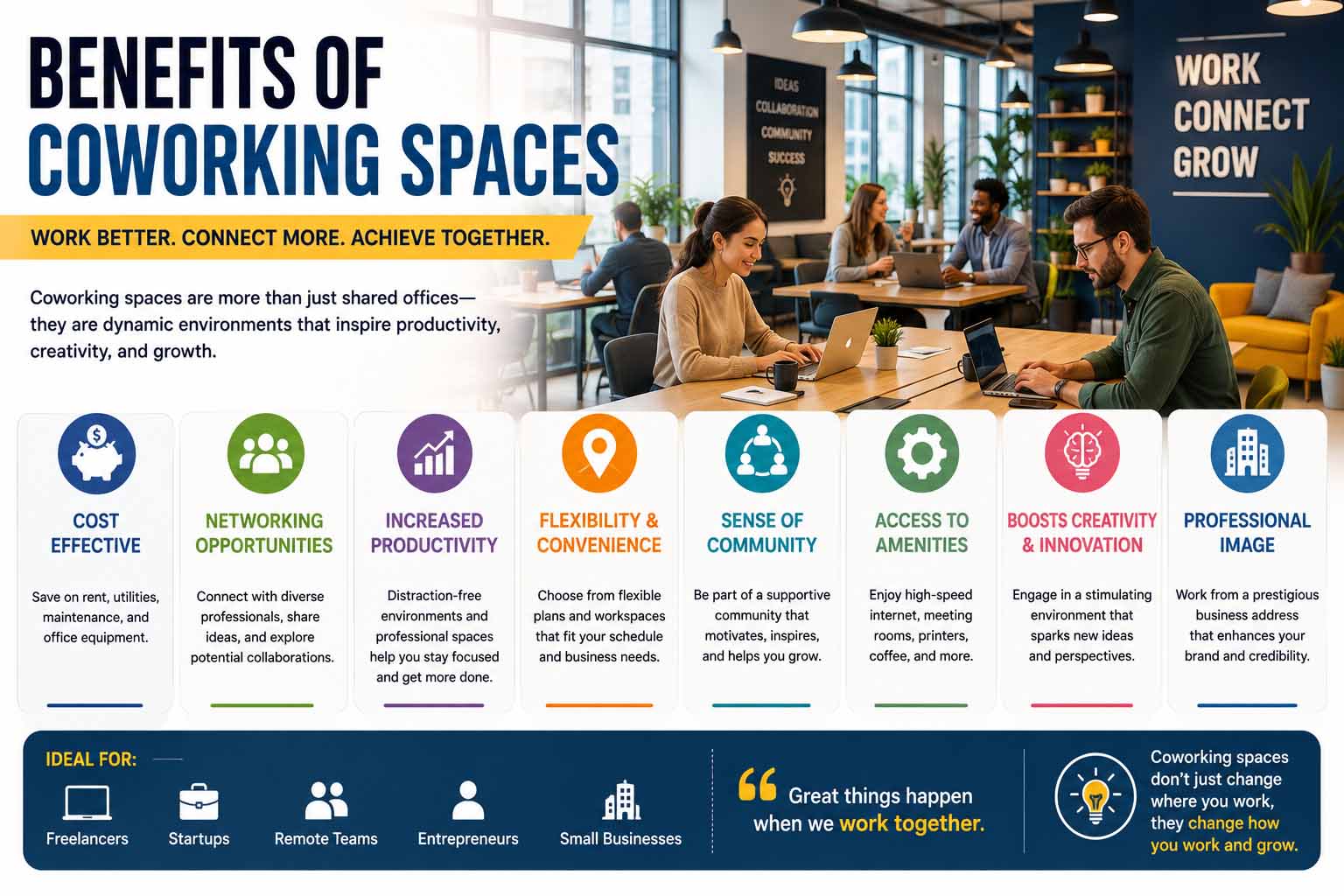
For many businesses, signing a long commercial lease no longer feels like the only sensible way to get office space. The benefits of coworking spaces include flexible terms, shared amenities, lower setup costs, professional meeting areas, and easier access to a business community. As a result, coworking can appeal to freelancers, startups, remote teams, consultants, and even larger companies testing new markets.
A coworking space is more than a desk in a shared room. Depending on the provider, it may include private offices, meeting rooms, phone booths, reception services, mail handling, high-speed internet, kitchens, event spaces, and community programming.
Still, coworking is not automatically cheaper or better for every company. The right choice depends on team size, privacy needs, location, growth plans, and how often employees actually use the space.
What Is a Coworking Space?
A coworking space is a shared workplace used by people from different companies, industries, or independent businesses.
Instead of one organization leasing an entire office and paying separately for furniture, utilities, internet, cleaning, security, and reception, members typically pay for access to a ready-to-use workspace.
Some plans offer hot desks, where members use any available seat. Others provide dedicated desks or private offices.
This model fits into a broader range of types of work environments, from traditional corporate offices and remote work to hybrid teams and fully distributed companies.
The main attraction is flexibility. A business can often start using the space quickly without committing to the same level of upfront cost or long lease term associated with a conventional office.
The Main Benefits of Coworking Spaces
Coworking solves several common business problems at once.
A small company may need a professional address but not a full office. A remote employee may need somewhere quieter than home. Meanwhile, a growing startup may need six desks this month and ten next quarter.
Shared workspaces can adapt to those needs more easily than many traditional leases.
1. Lower Upfront Office Costs
Setting up a private office can be expensive.
Businesses may need to pay deposits, purchase desks and chairs, install internet service, furnish meeting rooms, arrange cleaning, and handle utilities before employees can work effectively.
A coworking membership usually bundles many of those costs into one fee.
That can reduce the initial cash required to establish a professional workspace.
However, coworking is not always cheaper over the long term. A large company with stable headcount may eventually find a conventional lease more economical on a per-person basis.
The biggest financial advantage is often flexibility rather than the lowest possible monthly cost.
2. Flexible Membership Terms
Traditional commercial leases can run for several years.
That creates risk for companies with uncertain growth.
Suppose a startup leases an office for 15 employees but grows to 30 within a year. The company may quickly outgrow the space.
If headcount falls, the business may continue paying for empty desks.
Coworking spaces often offer shorter commitments and easier changes between plans. Consequently, companies can increase or reduce space more gradually.
That flexibility is especially useful for project teams, seasonal staff, remote employees, or businesses entering a new city.
Benefits of Coworking Spaces for Startups
The benefits of coworking spaces for startups go beyond furniture and internet access.
Early-stage companies often face uncertainty around funding, hiring, office requirements, and growth. product development, sales, or hiring.
Coworking gives founders access to professional space without building an office from scratch.
Candidates may view a well-equipped shared office more positively than working from a founder’s home or an improvised temporary location.
Another advantage is speed.
A startup may be able to move into a furnished office within days instead of spending weeks coordinating contractors, furniture deliveries, internet installation, and building access.
For a young company, that can mean spending more time building the business and less time managing facilities.
Networking Happens More Naturally
One of the most distinctive benefits of coworking spaces is proximity to other professionals.
A shared office may contain designers, developers, marketers, lawyers, consultants, recruiters, accountants, and founders from different businesses.
That creates opportunities for informal introductions that would rarely happen in an isolated private office.
A founder might meet a freelance designer in the kitchen. Meanwhile, a consultant may meet a future client during a community event.
Those connections should not be treated as guaranteed business opportunities. Still, coworking can increase the number of useful professional interactions a person encounters.
People who want to make the most of those opportunities can apply many of the same Tips for Networking Events: introduce yourself clearly, ask genuine questions, avoid aggressive selling, and follow up when there is a real reason to stay in touch.
Coworking Can Reduce the Isolation of Remote Work
Remote work offers flexibility, but working alone every day does not suit everyone.
Some people miss casual conversation, social contact, and the sense of routine that comes with leaving home for work.
Coworking can create a middle ground.
A person can maintain independence while still working around other professionals.
This can be particularly useful for freelancers and remote employees who live alone or have distracting home environments.
However, the social side of coworking varies by location. Some spaces actively build community through events and shared lunches, while others operate more like quiet serviced offices.
If community matters to you, visit the space before joining and observe how members actually interact.
Professional Meeting Rooms Improve Client Experience
Coffee shops can also be noisy, crowded, and difficult for confidential conversations.
Many coworking memberships include access to meeting rooms that offer screens, whiteboards, video conferencing equipment, and professional seating.
This can make a small business appear more established without requiring it to lease a full office.
The right room also depends on the purpose of the meeting. A private interview, brainstorming session, client presentation, and board discussion may each need different layouts.
Understanding the types of meetings a team runs most often can help determine whether a coworking provider has the right spaces available.
Built-In Amenities Save Administrative Time
Running an office involves many small tasks.
Someone must arrange internet service, cleaning, coffee supplies, maintenance, security access, and furniture.
Coworking operators usually handle much of that work.
Members can arrive and focus on their jobs instead of managing facilities.
Common amenities may include:
- Wi-Fi
- Printing
- Kitchen access
- Coffee and tea
- Reception areas
- Mail handling
- Phone booths
- Meeting rooms
- Cleaning
- Security systems
- Community events
Not every provider includes everything in the base price, though.
Some charge extra for meeting-room hours, printing, lockers, parking, mail services, or after-hours access.
Therefore, businesses should compare the total expected monthly cost rather than looking only at the advertised desk price.
Coworking Can Support Better Work Routines
Working from home can blur the line between professional and personal time.
A coworking space gives employees a separate location associated with work.
That physical change can make routines easier to establish.
For example, someone may arrive at 9 a.m., work in focused blocks, take lunch away from the desk, and leave at a regular time.
A dedicated environment can also remove some home distractions.
Of course, coworking spaces create distractions of their own, such as conversations, phone calls, and foot traffic.
The ideal environment depends on the person.
Quiet zones, phone booths, private offices, and noise-canceling headphones can make a major difference.
Digital tools matter as well. Anyone asking What Is Productivity Software may find that task managers, calendars, collaboration tools, and focus apps become even more useful when a team works across home, coworking, and office locations.
Benefits of Coworking Spaces for Startup Teams
The benefits of coworking spaces for startup teams become especially clear as a company begins hiring.
A founder working alone may need only a hot desk. Once the company adds employees, however, private rooms, meeting space, secure storage, and team collaboration become more important.
Coworking lets companies upgrade gradually.
A business might start with two dedicated desks, move into a four-person private office, and later expand into a larger suite in the same building.
That reduces disruption compared with moving between completely separate offices every time headcount changes.
Still, rapid growth can expose limits.
If a coworking location cannot provide enough adjacent space, the team may become spread across several rooms or floors.
Growing companies should ask how easily the provider can accommodate expansion before signing.
Better Access to Prime Business Locations
Traditional office space in central business districts can be expensive.
Coworking allows smaller companies to access desirable locations without leasing an entire floor or suite.
A strong location can improve commute options, client convenience, and access to nearby services.
It may also provide a more credible business address.
Yet businesses should not pay a premium for a prestigious address if employees rarely use the space.
Accessibility, parking, transit, and actual usage usually matter more than reputation alone.
Knowledge Sharing Can Happen Across Companies
Shared environments can create unexpected opportunities for learning.
A marketing specialist may learn from a founder. A software developer may exchange ideas with a product manager. Meanwhile, a business owner may hear how another company solved a similar operational problem.
This is informal knowledge exchange rather than structured training.
Still, it can be valuable.
The same principle connects to the benefits of knowledge management inside companies: useful information creates more value when people can find, share, and apply it instead of keeping it isolated.
Coworking spaces can encourage that behavior naturally when members feel comfortable exchanging ideas.
Key Benefits of Class A Coworking Spaces
The phrase key benefits of Class A coworking spaces usually refers to shared workplaces located in higher-quality commercial buildings with stronger amenities, finishes, access, and building services.
These spaces may offer premium reception areas, newer infrastructure, better meeting facilities, stronger security, high-quality furnishings, and desirable locations.
For companies that meet clients frequently, those details can matter.
However, a premium environment comes at a price.
A freelancer who needs only reliable internet and a quiet desk may gain little from marble reception areas or luxury lounges.
Therefore, choose the level of workspace based on business needs rather than appearance alone.
Potential Disadvantages of Coworking
A balanced decision should also consider the downsides.
Privacy is one concern.
Open coworking areas may not suit confidential legal, financial, healthcare, or HR discussions.
Noise can also become distracting, particularly during busy periods.
Storage may be limited, while custom branding and office modifications are often more restricted than in private leased space.
There is also less control over the overall environment.
Your business does not choose every neighboring company, event, visitor, or building policy.
Finally, costs can rise as the team grows.
What looks inexpensive for two employees may become less competitive once 25 people need dedicated desks, meeting rooms, and private offices.
Coworking vs Traditional Office: Quick Comparison
| Factor | Coworking Space | Traditional Office |
|---|---|---|
| Setup time | Usually fast | Often slower |
| Lease flexibility | Usually higher | Usually lower |
| Upfront costs | Lower in many cases | Often higher |
| Customization | Limited | Greater control |
| Privacy | Varies | Usually stronger |
| Networking | Built-in opportunities | Depends on company |
| Amenities | Shared | Company manages them |
| Scalability | Easy at smaller sizes | Depends on lease |
| Branding | Limited | More freedom |
Neither option wins in every situation.
A small startup may value flexibility most, while a larger established company may prefer control and long-term cost predictability.
How to Choose the Right Coworking Space
Start with location.
Then calculate the true monthly cost, including meeting rooms, parking, printing, lockers, mail handling, and any extra services.
Next, test the workspace during the hours you are likely to use it.
A quiet space at 8 a.m. may feel very different at 2 p.m.
Check internet reliability, mobile reception, call privacy, security, access hours, and meeting-room availability.
For teams, ask about expansion options.
Finally, read the cancellation and renewal terms carefully. Flexibility is one of coworking’s biggest advantages, so a restrictive agreement can undermine much of its value.
Frequently Asked Questions About Coworking Spaces
Are coworking spaces worth it?
They can be. Coworking makes the most sense when you value flexibility, professional facilities, and lower setup effort. However, frequent use, team size, and local pricing determine the actual value.
Are coworking spaces only for freelancers?
No. Freelancers remain common users, but startups, remote employees, consultants, project teams, and larger businesses also use shared offices.
Do coworking spaces offer private offices?
Many do. Private offices can give teams more privacy while retaining access to shared kitchens, meeting rooms, reception areas, and other amenities.
Is coworking cheaper than renting an office?
It can be, especially for small teams or short-term needs. However, a large stable team may eventually pay less per employee with a conventional long-term lease.
Can I meet clients in a coworking space?
Usually, yes. Many locations offer reservable meeting rooms and professional reception areas. Check guest policies and room charges before choosing a membership.
When Coworking Makes the Most Business Sense
The benefits of coworking spaces are strongest when a business needs flexibility more than complete control.
They work particularly well for freelancers who want separation from home, startups protecting cash, remote employees who need a professional environment, and teams expanding into new locations.
Before joining, compare total cost, privacy, commute, meeting facilities, internet quality, and expansion options rather than choosing based on décor alone.
A good coworking space should remove friction from the workday. If it gives your team the right environment, facilities, flexibility, and professional connections without locking the business into unnecessary overhead, it can be a practical alternative to both working from home and leasing a traditional office.