Types of Work Environments: A Complete Guide for Employees and Employers
Have you ever accepted a job only to realize the workplace wasn’t the right fit? Understanding types of work environments can help you avoid that situation. The environment where people work affects productivity, communication, job satisfaction, and even career growth. While salary and benefits matter, the workplace itself often determines whether employees enjoy their jobs and perform at their best.
Today’s businesses offer more workplace options than ever before. Traditional offices still exist, but many organizations now embrace hybrid schedules, remote work, flexible spaces, and collaborative environments. Knowing the strengths and challenges of each option helps both employers and employees make better decisions.
What Are Types of Work Environments?
The term types of work environments refers to the physical, cultural, and organizational settings where employees perform their jobs.
A work environment includes much more than an office building. It also covers management style, communication methods, teamwork, company culture, technology, flexibility, and workplace expectations.
The different types of work environments are designed to support different industries, business goals, and employee needs. Some encourage close collaboration, while others focus on independence and flexibility.
Why Work Environments Matter
A positive work environment benefits both employees and employers.
For employees, it can lead to:
- Higher job satisfaction
- Better work-life balance
- Increased motivation
- Improved mental well-being
- Greater career development
For businesses, the benefits often include:
- Higher productivity
- Better employee retention
- Stronger collaboration
- Lower turnover
- Improved customer service
As companies adopt new technologies, many rely on Managed IT Support Services to keep employees connected, secure, and productive across office and remote work locations.
Common Types of Work Environments
Although every company has its own culture, most workplaces fall into several common categories.
Traditional Office Environment
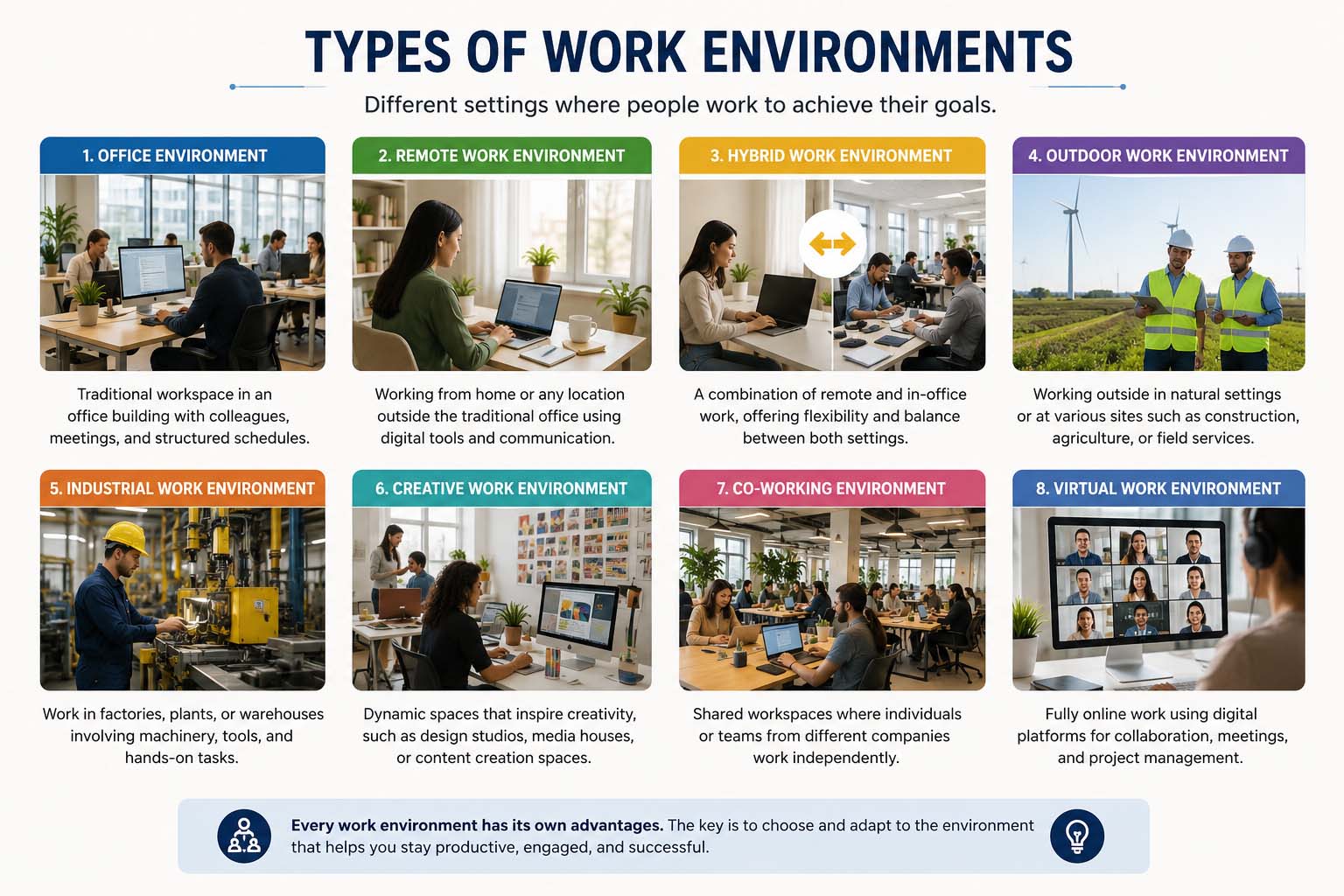
The traditional office remains one of the most familiar types of work environments examples.
Employees work from a shared physical location during regular business hours.
This environment typically offers:
- Face-to-face communication
- Easy collaboration
- Structured supervision
- Immediate access to coworkers
Industries such as banking, healthcare administration, legal services, and finance often continue using traditional office settings.
Remote Work Environment
Remote work allows employees to perform their duties from home or another location outside the company’s office.
Cloud software, video conferencing, and collaboration platforms make this possible.
Benefits include:
- Flexible schedules
- Reduced commuting
- Better work-life balance
- Access to wider talent pools
However, remote employees may need stronger self-discipline and effective communication habits to stay connected with their teams.
Hybrid Work Environment
Hybrid work combines office attendance with remote work.
Employees divide their time between home and the workplace according to company policies or personal preferences.
Many businesses have adopted hybrid models because they balance flexibility with in-person collaboration.
Coworking Environment
Coworking spaces provide shared offices for freelancers, startups, consultants, and small businesses.
Instead of leasing a private office, multiple organizations share meeting rooms, workstations, internet access, and common areas.
These environments encourage networking and reduce overhead costs.
Industrial Work Environment
Factories, warehouses, manufacturing facilities, and production plants create industrial work environments.
Employees often work with specialized equipment while following strict safety procedures.
Companies involved in manufacturing frequently improve efficiency through careful planning and continuous improvement, much like the processes described in Product Development Life Cycle, where structured workflows support consistent business results.
Field Work Environment
Some jobs require employees to work outside a traditional office.
Construction crews, utility technicians, inspectors, sales representatives, and maintenance professionals spend much of their time at customer locations or project sites.
Technology such as mobile devices and cloud applications helps field employees stay connected with their organizations.
Comparing Different Workplace Types
Choosing the right workplace depends on both business objectives and employee preferences.
| Work Environment | Flexibility | Collaboration | Best For |
|---|---|---|---|
| Traditional Office | Low | High | Team-based roles |
| Remote | High | Moderate | Independent work |
| Hybrid | High | High | Knowledge workers |
| Coworking | High | Moderate | Freelancers and startups |
| Industrial | Low | Team-based | Manufacturing and production |
| Field Work | Moderate | Varies | On-site services |
Each environment has strengths that make it suitable for different industries and job roles.
Workplace Culture Matters as Much as Location
Physical space is only one part of a healthy workplace.
Company culture often has an even greater influence on employee satisfaction.
A positive culture usually includes:
- Open communication
- Mutual respect
- Clear expectations
- Fair leadership
- Recognition for good work
- Opportunities to grow
Organizations planning long-term improvements often work with IT Strategy Consulting specialists to ensure technology supports collaboration, security, and employee productivity as workplace expectations continue to evolve.
What Are Three Types of Hostile Work Environments?
Many people search for what are three types of hostile work environments when learning about employee rights.
While legal definitions vary by country, three common situations can create an unhealthy or hostile workplace.
Harassment-Based Environment
Repeated harassment based on protected characteristics such as race, gender, religion, disability, or age can create a hostile work environment.
Employers are generally expected to investigate complaints promptly and take appropriate action.
Bullying and Intimidation
Persistent bullying, verbal abuse, threats, or humiliation can damage employee morale and reduce productivity.
Although bullying may not always meet the legal definition of workplace harassment, it still creates an unhealthy organizational culture.
Discrimination and Exclusion
Employees who experience unfair treatment, exclusion from opportunities, or unequal workplace policies may feel unsafe or unsupported.
Businesses that encourage inclusion and accountability are more likely to maintain positive working relationships and higher employee engagement.
Characteristics of High-Performing Work Environments
Successful organizations rarely rely on one factor alone.
Instead, they combine several workplace characteristics that help employees perform at their best.
These include:
- Clear leadership
- Transparent communication
- Trust between managers and employees
- Modern workplace technology
- Fair performance evaluations
- Continuous learning opportunities
- Strong teamwork
- Adaptability to changing business needs
The exact mix varies depending on the industry, company size, and organizational goals, but these qualities consistently contribute to healthier and more productive workplaces.
Types of Toxic Work Environments
Not every workplace supports employee well-being or business success. Understanding the types of toxic work environments can help both employers and job seekers recognize warning signs before they become serious problems.
Micromanagement Culture
In a micromanaged workplace, employees have little freedom to make decisions or solve problems independently.
Managers may monitor every task, require constant updates, or discourage initiative. Over time, this can reduce confidence, creativity, and motivation.
Poor Communication
Confusing instructions, inconsistent feedback, and a lack of transparency often create frustration across teams.
When employees don’t understand company goals or expectations, productivity and morale usually suffer.
Blame-Focused Leadership
Some organizations respond to mistakes by assigning blame instead of solving problems.
This approach discourages innovation because employees become afraid to take calculated risks or suggest new ideas.
Healthy workplaces focus on learning, accountability, and continuous improvement instead of punishment.
How to Choose the Right Work Environment
There isn’t a single workplace that’s ideal for everyone. The best environment depends on your personality, career goals, and preferred way of working.
Before accepting a new role, ask yourself:
- Do you enjoy working independently or with a team?
- Would you rather work remotely or in an office?
- How important is schedule flexibility?
- Do you prefer structured processes or creative freedom?
- What type of leadership helps you perform your best?
Answering these questions can help you find a workplace where you’re more likely to succeed and stay engaged.
How Employers Can Build Better Work Environments
Creating a positive workplace doesn’t always require major investments. Small improvements often make a meaningful difference.
Business leaders can strengthen their work environment by:
- Encouraging open communication.
- Providing regular feedback.
- Recognizing employee achievements.
- Supporting professional development.
- Promoting work-life balance.
- Investing in reliable workplace technology.
- Creating clear policies and expectations.
Organizations planning long-term workplace improvements often include Digital Strategy Consulting as part of broader business transformation efforts, ensuring technology aligns with employee experience and operational goals.
Real-World Examples of Work Environments
Different industries naturally require different workplace settings.
Technology Company
A software development company may use a hybrid model where developers work remotely while meeting in person for planning sessions and collaborative projects.
Retail Business
Retail employees usually work in physical locations where customer interaction is essential. Success depends on teamwork, communication, and efficient daily operations.
Manufacturing Facility
Production employees often work in structured environments with standardized procedures, scheduled shifts, and strict safety guidelines.
Marketing Agency
Creative agencies frequently combine office collaboration with remote flexibility, allowing designers, writers, and marketers to balance teamwork with focused individual work.
Understanding What Is a Target Market also helps managers design workplaces that support the needs of teams serving specific customer groups, since business strategy and employee workflows often go hand in hand.
Common Mistakes Businesses Make
Even well-intentioned organizations can create workplace challenges if they overlook employee needs.
Some common mistakes include:
- Treating every employee the same despite different work styles.
- Ignoring employee feedback.
- Using outdated technology.
- Failing to communicate organizational changes.
- Offering little opportunity for learning or advancement.
- Expecting constant availability outside working hours.
Addressing these issues early often improves employee satisfaction and reduces turnover.
Best Practices for a Healthy Work Environment
Organizations that consistently perform well usually share several workplace habits.
A healthy work environment often includes:
- Clear expectations from leadership.
- Respectful communication.
- Fair performance reviews.
- Opportunities for career growth.
- Flexible work arrangements where appropriate.
- Safe and inclusive workplaces.
- Recognition for individual and team achievements.
Regular employee surveys and one-on-one conversations also help leaders identify improvement opportunities before small concerns become larger problems.
Frequently Asked Questions
What are the most common types of work environments?
The most common work environments include traditional offices, remote workplaces, hybrid models, coworking spaces, industrial facilities, and field-based workplaces. Each serves different industries and business needs.
Which work environment is best?
The best environment depends on the individual and the role. Some employees thrive in collaborative office settings, while others are more productive when working remotely or in flexible hybrid arrangements.
Can a company have more than one work environment?
Yes. Many organizations combine multiple workplace models. For example, office staff may work in a hybrid environment while warehouse employees remain on-site full time.
How can employers improve workplace culture?
Employers can improve culture by encouraging communication, supporting employee development, recognizing achievements, providing effective leadership, and maintaining fair workplace policies.
Why do work environments affect productivity?
Employees perform better when they have the right tools, supportive leadership, clear expectations, and a workplace that matches the demands of their role. A positive environment reduces unnecessary stress and helps teams stay focused on meaningful work.
Key Takeaways
Understanding types of work environments helps both employers and employees make smarter decisions. A workplace is more than a physical location—it’s a combination of culture, leadership, communication, flexibility, and the tools people use every day.
As businesses continue to evolve, successful organizations recognize that there isn’t a one-size-fits-all approach. By choosing or creating an environment that supports collaboration, well-being, and productivity, companies can build stronger teams while employees gain a better chance to grow, contribute, and enjoy long-term career success.