
Difference Between CEO and President: Roles, Responsibilities, and Key Differences Explained
Have you ever looked at a company’s leadership team and wondered about the difference between CEO and president? Many organizations use both titles, while others have only one. In startups and small businesses, the same person may even hold both positions. Because every company is structured differently, it’s easy to see why these executive roles are often confused.
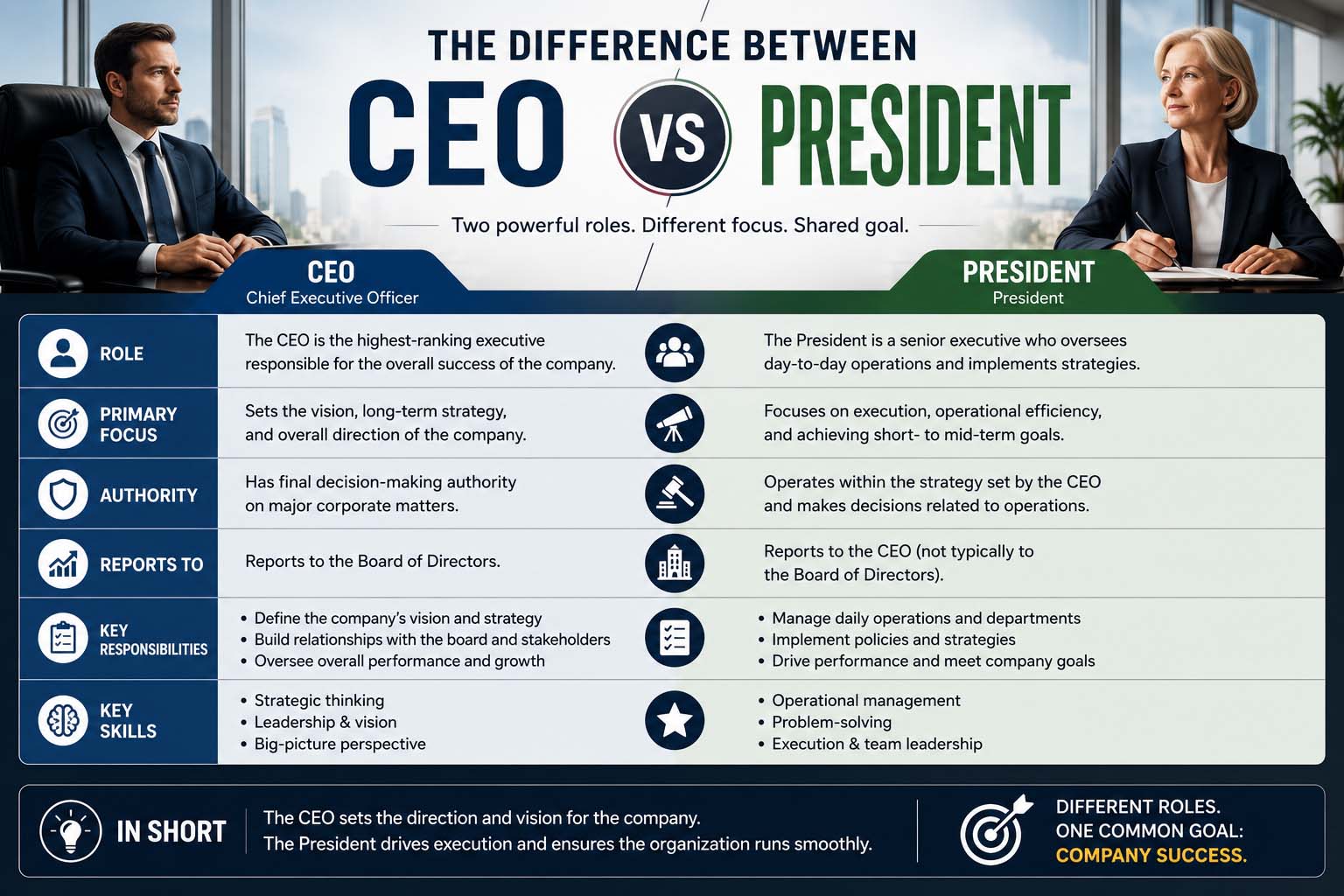
The short answer is that the CEO usually focuses on the company’s long-term vision, growth, and overall strategy, while the president is responsible for leading day-to-day operations and making sure business plans are carried out effectively. Although their responsibilities sometimes overlap, each role serves a distinct purpose within an organization.
Whether you’re an entrepreneur, business student, job seeker, or simply curious about corporate leadership, understanding these positions will help you better interpret how businesses are managed.
Difference Between CEO and President: A Quick Overview
The difference between CEO and president becomes much easier to understand when you think about strategy versus execution.
A Chief Executive Officer (CEO) is generally the highest-ranking executive in a company. This person establishes long-term goals, represents the business to investors and stakeholders, and works closely with the board of directors.
The president typically manages the company’s daily operations. They oversee departments, coordinate leadership teams, monitor performance, and ensure the company’s strategy is being successfully implemented.
While both executives work toward the same business goals, they approach those goals from different perspectives.
| CEO | President |
|---|---|
| Sets long-term company vision | Oversees daily operations |
| Reports to the board of directors | Often reports to the CEO |
| Focuses on business growth | Focuses on execution |
| Represents the company externally | Leads internal business functions |
| Makes strategic decisions | Manages operational performance |
The exact reporting structure varies depending on the organization’s size and ownership.
What Is the Difference Between CEO and President?
Many professionals ask, what is the difference between CEO and president, especially when reviewing company leadership pages or executive job titles.
Although responsibilities vary from business to business, most organizations follow a similar structure.
The CEO Leads the Organization
The CEO is responsible for determining where the company is headed.
Their work often includes:
- Developing long-term strategy
- Making high-level financial decisions
- Building relationships with investors
- Working with the board of directors
- Approving major acquisitions or expansions
- Protecting the company’s reputation
- Leading executive leadership
Since the CEO carries ultimate responsibility for company performance, they must constantly evaluate opportunities, risks, and changing market conditions.
Strong CEOs also understand what is the difference between leadership and management, because inspiring an organization requires more than supervising employees. They must influence culture while helping executives move toward shared objectives.
The President Runs Daily Operations
The president focuses on execution.
Instead of asking where the company should be five years from now, the president asks what needs to happen this month or this quarter to achieve those long-term goals.
Common responsibilities include:
- Supervising department leaders
- Improving operational efficiency
- Monitoring company performance
- Managing budgets
- Coordinating executive teams
- Implementing company policies
- Solving operational challenges
Because presidents spend more time inside the business, they often work closely with managers across multiple departments.
The CEO’s Role in Business Strategy
The CEO’s responsibilities extend beyond supervising employees.
Their primary objective is creating sustainable business growth.
This often involves:
- Entering new markets
- Approving major investments
- Evaluating competitors
- Building strategic partnerships
- Leading innovation
- Managing organizational change
The CEO also serves as the public face of the company.
Large corporations expect their CEOs to communicate with shareholders, speak at industry events, meet with investors, and guide public messaging during major announcements.
Their decisions influence every part of the organization, even if they aren’t directly involved in daily operations.
The President’s Role in Business Operations
If the CEO creates the roadmap, the president makes sure the journey stays on schedule.
Presidents oversee the systems that keep businesses running efficiently.
Typical areas include:
- Sales performance
- Customer service
- Human resources
- Manufacturing
- Operations
- Supply chain management
- Department coordination
Rather than focusing on broad corporate strategy every day, presidents concentrate on measurable performance.
For example, if the CEO announces international expansion, the president develops hiring plans, coordinates department leaders, establishes timelines, and monitors progress throughout the project.
This operational focus helps organizations turn strategic ideas into measurable results.
Difference Between President and CEO in Different Businesses
The difference between president and CEO isn’t identical across every company.
Business size, ownership, and corporate governance all influence executive responsibilities.
Large Public Companies
Most publicly traded corporations separate both positions.
The CEO serves as the highest-ranking executive.
The president oversees internal operations while reporting to the CEO.
Senior vice presidents and department executives often report to the president.
This structure allows each executive to focus on their area of expertise while improving accountability throughout the organization.
Small Businesses
Many small businesses don’t need separate executive positions.
The owner often serves as:
- CEO
- President
- Founder
- Managing Director
Combining roles reduces complexity and speeds up decision-making.
As businesses grow, owners frequently divide responsibilities by appointing a president or chief operating officer.
Family-Owned Businesses
Family businesses sometimes split executive responsibilities between family members.
One individual may oversee long-term growth while another manages daily operations.
This arrangement allows each executive to focus on their strengths without duplicating responsibilities.
Can the Same Person Be Both CEO and President?
Absolutely.
Many companies combine both titles.
This is especially common among:
- Startups
- Small businesses
- Founder-led companies
- Closely held corporations
Combining both positions often allows faster decision-making because fewer executives are involved in approvals.
However, as organizations become larger and more complex, separating the positions usually improves efficiency.
Each executive gains more time to focus on specialized responsibilities instead of balancing every aspect of leadership.
Who Has More Authority?
One of the most common questions people ask is, what is the difference between president and CEO when it comes to authority.
In most companies, the CEO has greater organizational authority.
The CEO typically:
- Leads the executive team.
- Reports directly to the board of directors.
- Makes final strategic decisions.
- Approves major investments.
- Oversees corporate performance.
The president usually has authority over business operations but remains accountable to the CEO when both positions exist.
That doesn’t mean the president has less influence.
In many organizations, the president plays a critical role in company success because operational execution determines whether strategic goals become reality.
How CEOs and Presidents Work Together
Successful organizations rely on strong collaboration between executive leaders.
A simple example illustrates the relationship.
Imagine a software company planning to expand into Europe.
The CEO may:
- Approve the expansion.
- Secure funding.
- Meet with investors.
- Establish long-term growth targets.
Meanwhile, the president may:
- Build operational teams.
- Hire regional managers.
- Coordinate product launches.
- Monitor performance.
- Ensure departments stay on schedule.
Instead of competing with one another, both executives contribute different strengths that help the company achieve shared objectives.
Leadership Skills Both Roles Need
Although their responsibilities differ, CEOs and presidents share many of the same leadership qualities.
Successful executives are typically skilled in:
- Strategic thinking
- Communication
- Decision-making
- Financial management
- Problem-solving
- Team building
- Emotional intelligence
- Adaptability
While the CEO often looks years ahead, the president ensures today’s decisions support tomorrow’s goals. Both roles require the ability to motivate teams, respond to changing market conditions, and make informed business decisions.
As companies grow, executive teams often revisit their business level strategy to ensure daily operations continue supporting long-term objectives.
Why Companies Separate the CEO and President Roles
Many organizations intentionally separate these positions because doing so creates a more balanced leadership structure.
Some of the biggest advantages include:
Better Strategic Focus
The CEO can dedicate more time to planning future growth instead of becoming involved in operational details.
Stronger Operational Management
The president can focus on improving efficiency, solving internal challenges, and supporting department leaders without being distracted by investor meetings or board responsibilities.
Clear Accountability
Employees understand who is responsible for long-term strategy and who oversees execution, reducing confusion throughout the organization.
Faster Decision-Making
Operational decisions often don’t require CEO approval when authority has been delegated to the president.
Common Misunderstandings About CEOs and Presidents
Several myths continue to create confusion about executive titles.
Every Company Has Both Positions
Not true.
Many businesses operate successfully with only a CEO, while others use only the title of president.
Smaller companies often combine both roles under one individual.
The President Always Reports to the CEO
This is common, but it’s not universal.
Some organizations have unique governance structures where both executives report directly to the board of directors.
CEOs Manage Every Employee
In reality, CEOs rarely supervise employees directly.
Instead, they lead through senior executives, while presidents and department leaders oversee daily management.
Real-World Example
Imagine a manufacturing company preparing to launch a new product line.
The CEO works with the board to approve the investment, evaluates market opportunities, secures financing, and communicates the company’s long-term vision to shareholders.
The president, meanwhile, coordinates production schedules, manages supply chain operations, oversees department leaders, and ensures the product reaches customers on time.
Both executives contribute to the same objective, but each focuses on different aspects of achieving it.
If leadership wants an outside perspective before entering a new market, hiring a business strategy consultant can provide valuable insights. Even then, it’s the CEO and president who decide how to apply those recommendations within the organization.
Common Mistakes When Comparing the Roles
Many people misunderstand executive leadership because they focus only on job titles.
Here are some common mistakes to avoid.
Assuming Titles Mean the Same Thing Everywhere
Companies define executive roles differently.
Always review an organization’s leadership structure before assuming responsibilities.
Believing the CEO Handles Every Decision
Most CEOs delegate operational work to experienced executives so they can concentrate on strategic priorities.
Ignoring Company Size
The larger the business, the more specialized executive roles usually become.
A startup founder may perform every executive responsibility, while a multinational corporation distributes those duties across several senior leaders.
How Organizational Structure Influences These Roles
A company’s structure often determines how much authority each executive has.
For example:
- In startups, founders often act as CEO and president.
- In medium-sized businesses, responsibilities are gradually divided.
- In large corporations, executive duties become highly specialized.
Organizational growth usually creates a greater need for clearly defined leadership responsibilities.
The president often works closely with managers responsible for supervising different types of employees, ensuring each department has the resources and direction needed to meet company goals.
Building Alignment Across the Organization
One of the CEO’s biggest responsibilities is ensuring every employee understands where the company is headed.
That vision becomes much easier to communicate when leadership creates a clear organizational purpose.
Many businesses begin this process by learning how to write a mission statement, since a well-crafted mission helps executives align long-term strategy with everyday decision-making.
Once employees understand both the mission and company priorities, presidents can more effectively translate those goals into operational plans.
Frequently Asked Questions
What’s the difference between CEO and president?
The CEO generally leads the company’s long-term strategy, while the president manages day-to-day business operations and ensures those strategies are successfully executed.
Is the CEO always above the president?
In most organizations, yes. The CEO is typically the highest-ranking executive and often supervises the president when both roles exist.
Can one person be both CEO and president?
Yes. This is common in startups, small businesses, and founder-led companies where one executive manages both strategic and operational responsibilities.
Does every company need both positions?
No. Many organizations function effectively with only one executive title, especially during their early stages of growth.
Which role works more closely with employees?
The president usually has more direct interaction with department leaders and operational managers, while the CEO focuses more on company-wide strategy, external relationships, and board governance.
Key Takeaways
Understanding the difference between CEO and president helps business owners, employees, students, and aspiring executives better understand how organizations operate. In most companies, the CEO focuses on vision, growth, investor relationships, and major strategic decisions, while the president oversees daily operations and turns those strategies into measurable results.
Although responsibilities vary between organizations, the relationship between these roles is complementary rather than competitive. Businesses perform best when strategic leadership and operational execution work together. Whether a company combines both titles or separates them, clearly defining responsibilities improves accountability, supports better decision-making, and creates a stronger foundation for long-term success.