
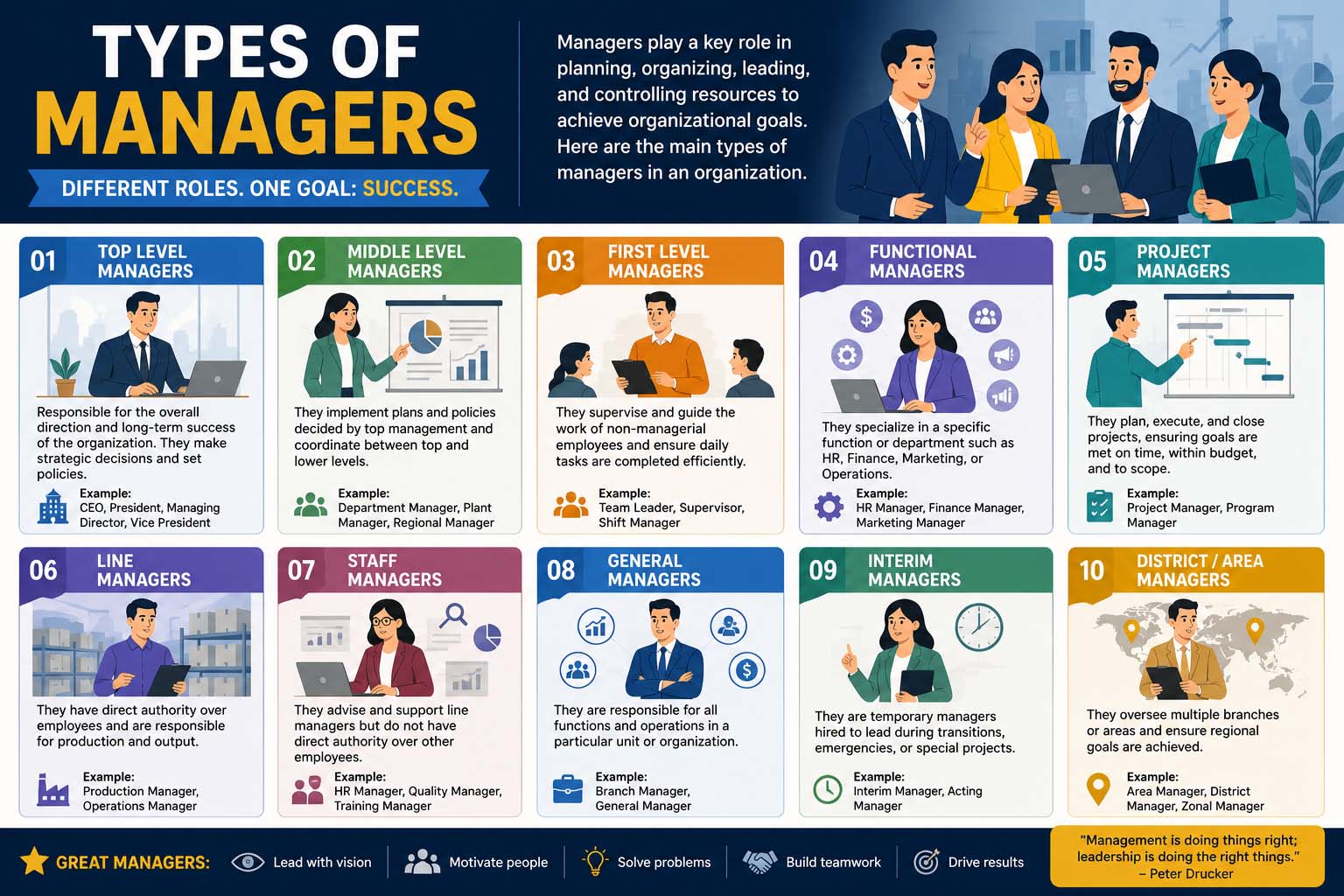
Types of Managers: Understanding Management Roles in Modern Businesses
Every successful business relies on effective management, but not all managers perform the same job. The types of managers found within an organization can differ by management level, department, responsibility, and business size.
Some managers make strategic decisions for an entire company, while others supervise departments, projects, products, or frontline employees. Understanding the different management roles helps business owners create clearer organizational structures, employees understand career paths, and future managers prepare for greater responsibility.
Whether you’re studying business, launching a company, or planning your next promotion, this guide explains the different kinds of managers and how their responsibilities fit together.
What Are Managers?
Managers are professionals responsible for planning, organizing, leading, and controlling resources to achieve business objectives. Their responsibilities can include supervising employees, making decisions, solving problems, setting goals, allocating resources, and monitoring performance.
The U.S. Bureau of Labor Statistics describes management occupations as roles that establish plans and policies, direct business activities, and oversee people, products, and services.
Although every organization is structured differently, managers generally help connect organizational goals with the employees and resources needed to achieve them.
Understanding what is the difference between leadership and management also helps clarify these responsibilities. Management generally emphasizes planning, organization, coordination, and execution, while leadership often places greater emphasis on vision, influence, and motivation.
Types of Managers in Management
One of the easiest ways to understand management is to separate managers according to organizational level.
The three broad levels commonly discussed are:
- Top-level managers
- Middle managers
- First-line managers
However, companies also employ functional, general, project, and product managers. Therefore, there is no universal list of exactly four manager types that applies to every organization.
Top-Level Managers
Top-level managers make strategic decisions that can affect the entire organization.
Common positions include:
- Chief Executive Officer (CEO)
- Chief Operating Officer (COO)
- Chief Financial Officer (CFO)
- President
- Executive Director
Their responsibilities can include:
- Setting company goals
- Developing long-term strategies
- Managing organizational growth
- Approving major investments
- Establishing important policies
- Representing the business publicly
These managers generally concentrate on the overall direction of the organization rather than supervising individual daily tasks.
For readers comparing executive positions, understanding the difference between CEO and president explains how responsibilities can vary between senior leadership roles.
Middle Managers
Middle managers connect senior leadership with lower management and operational teams.
Typical roles include:
- Department managers
- Regional managers
- Division managers
- Branch managers
- Operations managers
For example, executives might decide that a company should expand into a new region. A regional or department manager may then turn that strategy into staffing plans, budgets, targets, and operational priorities.
As a result, middle managers often translate broad company strategy into practical action.
They may also monitor performance, allocate resources, coordinate departments, and communicate organizational changes throughout the business.
First-Line Managers
First-line managers directly supervise employees responsible for everyday operational work.
Examples include:
- Team leaders
- Shift supervisors
- Store managers
- Production supervisors
- Customer service supervisors
These managers are usually closer to frontline employees than senior or middle management.
Therefore, their responsibilities frequently include assigning work, monitoring performance, providing feedback, resolving everyday problems, and helping employees meet operational goals.
Because they interact closely with staff, first-line managers can also influence employee development and workplace culture.
Types of Managers by Business Function
Another way to classify managers is according to the department or function they oversee.
A large company may have separate managers for operations, human resources, marketing, sales, finance, and technology. In contrast, one manager in a smaller company may handle several of these responsibilities.
Operations Manager
Operations managers focus on keeping business processes running efficiently.
Their responsibilities often include:
- Improving workflows
- Managing production
- Reducing unnecessary costs
- Monitoring quality
- Coordinating departments
- Allocating operational resources
Operations managers are particularly important in industries such as manufacturing, logistics, healthcare, and retail.
Human Resources Manager
Human resources managers oversee employee-related activities.
Their responsibilities may include:
- Recruitment
- Hiring
- Training
- Performance reviews
- Employee relations
- Workplace policies
- Compensation planning
Therefore, HR managers help organizations manage their workforce while supporting company policies and employment requirements.
Marketing Manager
Marketing managers help businesses promote products or services and communicate with target customers.
Typical responsibilities include:
- Campaign planning
- Brand management
- Market research
- Advertising
- Content strategy
- Customer engagement
They frequently collaborate with sales, product, and executive teams to ensure marketing activities support broader business objectives.
Sales Manager
Sales managers lead sales teams and focus on revenue-generating activities.
Their duties can include:
- Setting sales targets
- Coaching representatives
- Monitoring performance
- Building customer relationships
- Forecasting sales
- Reviewing sales results
In addition, sales managers often work closely with marketing and customer service teams.
Financial Manager
Financial managers oversee important areas of an organization’s financial activities.
They may manage:
- Budgets
- Financial reports
- Cash flow
- Investment planning
- Risk management
- Cost control
Consequently, financial managers provide information and oversight that can support budgeting, planning, and business decision-making.
Information Technology Manager
IT managers oversee an organization’s technology systems and related resources.
Responsibilities may include:
- Network security
- Software systems
- Technical support
- Cloud services
- Cybersecurity
- Technology projects
As businesses become increasingly dependent on digital systems, IT management can also contribute to strategic planning and operational continuity.
Types of Project Managers
Unlike managers responsible for permanent departments, project managers focus on completing specific projects within defined objectives, timelines, resources, and budgets.
Examples include:
- Construction project manager
- Software project manager
- Engineering project manager
- Healthcare project manager
- Marketing project manager
- Event project manager
For example, a software project manager might coordinate developers, designers, budgets, milestones, and deadlines for a new application.
A construction project manager, meanwhile, may coordinate contractors, schedules, materials, budgets, and project requirements.
Therefore, organizations may employ different project-management roles depending on their industry and the work being completed.
Types of Product Managers
Product management roles can also vary according to the organization, market, and product.
Common roles include:
- Technical product manager
- Digital product manager
- Growth product manager
- Platform product manager
- Consumer product manager
- Enterprise product manager
Product managers generally guide a product’s direction while balancing customer needs, technical requirements, and business objectives.
As a result, they often collaborate with engineering, design, sales, marketing, and executive teams throughout the product lifecycle.
Different Types of Managers in Small vs. Large Companies
Company size can significantly affect management responsibilities.
Small Businesses
Managers in smaller organizations often perform several functions.
For example, an operations manager might also oversee purchasing, employee scheduling, customer service, and other administrative responsibilities.
Therefore, job titles may not fully describe everything a small-business manager actually does.
Large Businesses
Larger organizations generally have more room for specialized management roles.
Instead of one person overseeing several functions, a company might have separate managers for:
- Finance
- Marketing
- Human resources
- Procurement
- Operations
- Technology
- Sales
This structure allows managers to develop deeper expertise within a particular business function.
Key Skills Different Types of Managers Need
Although responsibilities vary, many management positions depend on similar core skills.
These include:
- Communication
- Decision-making
- Problem-solving
- Time management
- Conflict resolution
- Strategic thinking
- Delegation
- Emotional intelligence
- Adaptability
- Coaching
However, the importance of individual skills can change according to management level.
For instance, first-line managers may spend more time coaching employees and solving immediate operational problems. Senior executives, on the other hand, may spend more time on strategic decisions, resource allocation, and organizational direction.
Technical expertise can be valuable, but managers also need the interpersonal skills required to communicate expectations and coordinate people effectively.
Management Responsibilities Compared
| Manager Type | Primary Focus | Typical Team |
|---|---|---|
| Top-Level Manager | Company strategy | Entire organization |
| Middle Manager | Department coordination | Multiple teams |
| First-Line Manager | Daily supervision | Frontline employees |
| Operations Manager | Process efficiency | Operations staff |
| HR Manager | Workforce management | HR department |
| Marketing Manager | Brand and promotion | Marketing team |
| Sales Manager | Revenue growth | Sales representatives |
| Financial Manager | Budget and reporting | Finance department |
| IT Manager | Technology systems | IT professionals |
| Product Manager | Product direction | Cross-functional teams |
| Project Manager | Project delivery | Project teams |
This comparison shows why the phrase “manager” can describe very different responsibilities depending on the organization.
Matching Managers With Different Types of Employees
Effective management also depends on understanding the types of employees within an organization.
Experienced professionals may work effectively with greater autonomy, while new employees may benefit from structured coaching, clear expectations, and regular feedback.
Similarly, different employees may respond differently to communication, delegation, and supervision.
Managers who adapt their approach while maintaining clear standards can support stronger working relationships and more consistent performance.
Common Challenges Managers Face
Regardless of their position, managers frequently balance several responsibilities at the same time.
Common challenges include:
- Managing conflicting priorities
- Resolving employee disputes
- Meeting deadlines
- Motivating teams
- Handling organizational change
- Managing budgets
- Supporting employee development
For example, a manager may need to meet an urgent deadline without overloading employees or reducing quality.
Therefore, effective communication, prioritization, planning, and delegation are important across many management roles.
Best Practices for New Managers
Moving into management requires more than technical expertise.
New managers should:
- Set clear expectations.
- Listen actively.
- Delegate responsibilities appropriately.
- Hold regular one-on-one meetings.
- Recognize employee achievements.
- Provide constructive feedback.
- Continue developing leadership skills.
- Build trust through consistency.
In particular, new managers should avoid assuming they need to personally complete every important task.
Delegating appropriate responsibilities allows employees to develop while giving managers more time for planning, coordination, and decision-making.
How Managers Support Business Strategy
Managers play an important role in translating organizational objectives into practical work.
For example, executives may establish a Business Level Strategy focused on expanding into new markets.
Department managers can then create operational plans, assign responsibilities, allocate resources, monitor progress, and adjust workflows to support that strategy.
Meanwhile, first-line managers can help ensure employees understand the specific tasks and performance expectations connected with those plans.
In this way, different management levels can connect long-term business strategy with everyday execution.
Work Environments Influence Management Roles
Management approaches can also change depending on the workplace.
A manufacturing facility, technology startup, hospital, retail store, or nonprofit organization can present very different challenges and expectations.
Understanding different types of work environments can help managers adjust communication, decision-making, scheduling, and supervision to match the needs of their teams.
For example, managing a distributed remote team may require different communication processes from supervising employees working together on a production floor.
Therefore, adaptability remains valuable across many management positions.
Common Mistakes New Managers Make
First-time managers often face a difficult transition from completing their own work to becoming responsible for the performance of other people.
Common mistakes include:
- Trying to do everything yourself
- Avoiding difficult conversations
- Micromanaging employees
- Failing to delegate
- Giving unclear instructions
- Ignoring employee feedback
- Focusing only on short-term results
For example, micromanagement can limit employee autonomy, while inadequate supervision can leave employees without enough direction.
Finding the appropriate balance usually requires experience, communication, and regular feedback.
Frequently Asked Questions
What are the main types of managers?
Managers can be classified in several ways. By organizational level, the broad categories are top-level, middle, and first-line management. Companies also employ functional managers such as operations, HR, marketing, sales, financial, and IT managers, as well as project and product managers.
What are the types of managers in management?
The most common classification by organizational level includes top-level managers, middle managers, and first-line managers. Organizations can then classify managers further according to function, department, project, product, or area of responsibility.
What are the different types of managers in a company?
A company may employ executive managers, department managers, frontline managers, operations managers, HR managers, marketing managers, sales managers, financial managers, IT managers, project managers, and product managers. The exact structure depends on the company’s size and needs.
Are there 4 types of managers?
There is no single universal four-type classification that applies to every organization. Management roles can be grouped by organizational level, business function, scope of responsibility, or other frameworks. When discussing organizational hierarchy, a common approach is to distinguish top-level, middle, and first-line management.
What do project managers do?
Project managers coordinate resources, schedules, budgets, responsibilities, and milestones to help complete specific projects according to their defined objectives.
What’s the difference between product managers and project managers?
Product managers generally focus on the direction and ongoing success of a product. Project managers coordinate temporary initiatives with defined objectives, resources, schedules, and completion requirements.
What type of manager should a company hire?
That depends on the organization’s needs. A growing business with operational problems might need an operations manager, while a company expanding its workforce may need stronger HR management. Larger organizations commonly use several specialized management roles.
Building a Strong Management Career
Understanding the types of managers makes it easier to see how organizations coordinate people, resources, operations, and strategy.
Top-level managers concentrate on organizational direction. Middle managers connect strategy with departments and teams. First-line managers oversee everyday work. Meanwhile, functional, product, and project managers provide specialized management for particular areas of the business.
If you’re planning a management career, focus on developing communication, decision-making, problem-solving, delegation, and adaptability alongside your technical knowledge.
Ultimately, job titles and responsibilities vary between organizations. However, managers at every level contribute by coordinating resources, supporting employees, solving problems, and helping the organization work toward its objectives.