
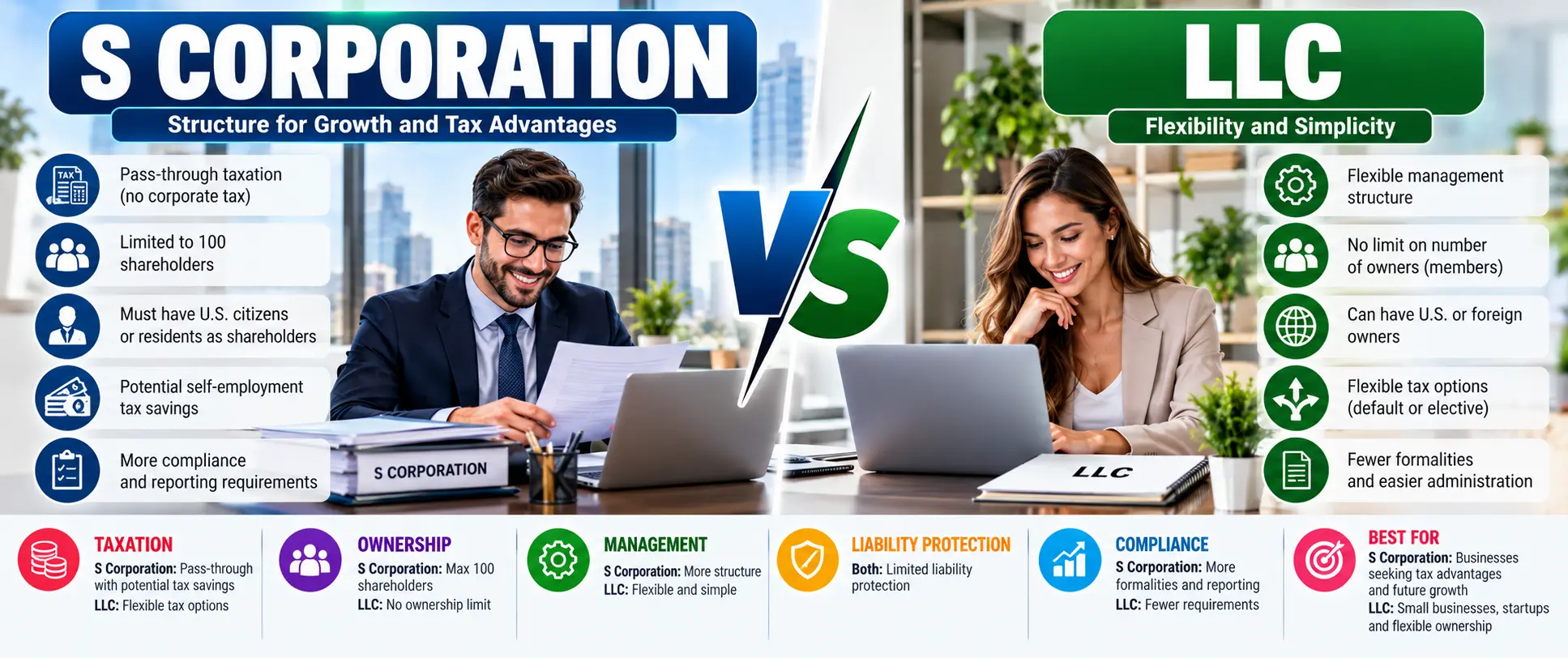
S Corporation vs LLC: What Business Owners Need to Know
Choosing between an S corporation vs LLC can feel confusing because the two terms do not describe exactly the same thing. An LLC is a legal business structure created under state law, while an S corporation is generally a federal tax classification available to qualifying corporations and LLCs. As a result, an LLC can potentially elect S corporation tax treatment while remaining an LLC under state law.
That distinction changes the way business owners should approach the comparison. Instead of asking which label sounds better, consider liability protection, taxes, management, ownership rules, payroll obligations, administrative work, and long-term growth plans.
What Is an LLC?
It creates legal separation between the business and its owners, who are usually called members.
As a result, members generally receive personal liability protection from business debts and claims, although guarantees, misconduct, and certain other circumstances can create personal exposure.
LLCs are also known for management flexibility. Depending on state law and the operating agreement, members may manage the company themselves or appoint managers.
Tax treatment can vary as well. taxed as a partnership. However, eligible LLCs can elect corporate tax treatment.
If you are still learning what is an llc and how does it work, understanding this distinction between the legal entity and its tax classification makes later comparisons much easier.
What Is an S Corporation?
An S corporation is not simply another version of an LLC. Instead, “S corporation” commonly refers to a business that has elected taxation under Subchapter S of the Internal Revenue Code and meets the applicable eligibility requirements.
Eligible corporations can make the election. Likewise, qualifying LLCs can choose to be treated as corporations for federal tax purposes and elect S corporation status.
S corporations generally use pass-through taxation. Therefore, eligible income, losses, deductions, and credits pass through to shareholders rather than being subject to federal corporate income tax at the entity level in the same way as a C corporation.
However, S corporations have restrictions. For instance, federal rules limit the number and types of shareholders and generally permit only one class of stock, although differences in voting rights may be allowed.
S Corporation vs LLC: Quick Comparison
Although an LLC and S corporation can overlap, several practical differences matter to business owners.
| Feature | LLC | S Corporation Tax Treatment |
|---|---|---|
| Basic concept | State-law business entity | Federal tax election/status |
| Liability protection | Generally yes | Depends on underlying legal entity |
| Pass-through taxation | Usually available | Yes, generally |
| Ownership restrictions | Usually flexible | Federal eligibility restrictions apply |
| Management | Flexible | Corporate requirements depend on underlying entity |
| Payroll for active owner | Depends on tax treatment | Shareholder-employees generally require reasonable compensation |
| Self-employment/payroll tax treatment | Depends on classification | Salary and distributions receive different tax treatment |
| Administrative complexity | Often relatively flexible | Usually requires more tax/payroll compliance |
| Ability to add owners | Flexible under state law/agreement | Subject to S corporation eligibility rules |
Therefore, the LLC vs S corporation decision is often less about forming one entity instead of another and more about choosing the right legal and tax setup.
S Corporation vs LLC: Liability Protection
Both structures can offer strong liability protection when properly formed and maintained.
An LLC generally separates the owners’ personal assets from company obligations. Likewise, a corporation generally creates a separate legal entity from its shareholders.
However, S corporation status itself does not create liability protection. Instead, the underlying legal entity provides that protection.
For example, an LLC that elects S corporation tax treatment remains an LLC under state law. Its liability protection comes from the LLC structure rather than its S election.
Business owners comparing entity structures may also want to understand corporation advantages and disadvantages, since traditional corporations can provide benefits such as continuity and share-based ownership while creating greater governance requirements.
Taxes on LLC vs S Corporation
Taxes are often the main reason business owners research taxes on LLC vs S corporation structures. Still, the answer depends heavily on the LLC’s tax classification, owner participation, income level, state rules, and other circumstances.
How a Default LLC May Be Taxed
For federal income tax purposes, the IRS generally treats a single-member LLC as a disregarded entity unless another classification is elected. Consequently, business activity usually appears on the owner’s federal tax return.
Meanwhile, a domestic LLC with two or more members is generally classified as a partnership for federal tax purposes unless it elects corporate treatment.
Active owners may owe self-employment tax on applicable business earnings under the relevant federal rules.
That flexibility is one reason the benefits of an llc can appeal to small-business owners who want liability protection without automatically adopting corporate-style taxation.
How S Corporation Taxes Work
An S corporation generally passes qualifying income and losses through to shareholders.
However, shareholder-employees who perform services for the company generally must receive reasonable compensation before non-wage distributions are made to them.
Remaining qualifying business profits may then pass through to shareholders without being treated as wages subject to Social Security and Medicare employment taxes in the same way.
That difference can create potential payroll-tax savings in some situations. Still, an S corporation election does not automatically reduce every owner’s tax bill.
Payroll costs, tax preparation, state taxes, reasonable-compensation requirements, and other expenses must also be considered.
Why Reasonable Compensation Matters
Reasonable compensation is one of the most important concepts for an owner actively working in an S corporation.
Suppose a profitable consulting company earns $150,000 before owner compensation. The owner cannot simply label the entire amount as a distribution to avoid payroll taxes.
Instead, if the owner performs substantial services as an employee, the business generally must pay reasonable compensation based on relevant factors such as duties, experience, time spent, and comparable compensation.
Only after handling appropriate wages and payroll obligations should the company consider distributions.
Therefore, business owners should not choose an S corporation solely because they have heard it eliminates self-employment taxes. The actual tax result depends on the numbers and circumstances.
Management and Administrative Differences
A member-managed LLC allows owners to participate directly in running the company. Alternatively, a manager-managed LLC can assign operating authority to selected managers.
State-law corporations typically have a more formal governance system involving shareholders, directors, and officers.
It can generally retain its LLC management framework while following the federal tax requirements associated with the S election.
For owners comparing several structures before forming a company, an LLC vs partnership analysis can also help clarify differences in liability, management, ownership, and taxation.
Ownership Rules Can Affect the Decision
Ownership flexibility can become a major factor when a company expects to add investors.
LLCs generally have broad flexibility over ownership arrangements, subject to state law and their operating agreements.
S corporations face tighter federal eligibility rules. For example, they generally cannot have more than 100 shareholders. Shareholders must also meet eligibility requirements, and certain entities and nonresident aliens generally cannot be shareholders.
Consequently, a business planning to pursue institutional investment or create multiple economic classes of equity may find S corporation restrictions limiting.
By contrast, a small owner-operated company may never encounter these limitations.
S Corporation vs C Corporation vs LLC
The phrase S corporation vs C corporation vs LLC combines legal structures and tax classifications, so understanding the terminology prevents confusion.
A C corporation is generally a corporation taxed under the standard corporate income-tax rules. as taxable dividends.
An S corporation generally passes qualifying income through to shareholders instead.
Meanwhile, an LLC is a state-law entity that can have different federal tax classifications depending on its ownership and elections.
Therefore, a C vs S corporation LLC comparison should consider both layers: first the legal structure, then the tax treatment.
A startup seeking venture capital, for example, may have very different priorities from a local consulting company owned by one person. Funding strategy, equity structure, expected profits, and future ownership all matter.
When an LLC May Make More Sense
An LLC can be attractive when an owner values simplicity and management flexibility.
For example, a new freelance business may have modest profits and no employees. In that situation, adding payroll administration and S corporation tax compliance may provide little practical benefit.
An LLC may also suit businesses that need flexible ownership arrangements that do not fit S corporation eligibility rules.
Similarly, entrepreneurs moving away from operating personally under their own name can first study the difference between sole proprietor and llc to understand how creating a separate legal entity changes liability and administration.
As the business grows, the owner can review whether a different tax election becomes worthwhile.
When S Corporation Tax Treatment May Be Worth Considering
S corporation taxation may become attractive when an eligible business generates enough profit beyond reasonable owner compensation to make the potential tax benefits meaningful.
Consider a service company whose owner actively works in the business. Once the company earns consistent profits, the owner might compare the total cost of default LLC taxation against S corporation treatment.
However, the calculation should include more than potential payroll-tax savings.
The business may need payroll software or a payroll provider, separate tax filings, more accounting support, and stronger recordkeeping. State-level fees or taxes may also change the result.
Therefore, the election tends to make the most sense when expected benefits comfortably exceed the extra administrative and professional costs.
Common Mistakes Business Owners Make
One common mistake is assuming an LLC and S corporation are mutually exclusive. In reality, an eligible LLC can elect S corporation tax treatment.
Another mistake is choosing S status before the business earns enough to justify the extra work. Small tax savings can disappear quickly after payroll, accounting, and filing costs.
Owners also sometimes underestimate reasonable-compensation rules. Paying an artificially low salary while taking large distributions can create tax problems.
Finally, entrepreneurs may focus entirely on federal taxes while ignoring state rules. States can impose separate taxes, filing requirements, franchise fees, or different treatment of S corporations.
Frequently Asked Questions
Is an S corporation better than an LLC?
Not automatically. An LLC provides a legal structure, while S corporation status concerns federal taxation. In fact, an eligible LLC can use S corporation tax treatment. The right setup depends on profits, ownership, management preferences, state rules, and long-term plans.
Can a single-member LLC become an S corporation?
requirements and makes the required elections correctly and on time.
Does an S corporation save more taxes than an LLC?
Sometimes, but not always. Potential savings often depend on how much profit remains after paying reasonable compensation to an owner-employee. Payroll costs, professional fees, state taxes, and other expenses also affect the calculation.
Does an LLC need payroll?
Not necessarily. Payroll requirements depend on how the LLC is taxed and whether it has employees. However, when an LLC elects S corporation treatment and its owner performs services as an employee, reasonable wages and appropriate payroll handling generally become necessary.
Can an S corporation have multiple owners?
Yes. However, S corporations must comply with federal shareholder eligibility requirements, the shareholder limit, and restrictions concerning classes of stock.
Making the Choice Based on Your Business
The S corporation vs LLC decision becomes much easier once you separate legal structure from tax treatment. An LLC can provide liability protection and flexible management, while an S corporation election can change how an eligible business and its owners are taxed.
Start by considering how much the business earns, how actively the owners work in it, whether you plan to add investors, and how much extra administration you are comfortable handling. Then compare estimated taxes and compliance costs under each option.
For a new business with modest profits, keeping a straightforward LLC tax setup may be practical. Meanwhile, as profits increase, reviewing an S corporation election with a qualified tax professional can reveal whether the potential savings justify the extra payroll and compliance work.
Rather than choosing based on a popular label, build the structure around the way your company actually operates today and where you expect it to go next.