
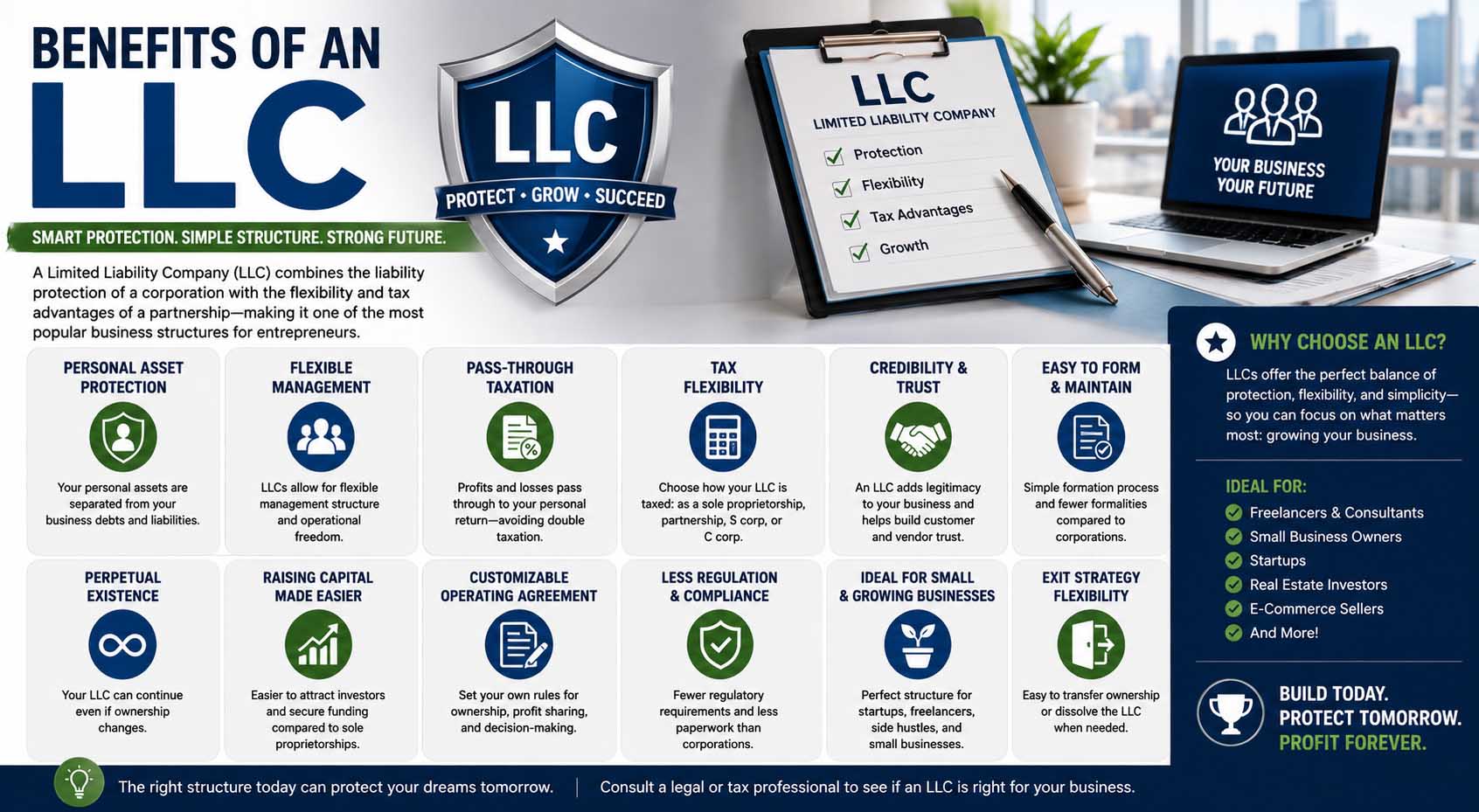
Benefits of an LLC: What Business Owners Should Know
Choosing a legal structure is one of the first major decisions a business owner makes. For many entrepreneurs, the benefits of an LLC make a limited liability company an appealing option. An LLC can help separate business liabilities from an owner’s personal assets while offering flexible management and several choices for federal tax treatment. However, forming one also brings fees, paperwork, and responsibilities that vary by state.
An LLC is not automatically the right structure for every business. Still, understanding how it works can help you compare your options and make a more informed decision.
What Is an LLC?
LLC stands for limited liability company. It is a business structure created under state law in the United States.
An LLC may have one owner, known as a member, or multiple members. Therefore, it can work for solo entrepreneurs as well as businesses owned by several people.
One of its defining features is that the LLC is generally a legal entity separate from its owners. As a result, business obligations normally belong to the company rather than automatically becoming the owner’s personal obligations.
However, liability protection is not unlimited. For example, an owner can still face personal responsibility for their own wrongdoing, certain personally guaranteed debts, or situations in which legal protections are lost.
If you’re deciding whether to remain an individual business owner or create a separate entity, understanding the difference between sole proprietor and llc can make that decision much clearer.
What Are the Benefits of an LLC?
Business owners often choose LLCs because they combine several useful characteristics. In particular, they can provide liability protection without requiring the same corporate structure that some corporations use.
Here is a quick overview:
| LLC Feature | Potential Benefit |
|---|---|
| Limited liability | Helps protect personal assets from many business debts and claims |
| Tax flexibility | Several federal tax classifications may be available |
| Flexible ownership | One or multiple members can own the company |
| Management flexibility | Members can often choose how the company is managed |
| Business identity | Creates a formal legal entity |
| Continuity | The business can operate separately from an owner’s everyday personal affairs |
| Administrative flexibility | Often has fewer corporate formalities than a corporation |
The exact rules depend on the state where the LLC is formed and operates. Therefore, owners should check state requirements rather than assuming every LLC works identically.
Liability Protection Is One of the Biggest Benefits of an LLC
For many entrepreneurs, limited liability is the main reason to consider an LLC.
Suppose you run a home-services company through an LLC. If the company takes on a business debt that it cannot repay, creditors generally pursue the LLC’s assets rather than automatically taking your personal assets simply because you own the company.
That separation can help protect assets such as personal savings or other property from many company liabilities.
However, simply filing LLC paperwork does not make every personal financial risk disappear. Owners should keep business and personal finances appropriately separate, follow applicable legal requirements, and avoid treating company funds as a personal bank account.
Likewise, a lender may ask an owner to personally guarantee a loan. In that situation, the LLC generally does not shield the owner from the obligation created by that personal guarantee.
Tax Benefits of an LLC and Flexible Tax Treatment
The phrase tax benefits of an LLC can be misleading because an LLC does not come with one universal tax system or automatic tax savings.
Instead, one of its main advantages is flexibility.
For federal income tax purposes, a single-member LLC is generally treated as a disregarded entity unless it elects another classification. Meanwhile, a domestic LLC with at least two members is generally treated as a partnership unless it elects corporate treatment.
Eligible LLCs may also choose to be taxed as corporations. In some circumstances, an LLC may qualify to elect S corporation tax treatment.
That flexibility allows owners to consider which tax classification fits their business circumstances.
Still, an S corporation and an LLC describe different concepts. An LLC is a legal entity created under state law, while S corporation status refers to a federal tax election. Therefore, business owners comparing these options should understand the difference between llc and s corp before assuming one is automatically more tax-efficient.
Tax consequences depend heavily on income, payroll, ownership, state rules, deductions, and other circumstances. Consequently, personalized advice from a qualified tax professional can be valuable before making an election.
Benefits of Having an LLC for Business Credibility
Creating an LLC can also make a small operation feel more established.
For instance, customers dealing with “Brightview Design LLC” can immediately see that they are working with a registered business entity. Likewise, suppliers, contractors, landlords, and potential partners may prefer dealing with a formal business.
An LLC can also make organizational tasks easier. For example, an owner can establish business banking arrangements, contracts, accounting records, and other company processes under the business entity.
Still, an LLC does not guarantee credibility by itself. Strong customer service, reliable products, transparent pricing, professional communication, and a good reputation matter far more over time.
Flexible Management for Small Businesses
Corporations may have governance requirements involving shareholders, directors, officers, and other formalities under applicable law. By comparison, LLCs generally offer significant flexibility in how owners structure management.
An LLC can commonly be member-managed or manager-managed.
In a member-managed business, owners participate directly in running the company. In a manager-managed LLC, designated managers handle management responsibilities according to the applicable structure and operating agreement.
This flexibility can be useful as a company grows.
For example, two founders may initially manage the company together. Later, they might appoint a manager to oversee everyday operations while the members focus on strategy.
Businesses with several owners may also consider other structures. In those cases, learning about the benefits of partnership can help entrepreneurs compare different approaches to shared ownership and management.
Benefits of Starting an LLC for a Growing Business
The benefits of starting an LLC can become especially noticeable when a small side business starts becoming a serious operation.
Imagine someone begins selling handmade products on weekends. At first, sales are occasional. However, orders eventually increase, wholesale customers appear, and the owner begins signing supplier agreements.
At that point, separating the company from personal financial activity may become increasingly useful.
An LLC can provide a clearer structure for contracts, bookkeeping, ownership arrangements, and business finances. As a result, it may support more organized operations as the company expands.
However, growth does not automatically mean an LLC is the best choice. Businesses planning to attract certain types of investors, issue stock, or pursue particular financing strategies may prefer a corporate structure.
When comparing entity choices, reviewing corporation advantages and disadvantages can help clarify why some growing companies choose corporations instead.
LLCs Can Have Flexible Ownership
Another advantage is that LLCs can accommodate different ownership arrangements, subject to applicable laws and tax rules.
Meanwhile, an operating agreement can usually establish important rules covering matters such as management responsibilities, voting, distributions, ownership changes, and procedures for resolving certain disputes.
Although requirements vary, having a well-written operating agreement can be useful even when state law does not require one.
For a multi-member business, clear rules become especially valuable. Otherwise, disagreements about responsibilities, money, or decision-making can become harder to resolve.
An LLC Does Not Replace Business Licenses or Insurance
A common mistake is assuming that forming an LLC completes every legal requirement for opening a business.
It does not.
Depending on the business and location, you may still need local, state, or federal licenses, permits, registrations, or professional credentials. Therefore, reviewing the types of business licenses relevant to your industry should be part of the startup process.
Likewise, an LLC should not be treated as a replacement for business insurance.
For instance, a restaurant may need appropriate property and liability coverage, while a consulting company may consider professional liability insurance. Businesses with employees may also face workers’ compensation requirements depending on state law and their circumstances.
An LLC provides a legal structure. Insurance addresses different types of financial risk.
Are There Disadvantages to an LLC?
Despite the benefits, LLCs have costs and limitations.
First, states may charge formation fees. Some also impose annual or periodic fees, taxes, franchise taxes, reporting requirements, or other obligations.
Second, owners must maintain accurate business records and comply with applicable rules. Therefore, creating an LLC can involve more administration than simply operating as a sole proprietor.
Third, taxes can become more complicated as the business grows or changes tax classification. Multi-member businesses may also need more sophisticated accounting and tax preparation.
Finally, LLC rules differ between states. A fee, filing requirement, or tax treatment that applies in one location may not apply in another.
For that reason, entrepreneurs should evaluate the rules that apply specifically to their state and business activities.
Common LLC Mistakes New Owners Should Avoid
Forming an LLC is only the beginning. Afterward, owners need to operate the business responsibly.
One common mistake is mixing personal and business money unnecessarily. Instead, maintaining clear financial records can make bookkeeping, tax preparation, and business management much easier.
Another mistake is ignoring ongoing state requirements. Depending on the jurisdiction, an LLC may need periodic reports, fees, registered-agent information, or other filings.
Owners also sometimes assume their LLC protects them from every possible lawsuit or debt. Yet limited liability has boundaries, so good contracts, appropriate insurance, careful operations, and professional advice remain valuable.
Finally, avoid choosing a tax election simply because another business owner says it saved them money.
Who Should Consider an LLC?
An LLC may be worth considering for freelancers, consultants, online sellers, contractors, family businesses, real estate businesses, service providers, and many other entrepreneurs.
Before forming one, ask yourself:
- Does the business expose me to meaningful liability?
- Will there be one owner or several?
- How do I want the business taxed?
- What does my state charge LLCs?
- Will I hire employees?
- Do I expect outside investors?
- What licenses and insurance will I need?
- How much administrative work can I reasonably manage?
These questions can reveal whether the benefits outweigh the extra costs and responsibilities.
FAQs About the Benefits of an LLC
Does an LLC protect my personal assets?
An LLC generally helps separate an owner’s personal assets from many debts and liabilities of the business. However, protection has limits. Personal guarantees, an owner’s own wrongful acts, and certain failures to respect the company’s separate legal status can create personal exposure.
Does an LLC automatically reduce taxes?
No. Forming an LLC does not automatically lower your tax bill. Instead, LLCs offer flexibility in federal tax classification. Your actual tax outcome depends on factors such as income, ownership structure, tax elections, state rules, and business expenses.
Can one person form an LLC?
Yes. A single-member LLC has one owner and is widely used by solo business owners.
Is an LLC better than a sole proprietorship?
Not in every situation. An LLC generally offers liability separation that a sole proprietorship does not provide. However, a sole proprietorship is typically simpler to start and maintain. Costs, risk, taxes, and future plans should guide the choice.
Do I need a lawyer to start an LLC?
State requirements vary, and many owners handle straightforward formations themselves. However, legal guidance can be helpful when an LLC has multiple owners, complicated ownership arrangements, significant assets, investor considerations, or unusual contractual needs.
Making the Right Business Structure Decision
The benefits of an LLC can be attractive for entrepreneurs who want personal liability protection, flexible management, a formal business identity, and choices in federal tax treatment. At the same time, an LLC brings filing costs, ongoing responsibilities, and state-specific rules.
Before filing, compare the LLC with realistic alternatives rather than choosing it simply because it is popular. Then, check your state’s current formation and compliance requirements and consider speaking with a qualified attorney or tax professional when legal or tax questions affect your decision.
A business structure works best when it matches how you operate today while leaving enough flexibility for where you want the company to go next.