
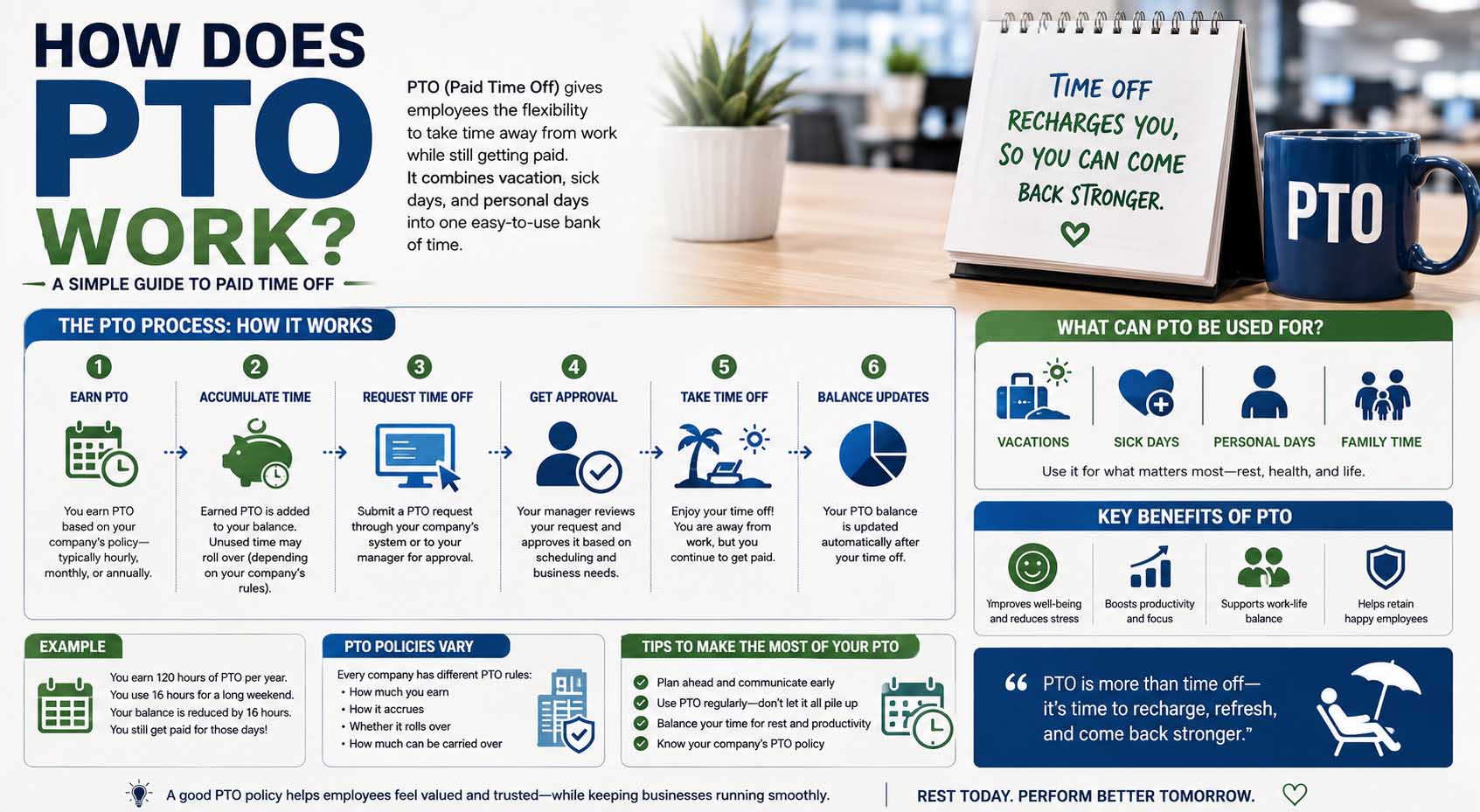
How Does PTO Work? A Complete Guide to Paid Time Off
You see 40 hours of PTO listed in your employee portal, but what exactly can you do with those hours? If you are wondering how does PTO work, the basic idea is simple: paid time off allows eligible employees to take approved time away from work while continuing to receive pay. However, the way employees earn, request, carry over, and use PTO depends on the employer’s policy and applicable laws.
Some companies provide a fixed number of days each year. Others let employees earn PTO gradually as they work. Meanwhile, a growing number of workplaces use flexible or unlimited PTO policies.
Because the rules can vary so much, understanding your company’s specific policy is just as useful as understanding PTO itself.
What Is PTO?
PTO stands for paid time off. In many workplaces, it refers to a pool of paid leave employees can use for approved absences.
Depending on the employer, PTO might cover vacation days, personal time, and some short-term absences. However, employers may also maintain separate categories for vacation, sick leave, holidays, parental leave, or other types of leave.
If you’re unfamiliar with the terminology, understanding what does PTO stand for is a useful starting point because companies sometimes use the term differently.
For example, one employer might give an employee 15 PTO days that can be used for several purposes. Another company may provide 10 vacation days plus a separate sick-leave allowance.
Therefore, employees should always check their handbook or benefits information rather than assuming every PTO policy works the same way.
How Does PTO Work for Employees?
So, how does PTO work in everyday employment?
Usually, an eligible employee receives or earns a certain amount of paid leave. When the employee wants time away, they submit a request according to the employer’s procedure. Once approved, PTO hours are deducted from the employee’s available balance, while the employee generally receives regular pay for the covered time.
Imagine an employee has 64 PTO hours available.
They request one eight-hour workday off. After using the day, their balance falls to 56 hours.
However, employers can set different rules around advance notice, scheduling, eligibility, increments of use, blackout periods, and approval, subject to applicable laws.
Some legally protected forms of leave may also operate separately from an employer’s ordinary PTO approval process.
How Does PTO Accrual Work?
One common system is accrual.
If you’re asking how does PTO accrual work, it means employees gradually earn paid time off instead of receiving the entire annual allowance at once.
For instance, imagine a company lets an employee accrue 120 hours over a year. Instead of placing all 120 hours in the account on January 1, the employer may add a portion during each pay period.
An employee paid twice per month could earn:
120 annual PTO hours ÷ 24 pay periods = 5 hours per pay period
After six pay periods, the employee would have earned 30 hours, assuming none had been used and no other policy rules affected the balance.
The actual calculation varies by employer. Therefore, employees should check their accrual rate rather than using this example as a universal formula.
How Does Accrued PTO Work When You Take Time Off?
When you use accrued PTO, the employer normally subtracts the requested hours from your available balance.
Suppose you have 35 hours available and use eight hours for a day off. Your new balance would generally be 27 hours.
Meanwhile, you may continue accruing additional time during future pay periods if the company’s policy allows it.
Some employers also set an accrual cap. For example, once an employee reaches a specified maximum balance, additional PTO may stop accumulating until the employee uses some existing hours.
This approach encourages employees to take leave while limiting the amount of unused PTO the company carries on its records.
Front-Loaded PTO vs Accrued PTO
Not every employer makes workers earn PTO gradually.
Some organizations use front-loaded PTO, meaning eligible employees receive their available allowance at the beginning of a benefit year or another defined period.
Here is a simple comparison:
| PTO System | How It Generally Works | Key Consideration |
|---|---|---|
| Accrued PTO | Time builds gradually | Balance grows as the employee works |
| Front-loaded PTO | A defined allowance becomes available upfront | More leave may be available earlier |
| Unlimited PTO | No traditional fixed annual bank | Requests still follow company rules |
| Separate leave banks | Vacation and other leave are tracked separately | Each category can have different rules |
Neither approach is automatically better.
For employees, front-loading can provide more flexibility early in the year. For employers, accrual can spread leave earning across the year and tie available PTO more closely to service.
How Does PTO Work for Hourly Employees?
Another common question is how does PTO work for hourly employees?
Hourly employees can receive PTO, although eligibility and accrual methods depend on employer policies and applicable law.
For example, an employer may calculate PTO based on hours worked. Another may provide a set accrual rate during each pay period.
Suppose an hourly employee normally works eight hours on Monday and uses eight approved PTO hours that day. Those PTO hours may replace the wages the employee otherwise would have earned for the scheduled time, based on the employer’s rules.
However, PTO should not automatically be treated as overtime hours worked. Overtime calculations are governed by applicable wage-and-hour laws, and paid leave may be treated differently from hours actually worked.
Eligibility can also vary based on employment classification. Understanding the difference between part time and full time can help employees see why two workers at the same company may receive different benefit packages.
How Does Unlimited PTO Work?
Under a traditional PTO policy, employees have a defined balance. Under an unlimited policy, there is generally no fixed annual bank of vacation hours to accumulate in the same way.
So, how does unlimited PTO work?
Employees typically request time away when needed, while managers evaluate requests according to company procedures, staffing needs, performance expectations, and any other applicable rules.
Despite the name, unlimited PTO does not usually mean employees can disappear whenever they want for any length of time.
Companies may still require:
- Manager approval
- Advance notice
- Adequate workload coverage
- Completion of essential responsibilities
- Compliance with attendance policies
- Reasonable scheduling around business needs
A clear policy matters because vague unlimited PTO can leave employees unsure about how much leave is actually acceptable.
Managers should therefore communicate expectations consistently rather than relying on unwritten rules.
Can PTO Be Used for Sick Days?
Sometimes.
Some employers combine vacation, personal time, and certain sick absences into one PTO bank. Others maintain separate sick-leave programs.
Local or state laws may also require particular sick-leave benefits or impose rules on how qualifying leave is earned and used.
As a result, an employee should not assume that every illness must be covered from a general vacation-style PTO balance.
Check the employee handbook, HR portal, employment agreement, and applicable local requirements when necessary.
What Happens to Unused PTO?
This is one of the areas where company policies and local laws can make a major difference.
Depending on the situation, unused PTO may:
- Carry into the next year
- Carry over only up to a limit
- Stop accruing after reaching a cap
- Be handled under another policy permitted by applicable law
Employees should pay close attention to year-end rules.
For instance, imagine you have 50 unused hours but your employer allows only 40 hours to carry forward. What happens to the remaining balance depends on the policy and the laws governing the employment relationship.
Therefore, reviewing your balance before the end of a benefit year can prevent surprises.
What Happens to Unused PTO When You Leave a Job?
Whether unused PTO is paid when employment ends depends on factors such as where the employee works, the employer’s written policy, the nature of the PTO plan, and applicable law.
In some jurisdictions, accrued vacation may need to be paid at separation under certain circumstances. Elsewhere, different rules may apply.
The reason for leaving can sometimes matter as well.
For example, policies may address resignation, retirement, termination, or failure to provide required notice differently where legally permitted.
Employees who have a substantial unused balance should review the policy before making assumptions about a final paycheck.
Different Employees May Have Different PTO Rules
Businesses employ people under many arrangements, so benefits are not always identical across the workforce.
The various types of employees within an organization may include full-time, part-time, temporary, seasonal, and other classifications. Eligibility for employer-provided benefits can differ among these groups, although legal requirements still apply.
A company might allow full-time employees to accrue PTO immediately while making another eligible group follow a different schedule.
Length of service can matter too.
For example, an employer could provide a higher annual accrual rate after an employee reaches a service milestone. This type of structure rewards tenure while keeping the basic PTO system consistent.
How to Request PTO Properly
Even when you have enough PTO available, you may still need approval before taking ordinary vacation time.
First, check the company’s notice requirements.
A workplace might request two weeks’ notice for planned vacations, while another organization may use a scheduling system with different rules.
Next, check your available balance before making plans.
Then submit the request through the correct channel, such as an HR platform, scheduling application, email, or manager approval system.
If your role involves ongoing projects, prepare a basic coverage plan. Let coworkers know about deadlines, provide essential information, and deal with urgent tasks before leaving.
However, emergency and legally protected absences may follow different procedures, so employees should use the appropriate policy for their circumstances.
Why PTO Policies Matter to Businesses
PTO is not simply an administrative benefit. It also affects scheduling, payroll, staffing, employee experience, and workforce planning.
A clear policy helps managers answer practical questions consistently.
Employees should know:
- Who qualifies for PTO?
- When does accrual begin?
- How is PTO earned?
- How can leave be requested?
- Can unused time carry over?
- Is there an accrual cap?
- How are holidays handled?
- What happens when employment ends?
Clear answers reduce confusion for both managers and employees.
Some growing companies use internal HR teams to administer these policies, while others explore the benefits of HR outsourcing when payroll, benefits administration, compliance support, and other HR responsibilities become more complex.
Regardless of who administers the program, workers should have easy access to the rules that affect their leave.
Common PTO Mistakes Employees Make
One mistake is assuming that having PTO automatically guarantees approval for any requested vacation date.
Employers still need to maintain staffing and business operations, although legally protected leave may involve separate requirements.
Another mistake is waiting until the end of the year to check the balance. If a policy includes carryover limits or accrual caps, early planning can provide more options.
Employees also sometimes confuse PTO with every other form of leave.
Bereavement leave, parental leave, jury duty, disability-related leave, legally protected family or medical leave, and company holidays may operate under separate policies.
Finally, avoid relying on a coworker’s experience as proof of your own eligibility. Different classifications, locations, hire dates, contracts, or policy versions can produce different results.
Management Tips for a Fair PTO Policy
Employers should write policies in plain language and apply them consistently.
First, explain eligibility and accrual clearly. Then show employees where they can view their balances and request time away.
Managers also need training.
If one manager routinely approves vacation while another rejects similar requests without a clear business reason, employees may view the system as unfair.
Businesses should also plan for busy seasons rather than simply discouraging leave. Cross-training employees and setting reasonable notice requirements can help maintain coverage.
At the same time, leaders should avoid creating a workplace where employees technically receive PTO but feel unable to use it.
A benefit has limited practical value if workers believe taking reasonable time away will damage their careers.
Frequently Asked Questions About PTO
Is PTO always paid?
PTO generally refers to paid time away from work. However, the amount of pay, eligibility requirements, and qualifying uses depend on the policy and applicable laws.
Do you earn PTO while using PTO?
It depends on the employer’s accrual rules. Some policies may allow accrual during paid leave, while others calculate accrual differently. Check your specific plan.
Can an employer deny PTO?
Employers may often manage ordinary vacation requests based on scheduling and policy requirements. However, certain absences may be protected by federal, state, or local laws and should not be treated as ordinary discretionary vacation requests.
Can Employees Use PTO Before It Is Earned?
Some employers allow employees to use advanced or negative PTO, while others limit employees to their current balance. The employee handbook should explain the rule.
Does PTO reset every year?
Not necessarily. Some policies allow unused hours to carry forward, while others use caps or different year-end arrangements where permitted. Applicable laws may restrict how employers handle accrued vacation.
Is unlimited PTO really unlimited?
Usually, unlimited PTO means there is no traditional fixed annual vacation bank. Employees still follow request procedures, performance expectations, and reasonable scheduling requirements established by the employer.
Making Your PTO Work for You
Once you understand how does PTO work, managing your available time becomes much easier. Start by learning whether your company uses accrual, front-loading, unlimited PTO, or separate leave banks. Then check the rules for requesting time, carryover, accrual caps, and employment separation.
Employees should review their PTO balance regularly instead of waiting until they need time away. Meanwhile, managers should make policies easy to understand and apply them fairly across eligible workers.
Most of all, never assume that another company’s PTO rules apply to yours. Your employee handbook, HR department, employment agreement, and applicable employment laws are the best places to confirm the details that affect your specific situation.