
What Does PTO Stand For? Meaning in the Workplace, School, and More
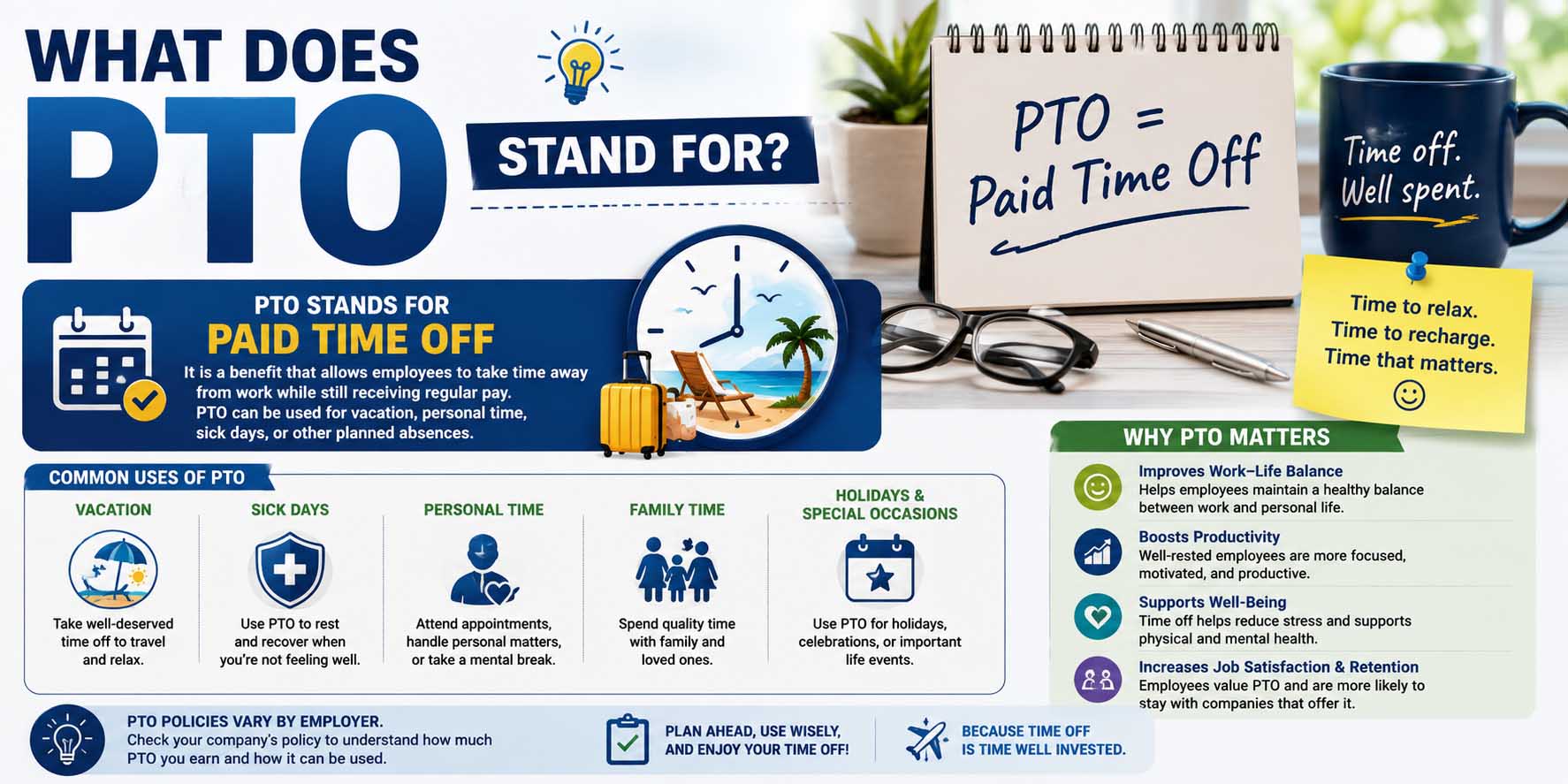
You see “PTO” in a job offer, employee handbook, or benefits portal—but what does PTO stand for? In most workplace situations, PTO means paid time off. It refers to time employees can take away from work while continuing to receive their regular pay. Depending on the employer, PTO may cover vacations, personal days, illness, appointments, or other approved absences. However, PTO has several other meanings outside the workplace, including Parent Teacher Organization in schools and power take-off on tractors and other machinery.
For employees, understanding PTO makes it easier to evaluate compensation and plan time away from work. Meanwhile, employers need clear policies so workers understand how time is earned, requested, used, and handled when employment ends.
What Does PTO Stand For in the Workplace?
When someone asks what does PTO stand for in the workplace, the answer is usually paid time off.
Paid time off is an employee benefit that allows eligible workers to take approved time away from their jobs without losing their regular wages for those hours or days.
However, companies structure PTO differently. Some combine vacation, sick, and personal time into one bank. Others maintain separate categories.
For example, an employee might receive 15 days of general PTO each year. The employee could potentially use those days for a vacation, a personal appointment, or illness, subject to the company’s rules.
Another employer might provide 10 vacation days, five sick days, and two personal days separately.
Neither system is automatically better. Instead, employees should compare the amount of leave, flexibility, eligibility rules, and restrictions.
PTO policies can also vary among different types of employees, since full-time, part-time, temporary, seasonal, and other workers may have different eligibility under company policies and applicable laws.
How Does Paid Time Off Work?
PTO seems simple until you look at how employers actually administer it.
Companies generally need to answer several questions: How much time does an employee receive? When does it become available? Does unused time carry over? What happens when someone leaves the company?
The answers depend on company policy and applicable laws.
PTO Accrual
Some employees earn PTO gradually.
For example, an employer might provide a certain number of PTO hours for each pay period or based on hours worked. As a result, an employee’s available balance increases throughout the year.
Other employers provide the entire annual allowance at the beginning of a calendar year, benefit year, or employment anniversary.
Requesting Time Off
Having PTO available does not always mean an employee can take any day off without approval.
Employers commonly establish a request process. For instance, employees may submit planned vacation dates through HR software and wait for a manager to approve them.
Meanwhile, unexpected illness may follow a different notification process.
Clear procedures help managers maintain staffing levels while giving employees a predictable way to request leave.
PTO vs. Vacation Time vs. Sick Leave
The terms are sometimes used interchangeably, but they don’t always mean exactly the same thing.
| Type of leave | Common purpose | Usually paid? |
|---|---|---|
| PTO | Vacation, personal needs, illness, or other approved reasons | Yes |
| Vacation time | Planned leisure or travel | Usually |
| Sick leave | Illness, medical needs, or qualifying family care | Often, depending on policy and law |
| Personal day | Personal obligations | Usually |
| Unpaid leave | Approved absence after or outside paid benefits | No |
A combined PTO system gives employees greater flexibility because they can decide how to use their available days. However, a separated system can protect sick leave so employees don’t feel pressured to save every available day for vacation.
Employees should read the actual policy rather than assuming that PTO and vacation mean the same thing at every company.
Does Everyone Get PTO?
No. Access to paid time off depends on the employer, employment arrangement, location, and applicable laws.
However, states and local jurisdictions may have requirements involving paid sick leave or other forms of leave.
Employers may also voluntarily provide PTO as part of their compensation package.
Full-time employees commonly receive broader benefit packages than some part-time workers, although this isn’t universal. Therefore, understanding the difference between part time and full time can help job seekers compare not only working hours but also potential benefits and leave eligibility.
Workers should check their employer’s policy and local employment rules rather than assuming one national PTO standard applies everywhere.
Common Types of PTO Policies
Businesses can structure paid leave in several ways. Consequently, two companies advertising “generous PTO” may provide very different benefits.
Traditional Accrued PTO
Under an accrued system, employees earn time gradually.
This approach can make labor costs and staffing easier to manage. However, employees who recently started a job may have limited paid time available.
Some companies increase accrual rates after employees reach certain service milestones.
Front-Loaded PTO
A front-loaded policy makes a defined amount of PTO available at the beginning of the benefit period.
For example, an eligible employee could receive 15 days on January 1 rather than earning those days gradually.
This system is straightforward for employees. Still, employers need clear rules for new hires and workers who leave partway through the year.
Unlimited PTO
Some companies use unlimited or flexible PTO policies instead of giving employees a fixed annual number of days.
However, “unlimited” doesn’t necessarily mean employees can take unlimited vacations whenever they want. Requests still need to comply with company policies, workload expectations, performance requirements, and manager approval.
Employers using this model need a healthy workplace culture as well. Otherwise, employees may actually take less time because they don’t know what amount is considered acceptable.
Why Businesses Offer Paid Time Off
PTO is more than an administrative benefit. When designed well, it can support both employees and business operations.
First, competitive benefits can help employers attract candidates. Salary remains a major consideration, yet applicants often compare vacation allowances, health benefits, flexible work options, and other parts of total compensation.
Paid time away from work can also give employees opportunities to rest, handle personal responsibilities, and return to work refreshed.
Meanwhile, clear leave policies can improve workforce planning. Managers know how requests should be submitted, while employees understand expectations before making travel or personal plans.
For smaller organizations without a large internal HR department, understanding the benefits of hr outsourcing can also be useful when deciding how to administer payroll, leave policies, compliance processes, and employee benefits.
How Employers Can Build a Clear PTO Policy
A good PTO policy should answer practical questions before employees need to ask them.
Start by defining who is eligible. For example, specify whether the benefit applies to full-time employees, part-time workers, or other categories.
Next, explain how PTO becomes available. If employees accrue hours each pay period, show the accrual method clearly.
Then, describe the request and approval process. Employees should know how far in advance to request planned leave and whom to contact when an absence is unexpected.
The policy should also explain:
- Annual PTO allowance or accrual rate
- Eligibility and waiting periods
- How employees request time
- Manager approval requirements
- Carryover rules
- Maximum accrual limits, if any
- Treatment of holidays
- Rules for unexpected absences
- Whether PTO can become unpaid leave
- How unused balances are handled when employment ends, subject to applicable law
Businesses should review policies against the employment laws that apply in each location where they have workers.
PTO Carryover and Use-It-or-Lose-It Rules
One of the biggest employee questions is what happens to unused PTO at the end of the year.
Some employers allow employees to carry a certain amount into the next year. For instance, a worker might carry over up to five unused days.
Other policies limit the amount an employee can accumulate.
Meanwhile, some employers may use “use-it-or-lose-it” approaches where legally permitted. Because state laws can restrict how accrued vacation or PTO is forfeited, employers should verify local requirements before creating these rules.
Employees should check their handbook rather than waiting until December to discover that their balance is subject to a deadline or cap.
What Happens to PTO When You Leave a Job?
Whether unused PTO must be paid when employment ends depends on the company’s policy and applicable state law.
In some jurisdictions, earned vacation or PTO may be treated in ways that affect whether an employer can forfeit it. Elsewhere, the employer’s written policy may play a larger role.
As a result, neither employers nor employees should assume the same rule applies nationwide.
Before resigning, employees can review their latest PTO balance and employee handbook. Employers, meanwhile, should apply their policy consistently and verify that it complies with relevant laws.
Managing PTO as a Growing Business
PTO administration becomes more complicated as a company grows.
A small business with five employees may track leave manually. However, that approach can become unreliable once the workforce expands across departments or locations.
HR software can help record accruals, available balances, requests, approvals, and absence calendars. Meanwhile, standardized processes reduce the chance that employees receive inconsistent information from different managers.
Companies that don’t want to manage these processes internally may consider Human Resources Outsourcing Services for selected administrative responsibilities. However, employers still need to understand their obligations and ensure that outsourced policies fit their workforce and legal requirements.
Good administration also requires communication. Employees shouldn’t have to search through several systems just to discover how many days they have available.
Common PTO Mistakes Employers Should Avoid
An unclear policy creates unnecessary confusion. If employees don’t understand whether PTO includes sick leave, for example, managers may receive the same questions repeatedly.
Another mistake is approving leave inconsistently. When similar requests receive different treatment without a legitimate business reason, employees can view the system as unfair.
Employers should also avoid treating every absence issue as merely a PTO question. Some absences may involve protected leave, disability accommodations, sick-leave laws, or other legal requirements.
Finally, businesses should not copy another company’s policy without checking local law. A policy that works for an employer in one state may create problems for a business operating elsewhere.
What Does PTO Stand For in School?
The abbreviation has a completely different meaning in education.
If you’re asking what does PTO stand for in school, it commonly means Parent Teacher Organization.
A school PTO is generally a group involving parents, guardians, teachers, and sometimes other school community members. Depending on the organization, it may support school events, fundraising, volunteer programs, classroom activities, or community-building projects.
People also search what does PTO stand for school when they encounter the abbreviation on newsletters or event announcements. In that context, it normally has nothing to do with employee vacation benefits.
A PTO may resemble other parent-school organizations, although its structure and affiliation can vary.
What Does PTO Stand For on a Tractor?
In agriculture and machinery, PTO means power take-off.
If you’re wondering what does PTO stand for on a tractor, it refers to a system that transfers mechanical power from the tractor’s engine to compatible equipment.
For example, a PTO can power certain mowers, balers, tillers, and other implements.
This use of PTO has no connection to paid leave. Therefore, context is the easiest way to determine the meaning.
A manager discussing a PTO request almost certainly means paid time off. Meanwhile, a farmer discussing PTO speed or a PTO shaft is talking about machinery.
Frequently Asked Questions About PTO
Is PTO the same as vacation?
Not always. Some employers use PTO as one combined bank for vacation, illness, and personal needs. Others maintain vacation and sick leave separately.
Is PTO paid?
When PTO means paid time off, yes. The employee generally receives pay for approved PTO according to the employer’s policy.
Is PTO required by law?
In the United States, federal law generally doesn’t require private employers to provide paid vacation. However, state and local laws may require certain forms of paid sick or other leave. Therefore, businesses need to check the laws that apply to their employees.
Can an employer deny a PTO request?
A PTO balance doesn’t necessarily guarantee approval for every requested date. Employers may have legitimate scheduling and staffing requirements. However, some absences can involve legally protected leave or other rights, so employers need to distinguish ordinary vacation requests from legally protected situations.
Can PTO expire?
Possibly, depending on the employer’s policy and applicable state law. Some employers allow carryover, while others place limits on accrual or usage.
What does PTO mean on a job offer?
It usually means paid time off. Before accepting an offer, ask how many days are provided, whether time accrues, when you become eligible, and whether unused days carry over.
Making PTO Work Better for Employees and Employers
When evaluating a job, don’t stop at the number of PTO days advertised. Instead, find out how those days are earned, what they can be used for, whether they carry over, and how easily employees can actually take them.
Likewise, employers should keep policies clear, accessible, consistent, and compliant with applicable laws. A simple system often works better than a generous-looking benefit surrounded by confusing restrictions.
So, what does PTO stand for? At work, it generally means paid time off; at school, it often means Parent Teacher Organization; and on a tractor, it means power take-off. Once you know the context, the abbreviation becomes much easier to understand.