
Difference Between Part Time and Full Time
Understanding the difference between part time and full time employment is essential when choosing a job or planning your workforce. Although working hours are the most obvious distinction, employment status can also affect income, benefits, scheduling flexibility, and career opportunities.
For employees, the right arrangement depends on financial needs, personal responsibilities, and professional goals. Meanwhile, employers must consider staffing costs, customer demand, and operational requirements.
For example, a college student may prefer flexible part-time shifts, while an experienced professional might prioritize the predictable income of a full-time position. However, neither arrangement guarantees a particular salary, benefit package, or level of job security.
Whether you’re applying for your first job, changing careers, or hiring employees, this guide explains how both employment types work and what to consider before making a decision.
What Is Part-Time Employment?
Part-time employment generally refers to a work schedule with fewer weekly hours than an employer’s standard full-time schedule.
However, no single definition applies to every employer or jurisdiction. Some organizations classify employees who work fewer than 30 hours per week as part-time, while others use different thresholds.
In addition, legal definitions may vary depending on the purpose of a particular employment law.
For example, a company might consider 35 hours a full-time schedule for internal staffing purposes, even though a separate law uses another threshold for benefits eligibility.
Part-time arrangements may include:
- Evening shifts
- Weekend schedules
- Flexible working hours
- Seasonal employment
- Job-sharing arrangements
- Shorter daily shifts
As a result, part-time work can suit people who need income without committing to a standard full-time schedule.
How Many Hours Is a Part-Time Job?
Many part-time positions involve fewer than 30–35 hours per week. However, some employers offer schedules closer to 40 hours while still applying their own employment classifications.
Therefore, applicants should confirm the expected weekly hours directly with the employer.
They should also ask whether the schedule remains consistent or changes according to business demand.
For instance, a retail employee may work 15 hours during a quiet week and 25 hours during a busy shopping period.
What Is Full-Time Employment?
Full-time employment usually involves working an employer’s standard weekly schedule.
In many workplaces, employees work approximately 35–40 hours each week. However, the precise number depends on the organization, industry, employment agreement, and applicable laws.
Full-time positions often involve:
- Regular weekly schedules
- Consistent working days
- Ongoing responsibilities
- Greater involvement in long-term projects
- Access to employer-sponsored benefits, where eligible
In addition, full-time employees may have more opportunities to participate in workplace training and management development.
Nevertheless, full-time status does not automatically guarantee benefits, permanent employment, or a fixed schedule.
Is 40 Hours Always Considered Full-Time?
No. Although many employers use a 40-hour workweek, there is no universal full-time threshold.
For example, the U.S. Fair Labor Standards Act does not establish a general definition of full-time or part-time employment.
The U.S. Department of Labor’s guidance on full-time employment explains that employers generally determine these classifications, subject to other applicable legal requirements.
Therefore, employees should review company policies and local employment regulations rather than assuming every workplace follows the same standard.
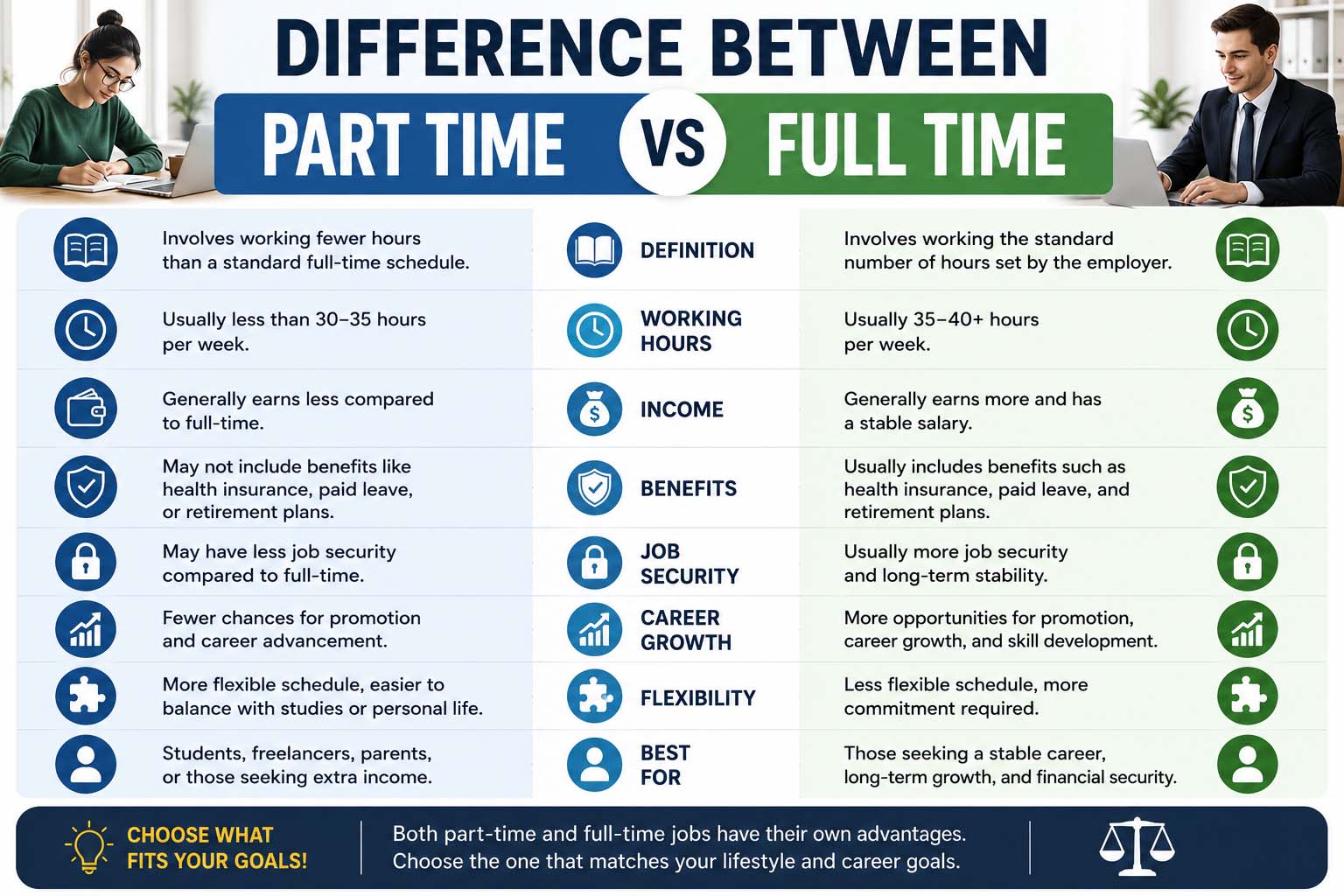
Difference Between Part Time and Full Time: Quick Comparison
The following table summarizes the main differences between these employment arrangements.
| Feature | Part-Time Employment | Full-Time Employment |
|---|---|---|
| Weekly hours | Usually fewer than the employer’s standard schedule | Usually the employer’s standard schedule |
| Work schedule | May be flexible or variable | Often more consistent |
| Total earnings | Often lower because of fewer hours | Often higher because of more hours |
| Hourly pay | Depends on the position | Depends on the position |
| Employee benefits | Eligibility varies | Often broader eligibility |
| Career advancement | Possible, depending on the employer | May offer more development opportunities |
| Work-life balance | Can provide more personal time | May require a greater time commitment |
| Job security | Depends on the employment agreement | Depends on the employment agreement |
Although these patterns are common, individual employers may offer very different arrangements.
For example, a part-time professional might earn a higher hourly rate than a full-time employee in another position.
Therefore, comparing actual job offers provides more useful information than relying on employment labels alone.
How Working Hours, Income, and Benefits Compare
The differences between these arrangements extend beyond the number of hours employees spend at work.
Working Hours and Scheduling
Part-time employees usually work fewer weekly hours.
For example, a student may work three evening shifts, while a full-time office employee follows a five-day schedule.
However, part-time schedules aren’t always flexible. Some employers require employees to work fixed shifts or remain available during specific periods.
Meanwhile, full-time positions may offer flexible schedules, remote work, or compressed workweeks.
Therefore, applicants should ask about actual scheduling expectations instead of assuming that employment status determines flexibility.
Income and Total Earnings
Full-time employees often earn more overall because they work additional hours.
For example, consider two employees who earn $20 per hour:
| Employment Type | Weekly Hours | Weekly Gross Pay |
|---|---|---|
| Part-time | 20 | $400 |
| Full-time | 40 | $800 |
These figures assume the same hourly rate and exclude overtime premiums, deductions, and benefits.
As a result, the full-time employee earns twice as much in this example because they work twice as many hours.
However, hourly wages may differ between positions. In addition, commuting costs and other work-related expenses can affect the financial value of a job.
Employee Benefits
Many employers provide benefits to eligible workers.
These may include:
- Health insurance
- Paid vacation
- Sick leave
- Retirement contributions
- Paid holidays
- Professional development programs
However, eligibility depends on employer policies and applicable laws.
Some part-time workers qualify for certain benefits, while some full-time positions offer limited employer-sponsored coverage.
Therefore, employees should compare the complete compensation package before accepting an offer.
Industries That Commonly Offer Part-Time Jobs
Part-time positions are common in industries where staffing requirements change throughout the day, week, or year.
Examples include:
- Retail
- Hospitality
- Food service
- Education
- Recreation
- Healthcare
- Customer service
For instance, restaurants may hire additional workers for evening and weekend shifts. Similarly, retail stores often increase staffing during seasonal shopping periods.
Healthcare organizations also use different scheduling arrangements to meet patient needs.
Someone exploring Surgical Tech Jobs may find opportunities with different weekly schedules, depending on the hospital, facility, and position.
However, applicants should confirm the actual hours and employment conditions for each vacancy.
Advantages of Part-Time Employment
Part-time work offers several practical benefits, especially for people balancing employment with other commitments.
Greater Scheduling Flexibility
Many employees choose part-time work because it may provide more control over their schedules.
For example, shorter working hours can make it easier to balance:
- College classes
- Family responsibilities
- Personal projects
- Freelance work
- Retirement activities
In addition, some employers allow part-time employees to choose shifts that fit their availability.
However, flexibility varies by workplace, so employees should confirm scheduling policies before accepting a position.
Better Work-Life Balance
Working fewer hours can create more time for personal responsibilities and interests.
For instance, parents may use the additional time for childcare, while students may devote it to studying.
As a result, part-time employment can support a healthier balance between work and personal commitments.
Nevertheless, irregular schedules or multiple part-time jobs can reduce these advantages.
Opportunities to Explore New Careers
Part-time positions allow workers to gain experience without immediately committing to a full-time role.
For example, someone interested in marketing might begin with a part-time assistant position.
Meanwhile, they can continue studying or developing additional skills.
Therefore, part-time employment can provide a practical starting point for career exploration.
Advantages of Full-Time Employment
Full-time employment can offer several benefits for workers seeking consistent income and long-term professional development.
More Predictable Income
A regular work schedule often provides more consistent earnings.
Consequently, employees may find it easier to:
- Plan monthly expenses
- Build emergency savings
- Manage household budgets
- Prepare for retirement
- Evaluate major financial commitments
However, actual income stability depends on the employment agreement and whether the employer guarantees working hours.
Career Development Opportunities
Some organizations provide full-time employees with greater access to training, mentoring, and long-term projects.
For example, employees who participate in ongoing business operations may gain experience managing teams or coordinating major assignments.
As a result, these responsibilities can support professional development.
However, part-time employees can also advance when employers provide suitable opportunities.
Access to Workplace Benefits
Eligible full-time employees may receive health coverage, retirement contributions, paid leave, and other benefits.
In addition, employers sometimes offer professional training or tuition assistance.
Therefore, the overall value of a full-time position may extend beyond its salary.
Nevertheless, employees should verify eligibility and coverage rather than assuming every full-time job includes the same benefits.
Which Employment Arrangement Works Best for Employers?
Businesses often combine part-time and full-time employees to meet different operational needs.
However, the right staffing model depends on customer demand, available resources, and the nature of the work.
When Part-Time Staffing Makes Sense
Part-time staffing may suit businesses that experience:
- Peak shopping hours
- Seasonal demand
- Weekend customer traffic
- Short-term projects
- Variable service requirements
For example, a retail business may need additional employees during weekends without requiring the same staffing levels throughout the week.
As a result, part-time positions can help employers align scheduled hours with customer demand.
However, businesses must still account for training, supervision, payroll administration, and applicable employment requirements.
When Full-Time Staffing Makes Sense
Full-time positions may work better for:
- Leadership responsibilities
- Ongoing administrative tasks
- Long-term projects
- Customer relationship management
- Specialized operational roles
For example, a growing company may benefit from a full-time operations manager who coordinates daily activities.
In addition, consistent staffing can improve communication and accountability.
Therefore, employers should evaluate the responsibilities of each position before deciding how many hours it requires.
Managing a Mixed Workforce
Businesses with both employment types need clear policies for scheduling, payroll, onboarding, and communication.
For instance, managers should explain how employees request time off and how the company assigns shifts.
Organizations experiencing growth may also explore Human Resources Outsourcing Services to support recruiting, payroll administration, and workforce management.
However, outsourcing administrative work does not automatically remove an employer’s legal responsibilities.
Employment Stability During Business Changes
Economic conditions and changing business requirements can affect both part-time and full-time workers.
For example, an employer may reduce scheduled hours when customer demand declines.
In other situations, a business may temporarily suspend work or eliminate positions.
Therefore, employees should understand the difference between a schedule reduction, a furlough, and a layoff.
The guide to Difference Between Furlough and Layoff explains these employment situations and their potential consequences.
In addition, employers should communicate workforce decisions clearly and follow applicable labor laws.
Although full-time employment may provide more predictable hours, it does not guarantee protection against layoffs or business closures.
Real-World Examples of Different Work Schedules
Practical examples can make employment arrangements easier to understand.
Example 1: College Student
A university student works 20 hours each week at a retail store.
For example, the employer schedules shifts during evenings and weekends so the student can attend classes.
As a result, the student earns additional income while maintaining time for academic responsibilities.
In this situation, part-time work may be the better fit.
Example 2: Office Professional
A marketing coordinator works 40 hours each week with a regular Monday-to-Friday schedule.
In addition, the employer provides paid vacation, health insurance, and retirement benefits.
Therefore, the employee receives predictable earnings and a compensation package that supports financial planning.
However, the position also requires a greater weekly time commitment.
Example 3: Healthcare Worker
A healthcare professional may have access to different schedules depending on the employer.
For instance, clinics may hire employees for shorter shifts, while hospitals may require regular full-time coverage.
Someone reviewing the Physical Therapy Assistant Salary Guide can explore compensation considerations before comparing available positions.
Nevertheless, actual pay and scheduling arrangements depend on the employer, location, and responsibilities.
Workplace Productivity and Team Coordination
Productivity matters regardless of how many hours an employee works.
However, businesses should measure performance using meaningful results rather than assuming longer schedules always produce better outcomes.
For example, a part-time employee may complete specialized tasks efficiently during a shorter shift.
Meanwhile, a full-time employee may manage projects that require continuous coordination.
Businesses can use What Is Productivity Software to explore tools for organizing tasks, tracking deadlines, and improving communication.
In addition, clear documentation helps employees understand their responsibilities when different shifts overlap.
As a result, effective management can support collaboration between both types of workers.
Factors to Consider Before Accepting a Job
Before choosing between job offers, compare more than the hourly wage.
Instead, evaluate the complete employment arrangement.
Review the Expected Working Hours
First, ask how many hours the employer expects you to work each week.
Next, confirm whether those hours are guaranteed or may change according to business demand.
For example, a position advertised as 25 hours per week may involve different schedules during busy periods.
Therefore, understanding scheduling expectations can prevent misunderstandings.
Compare Total Compensation
Consider:
- Hourly pay or salary
- Expected weekly earnings
- Health insurance
- Paid leave
- Retirement contributions
- Commuting expenses
- Other work-related costs
For example, a position with slightly lower wages may provide valuable benefits or reduced commuting expenses.
As a result, it may offer greater overall value than a higher-paying alternative.
Consider Career Growth
Ask whether the employer offers:
- Training opportunities
- Mentoring
- Internal promotions
- Professional development
- Opportunities to increase working hours
In addition, find out whether employees can move between part-time and full-time positions.
Therefore, you can evaluate how the job supports your longer-term goals.
Evaluate Your Personal Priorities
Your preferred schedule should fit your lifestyle.
For instance, students may need time for classes, while parents may prioritize family responsibilities.
Meanwhile, someone saving for a major financial goal may prefer a position with more predictable earnings.
Ultimately, the most suitable arrangement depends on your circumstances rather than a universal rule.
Common Misunderstandings About Employment Status
Several misconceptions can make job decisions unnecessarily confusing.
Part-Time Jobs Never Lead to Careers
This assumption is incorrect.
Many workers begin in part-time positions and later move into roles with additional responsibilities.
For example, a retail assistant may gain experience and eventually qualify for a supervisory position.
However, advancement depends on performance, available opportunities, and employer policies.
Full-Time Jobs Always Include Benefits
Not every employer provides the same benefit package.
Although some benefits may depend on legal requirements, others depend on company policies.
Therefore, applicants should review the employment agreement and ask about eligibility.
More Hours Always Mean Better Financial Value
Additional working hours can increase earnings.
However, taxes, commuting expenses, childcare costs, and benefits also affect the overall value of employment.
For example, a worker who increases their weekly hours may also face higher transportation or childcare expenses.
Therefore, comparing total compensation and expenses provides a more complete picture than salary alone.
Common Mistakes When Choosing a Work Schedule
Avoiding a few common mistakes can help employees make better decisions.
Focusing Only on Pay
Higher wages may look attractive initially.
However, benefits, flexibility, and long-term career opportunities can also provide significant value.
Therefore, compare the full employment package before accepting an offer.
Ignoring Personal Responsibilities
A work schedule should support your financial needs without creating unnecessary conflicts with important commitments.
For example, students and caregivers may need predictable availability outside working hours.
As a result, a position with fewer hours may suit them better than a higher-paying job with an unpredictable schedule.
Not Asking About Advancement
Before accepting a position, ask whether employees can move into roles with more hours or greater responsibility.
In addition, find out how the employer evaluates performance and makes promotion decisions.
Therefore, you can better understand the opportunities available after joining the organization.
Assuming Every Employer Uses the Same Definitions
Employment classifications vary between workplaces.
For example, two companies may use different weekly-hour thresholds for internal staffing purposes.
Consequently, employees should confirm the employer’s classification, benefit rules, and scheduling expectations.
Frequently Asked Questions
What Is the Difference Between Full-Time and Part-Time?
The main difference is the number of hours employees work each week.
Full-time employees generally follow an employer’s standard schedule, while part-time employees work fewer hours.
However, benefits, scheduling flexibility, and career opportunities may also differ.
How Many Hours Count as Part-Time?
There is no universal number of hours that defines part-time employment.
For example, some employers classify workers with fewer than 30 hours as part-time, while others use different thresholds.
Therefore, check the employer’s policies and applicable laws.
Can Part-Time Employees Receive Benefits?
Yes. Some employers provide benefits to eligible part-time employees.
However, eligibility depends on the benefit, company policy, and relevant employment laws.
Therefore, employees should ask about coverage before accepting an offer.
Is Full-Time Employment Always Better?
No. The better option depends on individual circumstances.
For example, full-time employment may suit someone who needs predictable income.
Meanwhile, part-time employment may work better for someone balancing education or family responsibilities.
Can a Part-Time Job Become Full-Time?
Yes. Some employers allow employees to move from part-time to full-time positions.
For instance, a business may offer additional hours when demand increases or a new vacancy becomes available.
However, the transition depends on employer requirements and available opportunities.
Which Option Is Better for Students?
Many students prefer part-time employment because it can leave more time for classes and studying.
However, the ideal schedule depends on academic workload, financial needs, and available support.
Therefore, students should choose working hours they can manage alongside their education.
Do Full-Time Employees Always Have Greater Job Security?
No. Employment status alone does not guarantee job security.
Although full-time positions may offer more predictable schedules, employers can still restructure operations or eliminate roles.
Therefore, job stability depends on several factors, including the employment agreement and business conditions.
Choosing the Best Option for Your Situation
Understanding the difference between part time and full time employment helps job seekers compare opportunities and helps businesses plan their workforce more effectively.
If flexibility, education, or family responsibilities are your priorities, part-time employment may offer a suitable arrangement. In contrast, full-time employment may better support workers who want predictable earnings, broader benefits, or sustained involvement in long-term projects.
However, neither option is automatically better for everyone. The right decision depends on your financial needs, personal commitments, and professional goals.
Before making a choice, compare actual working hours, compensation, benefits, and advancement opportunities. As a result, you can select an employment arrangement that supports both your immediate needs and future plans.