
What Is Notice Period? Meaning, Examples, and Workplace Guide
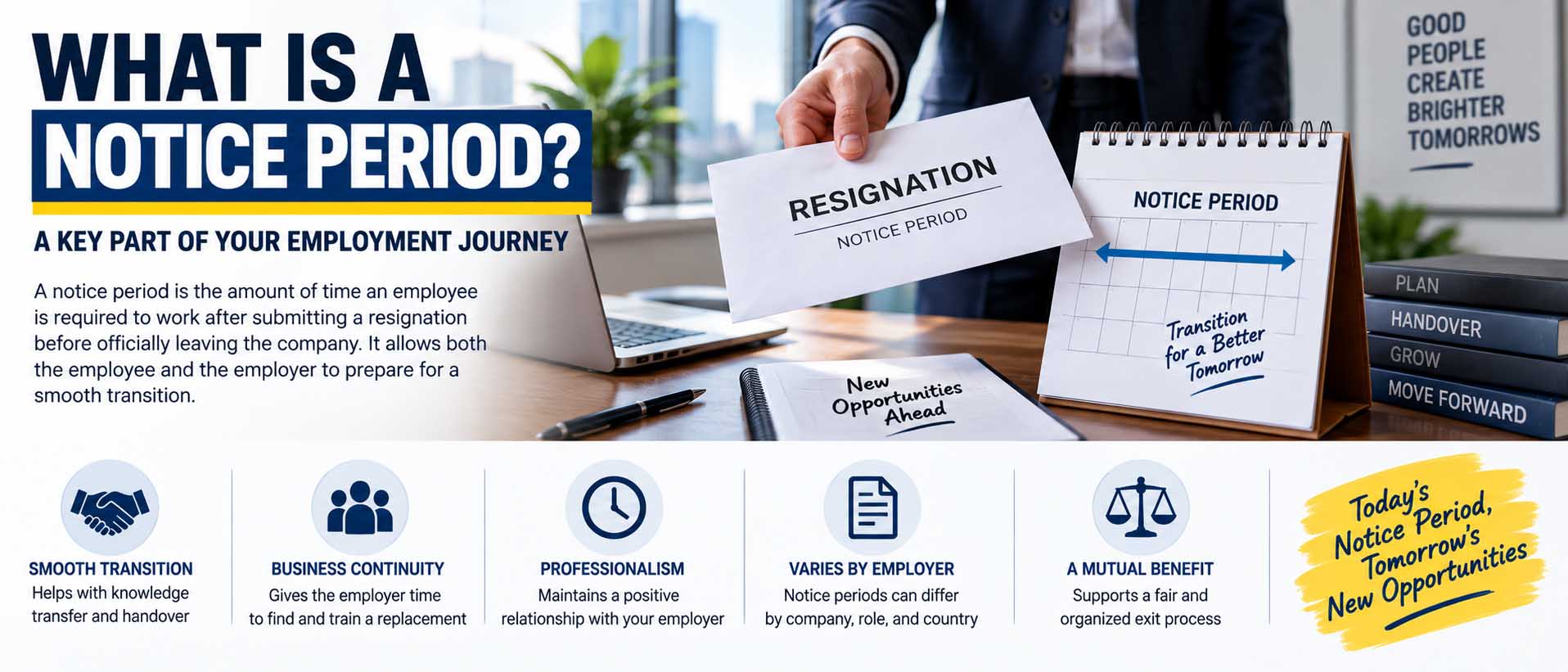
If you are leaving a job or applying for a new one, you may be asked about your notice period. So, what is notice period in simple terms? A notice period is the length of time between formally informing an employer that employment will end and the employee’s final working day. Depending on the employment agreement, company policy, local law, and circumstances, notice may be given by an employee who resigns or by an employer ending employment.
For an employer, that may mean arranging a replacement and transferring responsibilities. For an employee, it provides a defined timeline for leaving the current position and starting the next stage of their career.
What Is Notice Period in a Job?
A notice period is a transition period before employment officially ends. For example, if an employee resigns on June 1 and must provide two weeks’ notice, their final working day would generally fall about two weeks later, subject to the employer’s rules, working schedule, and applicable law.
The required period can come from several sources, including:
- An employment contract
- Company policies
- A collective agreement
- Local employment law
- An agreement between employer and employee
Therefore, employees should check their own employment documents rather than assuming that every workplace follows the same rule.
Notice periods are also different from other employment arrangements. For instance, understanding the difference between part time and full time can help workers recognize that working hours and employment status do not, by themselves, determine every resignation or notice requirement.
Why Do Employers Use Notice Periods?
Notice periods help businesses avoid sudden disruption.
Suppose a project manager resigns while overseeing several client accounts. If the employee disappeared immediately, clients and coworkers might not know the status of projects, deadlines, passwords, files, or upcoming meetings.
With a reasonable transition period, the company can organize a handover.
Meanwhile, employees benefit because notice establishes a more predictable departure process. They can finish essential work, return company property, discuss final administrative matters, and maintain professional relationships.
Still, notice rules are not identical everywhere. Employment laws differ considerably by country and sometimes by state, province, industry, or type of contract.
What Is a Notice Period on a Job Application?
The question what is a notice period on a job application usually refers to how soon you could leave your current employer and start the new position.
For example, an application might ask:
Notice period: ______
If your current contract requires 30 days’ notice, you could usually enter “30 days.” Likewise, if you are not currently employed and can begin immediately, you might state “Available immediately.”
Recruiters ask because they need to plan hiring timelines. A company filling an urgent vacancy may need someone quickly, while another employer may be comfortable waiting several weeks or months for the preferred candidate.
Therefore, answer accurately instead of giving the shortest possible period just to make your application more attractive.
“What Is Your Notice Period?” How to Answer
When a recruiter asks what is your notice period?, they want a practical timeline for your availability.
A straightforward response could be:
“My current employment agreement requires four weeks’ notice, so I would expect to be available approximately four weeks after formally resigning.”
If some flexibility exists, you can mention that without promising something your current employer has not approved.
For example:
“My contractual notice period is four weeks. However, I can discuss my final date with my employer if an earlier transition is necessary.”
This approach gives the recruiter useful information while keeping expectations realistic.
The answer can also depend on employment classification and workplace arrangements. Businesses use different types of employees, and permanent employees, temporary workers, contract workers, and other categories may operate under different agreements and rules.
“What Is Your Availability or Notice Period?” Explained
Another common recruitment question is what is your availability or notice period?
Although the terms are related, they are not exactly the same.
Your availability is the date or timeframe when you can actually start the new job.
For instance, you may have a two-week notice period but want one week between jobs. In that case, your availability could be three weeks after accepting an offer and completing the necessary resignation process.
Other commitments can affect the answer as well. You might have scheduled travel, relocation requirements, professional licensing paperwork, or another obligation before your start date.
As a result, giving recruiters a realistic start date usually works better than simply repeating the contractual notice period.
Common Notice Period Lengths
There is no universal notice period that applies to every worker.
Depending on the jurisdiction, employment contract, seniority, role, and company, a notice period might be:
| Notice Arrangement | Example |
|---|---|
| Immediate | Employment ends without a working notice period where permitted |
| One week | Used in some contracts or employment situations |
| Two weeks | Common professional convention in some workplaces |
| One month | Often written into employment contracts |
| 30 days | A clearly defined calendar-based requirement |
| 60–90 days | Sometimes associated with senior or specialized roles |
| Custom period | Determined by contract, law, or mutual agreement |
These are examples rather than universal legal standards.
Therefore, employees should review their contract and applicable employment rules before resigning. Employers should also make sure their policies comply with the law where their workers are employed.
Employee Resignation vs Employer Termination
Notice can arise when either side ends an employment relationship, but the rules may differ.
When an employee voluntarily resigns, the employment agreement may state how much notice the worker is expected or required to provide.
When an employer terminates employment, different contractual and legal requirements may apply. The employer may have obligations involving notice, pay, benefits, documentation, or other protections.
This is also why the Difference Between Furlough and Layoff matters. A furlough generally involves a temporary reduction or pause in work, while a layoff involves a different employment situation. Neither term should automatically be treated as equivalent to a voluntary resignation with notice.
Because employment law varies by jurisdiction, workers facing termination should check the rules that specifically apply to them.
Notice Period vs Severance Pay
Notice and severance are related to employment separation, but they are not interchangeable.
A notice period concerns the time between notice and the end of employment. Severance generally refers to compensation that may be provided when employment ends under qualifying circumstances.
Whether a worker receives severance depends on factors such as local law, employment agreements, employer policies, tenure, and the reason for separation.
Consequently, the answer to do you get severance if you get fired cannot be determined simply by knowing that an employee was terminated. Eligibility needs to be assessed according to the specific employment situation and applicable rules.
Likewise, notice pay, severance pay, accrued vacation, and a final paycheck can represent different obligations.
Can You Leave Before Your Notice Period Ends?
Sometimes an employee wants to leave sooner than the required date.
The best first step is usually to speak with the employer. In some cases, both parties may agree to shorten or waive part of the notice period.
For example, an employee might have a 30-day contractual requirement but ask to leave after 20 days. The employer could agree if the employee completes a satisfactory handover.
However, workers should not assume they can simply ignore a contractual requirement. Leaving early could have contractual, financial, professional, or legal consequences depending on the circumstances and jurisdiction.
Therefore, review the contract and get any agreed change to the departure date documented appropriately.
What Happens During a Notice Period?
Most employees continue performing their normal duties while serving notice.
However, the employer may place greater emphasis on transition work. Common tasks include:
- Completing priority projects.
- Documenting ongoing responsibilities.
- Updating files and records.
- Transferring knowledge to coworkers.
- Introducing a replacement to key contacts.
- Returning equipment and company property.
- Completing exit procedures.
A good handover can protect both your professional reputation and your former team from unnecessary confusion.
Employees should also clarify final-pay arrangements. Depending on the situation, they may need information about salary, unused leave, benefits, expenses, bonuses, or separation payments. When severance applies, understanding a typical severance package can provide useful context, although actual packages vary widely.
How to Resign Professionally
Once you understand your required notice period, plan the resignation carefully.
Check Your Employment Agreement
First, review the section covering resignation and termination.
Look for the required notice length, how notice must be delivered, and any special conditions. Also check relevant company policies.
Speak With Your Manager
Where practical, tell your manager directly before the news spreads through the workplace.
Keep the conversation professional and concise. You do not need to provide a long explanation unless you want to.
Submit Written Notice
Next, provide a written resignation if your contract or workplace process requires it.
Clearly state that you are resigning and specify your proposed final working day.
Prepare a Handover
Then, organize your projects, deadlines, contacts, and responsibilities.
A simple handover document can save your team considerable time after you leave.
Confirm Your Final Arrangements
Finally, ask HR or your manager about your final paycheck, unused leave, benefits, equipment returns, and any other exit requirements.
Should Employers Negotiate Notice Periods?
Sometimes flexibility benefits both sides.
For example, an employee who has completed all essential handover work may not need to remain for the entire original period if the employer agrees to an earlier departure.
In another case, a company may ask a departing specialist to stay slightly longer while a replacement is trained. The employee can then decide whether to accept the request.
However, any change should respect the employment contract and applicable law.
Businesses should also apply policies consistently. Uneven treatment can create confusion among employees and increase management problems.
Common Notice Period Mistakes
Employees sometimes resign before checking their contracts. As a result, they may promise a new employer a start date that conflicts with an existing obligation.
Another mistake is assuming a verbal conversation automatically satisfies formal notice requirements. Some agreements require written notice.
Likewise, employees may stop putting effort into their work after resigning. Yet professional performance during the final weeks can influence references and future relationships.
Employers can make mistakes too. For example, managers may assume company policy overrides employment law or contractual obligations. HR teams should review both the contract and current legal requirements before making separation decisions.
Finally, neither side should rely on general internet advice when a specific legal dispute is involved. Employment rules vary, so professional guidance may be appropriate for complicated cases.
FAQs About Notice Periods
Do I have to work during my notice period?
Often, yes. Employees commonly continue working until their final date. However, the exact arrangement depends on the contract, employer decision, applicable law, and any agreement between the parties.
Is two weeks always the standard notice period?
No. Two weeks is a familiar convention in some workplaces, particularly in the United States, but it is not a universal requirement. Your actual obligation may be shorter or longer.
Can an employer refuse my resignation?
Generally, resignation involves an employee communicating their decision to end employment, but the rules governing notice and the effective termination date depend on the applicable jurisdiction and contract. Check local requirements if a dispute arises.
Can I negotiate my notice period?
Potentially. An employer and employee may be able to agree on a different departure date, subject to the employment agreement and applicable law.
Should I mention my notice period during an interview?
Yes, if the recruiter asks when you can start. Giving an accurate timeframe helps the employer plan the hiring process and prevents confusion later.
Leave With a Clear Plan
Understanding what is notice period helps employees manage one of the most common transitions in working life. Before accepting a new start date, check your employment contract, company policies, and any relevant legal requirements.
Then, communicate clearly with both employers. Give accurate information about your availability, complete a professional handover, and confirm your final employment arrangements in writing where appropriate.
A well-managed notice period does more than establish your last day. It gives both sides time to prepare, protects professional relationships, and makes the transition to the next role much smoother.