
What Is a Floating Holiday?
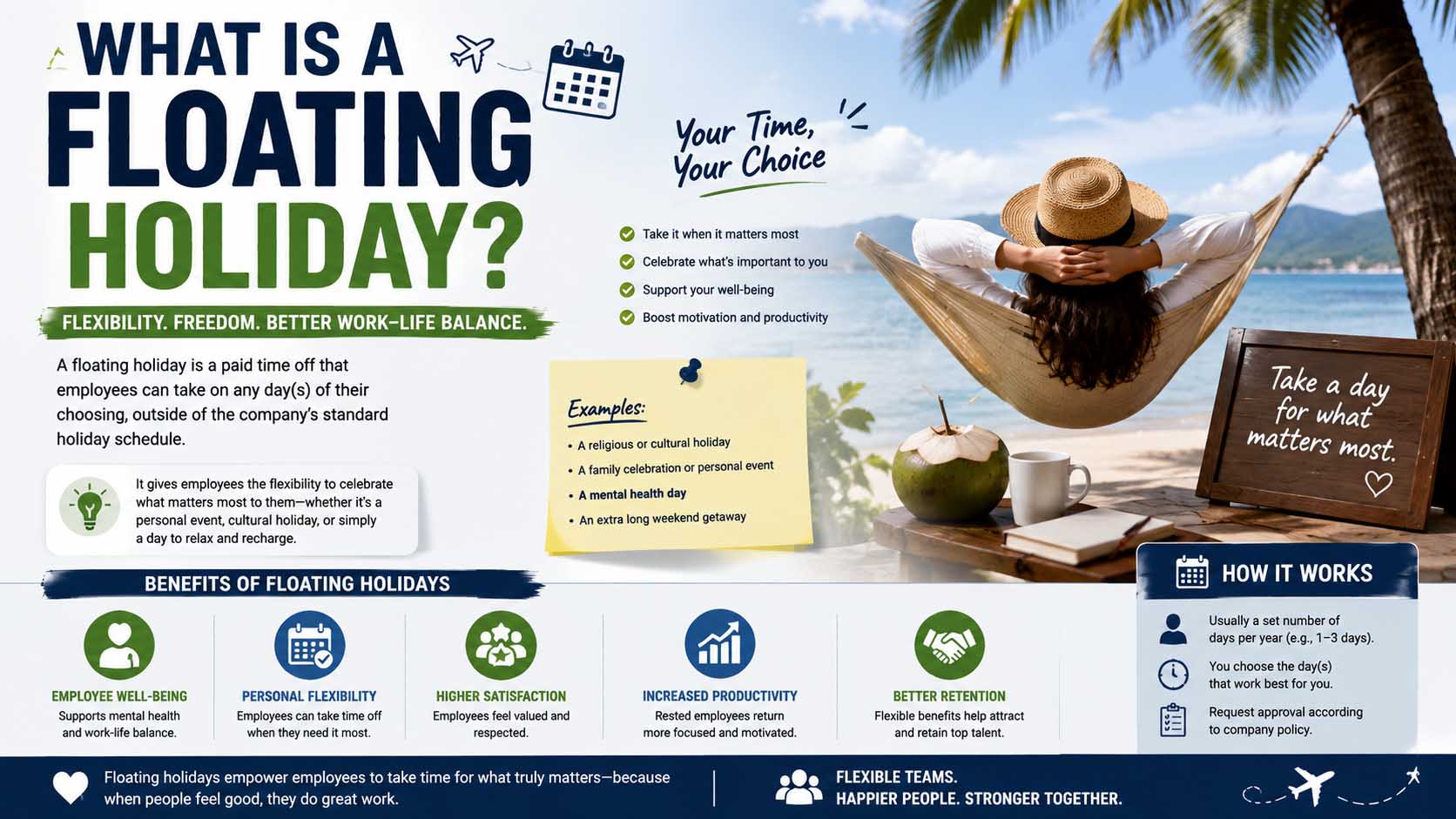
If your employer gives you a paid day off that you can use for a holiday or another approved occasion of your choice, you may wonder, what is a floating holiday? In simple terms, a floating holiday is a flexible day off that employees can usually take on a date that is not fixed on the company calendar. Instead of requiring everyone to observe the same holiday, an employer gives workers more choice over when they use that time.
Floating holidays can make a benefits package more flexible, especially in workplaces with employees from different cultures, religions, and backgrounds. However, policies vary widely. Some companies let employees choose almost any approved date, while others provide floating holidays only as substitutes for specific company holidays.
For employees, understanding the policy helps prevent confusion about scheduling, expiration, and pay. Meanwhile, employers need clear rules so the benefit remains useful without creating staffing problems.
What Is a Floating Holiday at Work?
So, what is a floating holiday at work in practical terms? Usually, it is an employer-provided day off that an employee can schedule rather than a holiday observed by the entire organization.
For example, suppose a company closes for Christmas Day, New Year’s Day, and Independence Day. Those dates are fixed. However, the company might also provide two floating holidays each year. An employee could potentially use one for a religious observance, cultural celebration, birthday, or another date permitted by company policy.
The exact rules depend on the employer. Therefore, employees should not assume that a floating holiday can automatically be used whenever they want. A company may require advance approval, restrict certain busy periods, or define which occasions qualify.
If workplace leave terminology feels confusing, understanding what does PTO stand for can also help because employers often list floating holidays alongside vacation, sick leave, and other paid-time-off benefits.
How Does a Floating Holiday Work?
Generally, an employer establishes the number of floating holidays available during a benefit year. The employee then requests an eligible day through the company’s normal time-off system.
For instance, imagine that an employee receives one floating holiday on January 1. They decide to use it for a cultural celebration in October. After checking their team’s schedule, they submit the request to their manager. Once approved, they take that day off while receiving pay according to the company’s policy.
However, another business might handle the benefit differently. It could designate several optional holidays and allow employees to select one or two. Therefore, the word “floating” does not always mean complete freedom to select any calendar date.
Employees should check the handbook, HR portal, employment agreement, or benefits guide before making plans.
Does a Floating Holiday Need Manager Approval?
Often, yes. Even when employees have earned or received the day, companies may require them to request it in advance.
Approval rules help managers maintain enough staffing during busy periods. For example, a retailer may limit time-off requests around major shopping weekends, while an accounting firm may have tighter scheduling rules during tax season.
Still, a well-designed policy should clearly explain the approval process. That way, employees know how early to request the day and whether any blackout dates apply.
What Is Considered a Floating Holiday?
There is no single occasion that always qualifies. Instead, what is considered a floating holiday depends mainly on the employer’s written policy.
A company may allow the day to be used for:
- Religious or cultural observances
- Birthdays or personal milestones
- Holidays the company does not officially observe
- Personal days
- Extended holiday weekends
- Other approved personal reasons
For example, an employee who does not celebrate one of the company’s commonly observed holidays may prefer a different date that matters personally. A floating holiday can provide that flexibility without requiring the business to create a company-wide closure.
However, some employers attach the benefit to specific dates. For instance, employees might receive a floating holiday because the business remains open on a holiday that other workplaces commonly observe.
Floating Holiday vs. PTO: What’s the Difference?
A floating holiday can resemble regular paid time off, yet the two benefits are not always identical.
| Feature | Floating Holiday | General PTO |
|---|---|---|
| Main purpose | Flexible holiday or approved personal day | Vacation or other eligible personal time |
| Number of days | Usually limited | Often part of a larger annual balance |
| Usage rules | May have special restrictions | Based on the employer’s PTO policy |
| Carryover | Depends on policy and applicable law | Depends on policy and applicable law |
| Scheduling | Usually requires approval | Usually requires approval |
| Availability | May be granted on a set date | May accrue or be granted upfront |
The biggest difference is usually how the employer defines the benefit. PTO often covers a broad range of absences, while floating holidays may exist specifically to provide flexibility around holidays or personal observances.
If you are comparing the two systems, learning how does PTO work can make it easier to understand whether your floating holiday sits inside a PTO bank or operates as a separate benefit.
What Is a Floating Holiday PTO Benefit?
People sometimes search for what is a floating holiday PTO because workplace systems may display both benefits together. However, a floating holiday does not necessarily come from an employee’s regular PTO balance.
For example, an employee might receive 15 PTO days plus two floating holidays. In that arrangement, using a floating holiday would generally leave the 15-day PTO balance unchanged.
Another employer may combine most paid leave into one bank. As a result, employees should rely on their company’s policy rather than assuming every workplace uses the same system.
Floating Holiday vs. Regular Paid Holiday
Regular company holidays normally occur on predetermined dates. If the workplace closes for that holiday, eligible employees typically do not choose when the day occurs.
A floating holiday offers more scheduling flexibility. Instead of everyone receiving the same day away from work, individual employees can potentially choose dates that better reflect their needs.
This approach can be useful for organizations with diverse workforces. After all, employees may observe different religious or cultural holidays. Likewise, some workers may prefer using the day for an important personal event.
However, fixed holidays remain easier for some businesses to schedule because everyone follows the same calendar. Therefore, many employers use a combination of fixed and floating holidays.
Who Is Eligible for Floating Holidays?
Eligibility depends on company policy and applicable employment laws. Some organizations provide floating holidays to all eligible employees, while others limit them according to employment classification, location, tenure, or scheduled hours.
For instance, a company might offer two floating holidays to full-time workers and use a different policy for employees with reduced schedules. Therefore, anyone comparing benefits across employment categories may also want to understand the difference between part time and full time, since benefit eligibility can vary between the two.
Employers should state eligibility rules clearly. Otherwise, employees may assume they have access to a benefit that does not apply to their employment category.
Workers should also check when eligibility begins. Some companies provide floating holidays immediately, whereas others make them available after a waiting period or at the beginning of a new benefit year.
Benefits of Offering Floating Holidays
For businesses, floating holidays can make a compensation and benefits package more adaptable without requiring the organization to close for every possible observance.
First, flexibility gives employees greater control over their time. Workers can choose dates that have personal significance instead of relying entirely on a standard corporate holiday calendar.
Likewise, floating holidays can support a workforce in which employees celebrate different cultural and religious events. A flexible system acknowledges those differences without requiring every worker to observe the same occasions.
From a recruiting perspective, flexible leave can also make a benefits package more appealing. While one or two days alone will rarely determine whether someone accepts a job, flexibility may contribute to the employee’s overall view of workplace benefits.
Businesses may also remain open on certain dates while allowing individual employees to take time away. As a result, companies can sometimes balance operational needs with employee choice.
Potential Drawbacks and Management Challenges
Although floating holidays offer flexibility, unclear policies can cause problems.
One common issue involves scheduling. If many employees request the same date, managers may struggle to maintain adequate coverage. Therefore, companies often require advance requests and may approve them based on staffing needs.
Another issue involves unused days. Employees may assume a floating holiday carries into the next year when the company’s policy says otherwise. Rules can also be affected by state, local, or national employment laws, so employers should make sure their policies comply with requirements that apply to their workforce.
Confusion can also occur when employees mix up floating holidays with other forms of leave. For example, what is bereavement leave addresses time away following the death of a qualifying person and serves a very different purpose from an optional floating holiday.
Clear terminology helps employees choose the correct leave category and understand what documentation or approval may apply.
How Employers Can Create a Clear Floating Holiday Policy
A good policy should answer the questions employees are most likely to ask before they need the day.
First, explain eligibility. Employees should know who receives floating holidays, how many are provided, and when they become available.
Next, define acceptable uses. If employees can use the day for any personal reason, say so. Conversely, if the company restricts the benefit to particular observances or dates, list those restrictions clearly.
Then, explain the request process. State how much notice employees should provide, who approves requests, and whether blackout periods exist.
The policy should also address unused days. Employees need to know whether floating holidays expire, carry forward, or receive another treatment where permitted or required by applicable law.
Finally, employers should explain what happens when someone leaves the organization with an unused floating holiday. Because wage-and-hour and leave rules differ by jurisdiction and policy structure, businesses should get qualified HR or legal guidance when creating these rules.
Common Mistakes Employees Should Avoid
One frequent mistake is assuming a floating holiday works exactly like vacation time. Although both may provide paid time away, employers can apply different rules to each benefit.
Another mistake is waiting until the last minute to request a popular date. If several coworkers want the same holiday off, an early request may make scheduling easier, although approval still depends on company policy.
Employees should also avoid assuming unused days automatically roll over. Instead, check the policy well before the benefit year ends.
Finally, review your available balance after using the day. Payroll or HR systems sometimes list floating holidays separately from vacation and sick leave, so checking the correct category can prevent misunderstandings.
FAQs About Floating Holidays
Are floating holidays paid?
They often are when an employer offers them as a paid benefit. However, policies differ, so employees should verify how their organization handles pay and eligibility.
Can I use a floating holiday whenever I want?
Not necessarily. Your employer may require advance approval, restrict certain dates, or limit the reasons for using the benefit.
Do floating holidays expire?
They may. Some employers require employees to use floating holidays within the benefit year, while other policies may handle unused time differently. Applicable employment law can also affect the rules.
Can a floating holiday be used as a personal day?
Sometimes. If the employer allows flexible personal use, an employee may be able to choose a birthday, family event, or another approved date. However, other companies limit floating holidays to designated observances.
Is a floating holiday the same as vacation time?
Usually not. Vacation or general PTO often provides a broader pool of paid leave, while a floating holiday is commonly a separate, limited benefit. Still, employers can structure leave programs differently.
Making the Most of a Floating Holiday
Once you understand what is a floating holiday, the benefit is fairly straightforward: it gives eligible employees more choice over when they take certain paid time away from work. However, the exact value depends on the employer’s rules.
Before choosing a date, check your available balance, approval requirements, eligible uses, blackout periods, and year-end rules. Meanwhile, employers should keep policies simple and accessible so workers can use the benefit without guessing.
When the rules are clear, floating holidays can offer a practical middle ground between a fixed company holiday calendar and a more flexible approach to employee time off.