
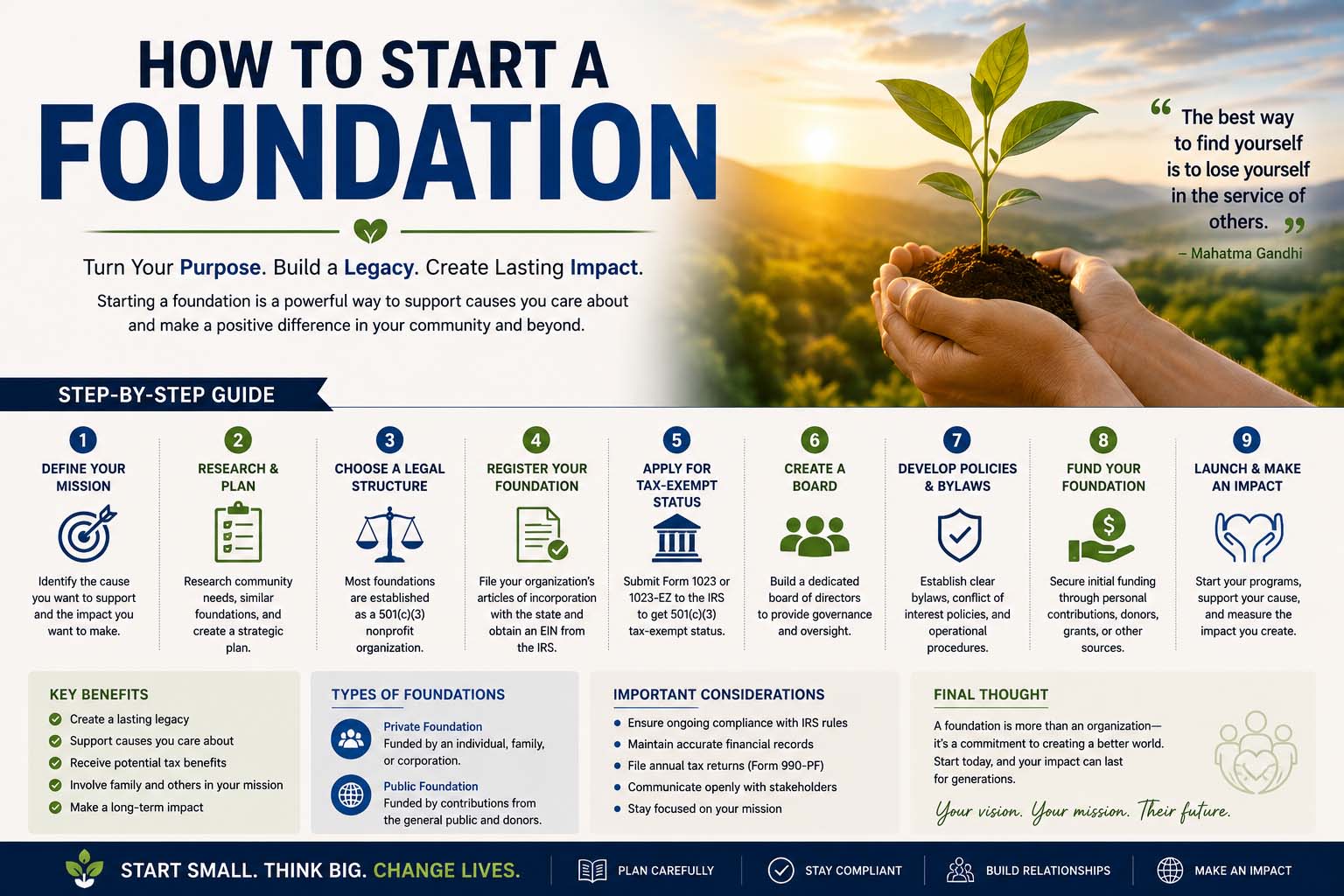
How to Start a Foundation: A Step-by-Step Guide for Beginners
Learning how to start a foundation is one way to support a cause you care about. Whether your goal involves funding scholarships, helping local communities, supporting medical research, or protecting the environment, a well-managed foundation can create lasting benefits.
Many people assume that only wealthy families can establish foundations. However, while some organizations begin with substantial endowments, other charitable initiatives start with smaller budgets and gradually expand through donations, grants, and community support.
Before launching, you need to understand the legal structure, financial responsibilities, governance requirements, and long-term commitments involved. In addition, the type of foundation you establish will influence how you raise funds and deliver charitable programs.
This guide explains the process step by step, including registration, startup costs, fundraising, family foundations, and practical strategies for long-term success. For related guidance, How to Start a Nonprofit explains the broader process of creating a mission-driven organization.
How to Start a Foundation: Quick Overview
The following table summarizes the main requirements and considerations.
| Topic | Overview |
|---|---|
| Purpose | Support charitable, educational, scientific, or other eligible public-benefit causes |
| Legal structure | May involve a nonprofit corporation, charitable trust, or another structure permitted by local law |
| Funding | Donations, grants, sponsorships, fundraising, or endowments |
| Management | Board of directors or trustees, as required by the legal structure |
| Registration | Depends on the country, state, and organizational classification |
| Tax status | Separate recognition or registration may be necessary |
| Timeline | Varies according to documentation, approvals, and local requirements |
Although these steps provide a general roadmap, legal requirements differ between jurisdictions.
Therefore, always confirm the rules that apply where you intend to establish and operate your organization.
How to Start a Foundation: Understanding the Basics
A foundation is an organization established to support charitable, educational, scientific, or other eligible public-benefit purposes.
Depending on its structure, it may distribute grants, operate charitable programs, or manage resources for a specific mission.
For example, foundations may support:
- Educational scholarships
- Community development
- Scientific research
- Emergency assistance
- Environmental conservation
- Cultural initiatives
- Public health programs
Unlike traditional businesses, charitable foundations generally direct their resources toward their stated purposes rather than distributing profits to private owners.
However, the legal meaning of foundation varies across countries. Some jurisdictions distinguish private foundations from publicly supported charities, while others use different classifications.
Private Foundations vs Public Charities
In the United States, private foundations and public charities are different tax classifications rather than simply alternative names for legal entities.
Private foundations often receive substantial support from one family, individual, or business. Public charities generally meet specific public-support or organizational requirements.
In addition, private foundations may face special rules concerning distributions, self-dealing, investments, and reporting.
Therefore, choosing the right classification requires more than deciding what to call your organization.
Why Establish a Charitable Foundation?
People establish foundations to organize charitable activities and provide sustained support for causes they value.
For example, common goals include:
- Supporting local communities
- Funding educational opportunities
- Advancing medical research
- Promoting the arts
- Protecting wildlife
- Supporting disaster relief
- Creating a family tradition of giving
A foundation can also provide a structured approach to managing charitable resources.
However, forming a separate organization brings ongoing administrative, financial, and legal responsibilities.
As a result, it is worth comparing a new foundation with alternatives such as donating through an existing charity or establishing a donor-advised fund where available.
How to Start a Foundation Step by Step
Starting a foundation involves more than completing registration paperwork. You also need a clear mission, suitable governance, reliable funding, and an operational plan.
The following steps provide a practical starting point.
| Step | Main Purpose |
|---|---|
| 1. Define your mission | Identify the cause and intended beneficiaries |
| 2. Choose a legal structure | Determine the appropriate organizational form |
| 3. Establish governance | Create oversight and decision-making arrangements |
| 4. Prepare documents | Set out operating rules and responsibilities |
| 5. Complete registration | Obtain the required legal recognition |
| 6. Plan funding | Develop a realistic financial strategy |
| 7. Launch activities | Begin delivering programs or making grants |
| 8. Evaluate results | Measure outcomes and improve operations |
Although the order may vary by jurisdiction, each step supports responsible organizational development.
Step 1: Define Your Foundation’s Mission
Every foundation needs a clear purpose.
Before choosing a name or filing documents, identify the problem your organization intends to address.
For example, ask yourself:
- Who do we want to help?
- What specific problem are we addressing?
- Which communities will benefit?
- What activities will support our mission?
- How will we measure progress?
A clear mission makes it easier to plan programs and explain your goals to supporters.
For instance, a scholarship foundation might use this mission statement:
Providing educational scholarships to first-generation college students who face financial barriers.
In addition, learning How to Write a Mission Statement can help you express your organization’s purpose clearly.
Therefore, start with a specific and achievable mission rather than a broad promise to solve every problem.
Step 2: Choose the Right Foundation Legal Structure
The appropriate legal structure depends on your location, funding model, charitable activities, and governance preferences.
Depending on local laws, possible arrangements include:
- Nonprofit corporation
- Charitable trust
- Private foundation classification
- Public charity classification
- Other recognized charitable structures
However, these terms do not always describe equivalent legal choices.
For example, a U.S. nonprofit corporation is a legal entity, while private foundation and public charity generally describe federal tax classifications.
Consequently, incorporating a nonprofit does not automatically make it tax-exempt.
In the United States, the IRS guidance on charities and nonprofits explains federal tax-exemption requirements and related responsibilities.
Before selecting a structure, consider your funding sources, management preferences, reporting obligations, and long-term plans.
If necessary, consult a qualified nonprofit attorney or tax professional.
Step 3: Establish a Foundation Governing Board
Many charitable organizations need directors or trustees to oversee their operations.
However, the required number of board members and their qualifications depend on the applicable laws and governing structure.
Board responsibilities may include:
- Setting organizational policies
- Overseeing financial decisions
- Approving major activities
- Monitoring legal compliance
- Managing organizational risks
- Supporting fundraising efforts
- Evaluating program performance
Ideally, board members should bring different skills and perspectives.
For example, expertise in finance, law, community leadership, fundraising, and program management can strengthen decision-making.
In addition, clear conflict-of-interest procedures help protect the organization’s integrity.
Step 4: Prepare Foundation Governing Documents
Foundations need written rules that explain how they operate.
Depending on the legal structure, these documents may include:
- Articles of incorporation or trust documents
- Bylaws
- Mission statement
- Conflict-of-interest policy
- Financial procedures
- Board responsibilities
- Recordkeeping policies
For example, bylaws may explain how the board selects officers, holds meetings, and approves decisions.
Meanwhile, financial procedures can establish controls for donations, spending, and financial reporting.
As a result, clear documentation supports accountability and reduces misunderstandings.
Step 5: Register Your Foundation
Registration requirements vary by country and region.
Depending on the jurisdiction, the process may involve:
- Choosing an available organizational name.
- Preparing formation documents.
- Registering the legal entity.
- Obtaining relevant identification or tax numbers.
- Applying for charitable or tax-exempt recognition when applicable.
- Completing any required fundraising registrations.
- Establishing ongoing reporting procedures.
However, legal formation and tax-exempt recognition are not always the same process.
For instance, some organizations must complete separate applications before receiving particular tax benefits.
Therefore, confirm all applicable requirements before accepting donations or publicly describing contributions as tax-deductible.
Step 6: Develop a Foundation Funding Strategy
Even nonprofit organizations need dependable financial resources.
A foundation may require funding for programs, administration, professional services, and reporting.
Possible sources include:
- Individual donations
- Corporate contributions
- Eligible grants
- Fundraising events
- Online fundraising campaigns
- Planned giving
- Endowment income
However, funding options depend on the organization’s legal classification and eligibility.
For example, a private foundation funded mainly by one family may follow a different financial model from a publicly supported charity.
In addition, understanding What Is a Target Market can help you identify potential supporters whose interests align with your charitable mission.
Instead of depending on a single funding source, consider a realistic mix of support where appropriate.
Step 7: Launch Your Foundation’s First Programs
After meeting the necessary legal and operational requirements, begin with activities your organization can manage responsibly.
For example, a scholarship foundation might launch a small application program with clear eligibility requirements.
Alternatively, a community foundation could support a limited number of local projects.
Before launching, define:
- Who qualifies for support
- How beneficiaries are selected
- What resources each program requires
- Who manages implementation
- How the organization records results
Starting with manageable activities helps the board identify weaknesses before expanding.
Step 8: Evaluate Foundation Programs and Results
Once programs begin, measure whether they achieve the intended outcomes.
For example, a scholarship program might track the number of awards, student participation, and relevant educational outcomes.
However, counting activities alone does not always show meaningful impact.
Therefore, combine measurable results with appropriate feedback from beneficiaries and community partners.
Over time, these findings can guide better decisions about funding, staffing, and program design.
How to Start a Foundation With No Money
Many people want to support a charitable cause but have limited startup resources.
Although some charitable initiatives can begin with volunteer support, establishing a separate legal foundation may involve unavoidable expenses.
In addition, certain legal classifications or funding models may require resources that make immediate formation impractical.
Starting a Foundation With Limited Resources
Consider these approaches:
- Recruit volunteers with relevant skills.
- Seek donated meeting spaces or equipment.
- Partner with established charitable organizations.
- Start a small community project.
- Explore eligible startup grants.
- Seek in-kind contributions.
- Build relationships with potential supporters.
- Use low-cost communication tools.
For example, a group interested in educational scholarships could first organize mentoring activities through an existing nonprofit.
This approach may help demonstrate community interest before creating a separate organization.
Consider Fiscal Sponsorship for Your Foundation Project
In jurisdictions where fiscal sponsorship is available, an established nonprofit may agree to support a charitable project under an appropriate arrangement.
As a result, the project may be able to operate without immediately creating its own separate tax-exempt entity.
However, fiscal sponsorship involves legal, financial, and operational responsibilities for the sponsoring organization and project.
Therefore, both parties should establish clear written terms before proceeding.
How Much Does It Cost to Start a Foundation?
There is no universal startup amount that applies to every foundation.
Instead, the required budget depends on the legal structure, location, intended activities, and funding model.
Typical expenses may include:
- Registration fees
- Legal services
- Accounting support
- Insurance
- Website development
- Fundraising materials
- Administrative systems
- Program expenses
Some private foundations begin with substantial assets. Other charitable organizations operate with smaller budgets.
However, a foundation with limited resources still needs enough financial capacity to meet its obligations.
Creating Your Foundation’s First-Year Budget
Start by separating one-time formation costs from ongoing operating expenses.
For example, your budget should estimate:
| Expense Category | What to Consider |
|---|---|
| Legal formation | Filing fees and professional assistance |
| Administration | Recordkeeping, software, and communications |
| Financial management | Accounting and reporting |
| Fundraising | Campaign materials and event expenses |
| Programs | Grants, supplies, or direct charitable services |
| Insurance | Coverage appropriate to organizational risks |
| Reserve funds | Resources for unexpected expenses |
Next, estimate realistic income rather than assuming every fundraising campaign will succeed.
Finally, review the budget regularly and adjust spending when necessary.
How to Start a Foundation for Charity
If your goal is supporting a charitable cause, begin by defining the specific public benefit your organization will provide.
Although the basic formation process remains similar, charitable organizations may need to satisfy additional requirements for recognition, fundraising, and reporting.
Key priorities include:
- Choosing an eligible charitable purpose
- Selecting the appropriate legal structure
- Establishing effective governance
- Completing necessary registrations
- Creating transparent financial procedures
- Developing suitable fundraising practices
- Measuring program outcomes
For example, a charitable foundation focused on education might fund scholarships or provide learning resources.
However, the organization should establish clear selection criteria and document how its activities advance its mission.
As a result, consistent procedures can improve accountability and public confidence.
How to Start a Foundation for Your Family
Family foundations allow relatives to organize charitable giving around shared values and long-term goals.
For example, family members may establish a foundation to support education, medical research, or local community programs.
Benefits of Creating a Family Foundation
Potential benefits include:
- Coordinated charitable giving
- Participation across generations
- Long-term grantmaking plans
- Shared philanthropic goals
- Structured oversight of charitable resources
However, family involvement also creates governance challenges.
For instance, relatives may disagree about funding priorities or leadership responsibilities.
Therefore, establish clear policies for board membership, decision-making, conflicts of interest, and succession.
Family Foundation Legal and Financial Requirements
Family foundations may face specific restrictions concerning transactions with insiders, charitable distributions, and investments.
In addition, charitable assets must support the organization’s permitted purposes rather than provide improper personal benefits.
Consequently, professional guidance can be especially valuable when substantial family assets or complex financial arrangements are involved.
How to Plan Your Foundation’s First Year
A practical first-year plan helps turn your mission into manageable tasks.
However, registration and approval timelines vary. The following schedule is an illustrative planning framework, not a guaranteed legal timeline.
| Timeframe | Suggested Priority |
|---|---|
| Months 1–2 | Define the mission, research requirements, and evaluate legal structures |
| Months 3–4 | Prepare governing documents and complete applicable formation steps |
| Months 5–6 | Establish financial procedures, communications, and fundraising materials |
| Months 7–9 | Begin eligible fundraising or initial activities after meeting relevant requirements |
| Months 10–12 | Evaluate early results and prepare the next operating plan |
If approvals take longer, adjust the schedule accordingly.
Meanwhile, use the preparation period to develop partnerships, recruit suitable board members, and improve financial planning.
Rather than expanding immediately, prioritize reliable operations and realistic commitments.
How to Promote Your Foundation and Attract Supporters
Even charitable organizations need effective communication to reach donors, volunteers, beneficiaries, and community partners.
However, nonprofit marketing should emphasize transparency and genuine outcomes rather than exaggerated promises.
Build a Professional Foundation Website
Your website should explain:
- The foundation’s mission
- Current programs
- Who can receive support
- Ways to contribute
- Volunteer opportunities
- Relevant contact information
For example, a scholarship foundation can explain eligibility requirements and application procedures.
In addition, clear information helps potential supporters understand how the organization uses its resources.
Use Social Media to Promote Your Foundation
Social platforms can help foundations share updates and communicate with supporters.
Useful content may include:
- Community announcements
- Volunteer activities
- Fundraising campaigns
- Program milestones
- Educational resources
However, obtain appropriate permission before sharing identifiable beneficiary stories or photographs.
As a result, your organization can communicate its work while respecting the people it serves.
Send Foundation Email Newsletters
Regular newsletters help supporters understand the organization’s progress.
For example, updates may include:
- Program results
- Upcoming events
- Volunteer opportunities
- Fundraising needs
- Relevant success stories
In addition, these Tips for Networking Events can help foundation leaders develop relationships with community partners, volunteers, and potential supporters.
As operations grow, some organizations may also explore Human Resources Outsourcing Services for administrative support.
However, outside service providers should complement responsible internal oversight rather than replace it.
Common Mistakes When Starting a Foundation
New foundations often face challenges that careful preparation can reduce.
Common mistakes include:
- Starting without a specific mission
- Choosing a legal structure without understanding its obligations
- Underestimating administrative expenses
- Maintaining incomplete financial records
- Giving the board insufficient oversight
- Overestimating fundraising income
- Ignoring reporting deadlines
- Expanding programs too quickly
- Failing to evaluate outcomes
For example, an organization may launch several programs before securing reliable funding.
Consequently, it may struggle to fulfill commitments or maintain essential services.
Instead, begin with manageable activities and expand when financial and operational capacity allows.
Best Practices for Managing a Successful Foundation
Successful charitable organizations need more than enthusiasm for their mission.
They also need dependable systems, responsible leadership, and consistent communication.
Maintain Foundation Financial Transparency
Keep accurate records of income, expenses, grants, and program spending.
In addition, prepare any financial statements or reports required by law.
Clear financial information helps the board evaluate performance and supports responsible decision-making.
Strengthen Foundation Governance
Board members should understand their responsibilities and review important organizational decisions.
For example, regular meetings can address budgets, program outcomes, financial risks, and compliance obligations.
Meanwhile, conflict-of-interest procedures help protect the organization’s charitable purpose.
Build Community Partnerships for Your Foundation
Partnerships can provide useful expertise, resources, and local knowledge.
For instance, an educational foundation might collaborate with schools or community organizations to identify genuine needs.
As a result, programs may become more relevant and effective.
Measure Your Foundation’s Impact
Instead of focusing only on fundraising totals, examine whether your activities achieve their intended purpose.
For example, track:
- People served
- Scholarships awarded
- Community projects completed
- Volunteer participation
- Donor retention
- Program effectiveness
However, choose measures that genuinely reflect your mission.
Finally, use evaluation findings to improve future programs and resource allocation.
Frequently Asked Questions About How to Start a Foundation
How Do You Start a Foundation?
Begin by defining your mission and researching the legal requirements in your jurisdiction.
Next, choose an appropriate structure, establish governance, prepare documents, and complete necessary registrations.
Finally, develop a sustainable funding plan and begin eligible charitable activities.
Can You Start a Foundation Without Money?
You may be able to begin a charitable project with volunteers, donated resources, or support from an existing nonprofit.
However, establishing a separate foundation can involve legal and administrative costs.
Therefore, consider partnerships or fiscal sponsorship before forming an independent organization with insufficient resources.
How Much Funding Is Needed to Start a Foundation?
The required amount depends on the jurisdiction, organizational structure, planned programs, and operating expenses.
Although no universal amount applies to every foundation, some legal arrangements or classifications may have specific financial requirements.
Consequently, prepare a realistic budget and confirm the applicable rules before proceeding.
Can One Person Start a Foundation?
In some jurisdictions, one person can initiate the formation process.
However, applicable laws and organizational structures may require additional directors or trustees.
Therefore, confirm governance requirements before registering.
How Do You Start a Charity Foundation?
First, identify an eligible charitable purpose and determine the appropriate legal structure.
Then, complete required registrations, establish financial oversight, and secure suitable funding.
After meeting the necessary requirements, launch programs that support your mission.
How Do You Establish a Family Foundation?
Start by identifying shared charitable goals and deciding how family members will participate.
Next, select an appropriate legal structure and establish clear governance rules.
In addition, develop policies for grantmaking, financial management, conflicts of interest, and future leadership.
How Long Does It Take to Start a Foundation?
The timeline depends on the jurisdiction, legal structure, application requirements, and administrative processing.
For example, some formation steps may be relatively straightforward, while tax-exemption applications or other approvals can take longer.
Therefore, avoid announcing a fixed launch date until you understand the applicable requirements.
How to Start a Foundation and Build Lasting Impact
Learning how to start a foundation begins with a clear mission, careful planning, and a commitment to responsible charitable work.
Whether you want to support a local community, establish a family giving program, or fund educational opportunities, the right organizational structure and financial plan can help you pursue those goals.
However, a separate foundation is not always the best starting point. For smaller initiatives, working with an established nonprofit may offer a practical alternative.
Above all, focus on genuine community needs, transparent operations, and measurable outcomes. With realistic goals and responsible management, your charitable efforts can develop into lasting support for the causes you value.