
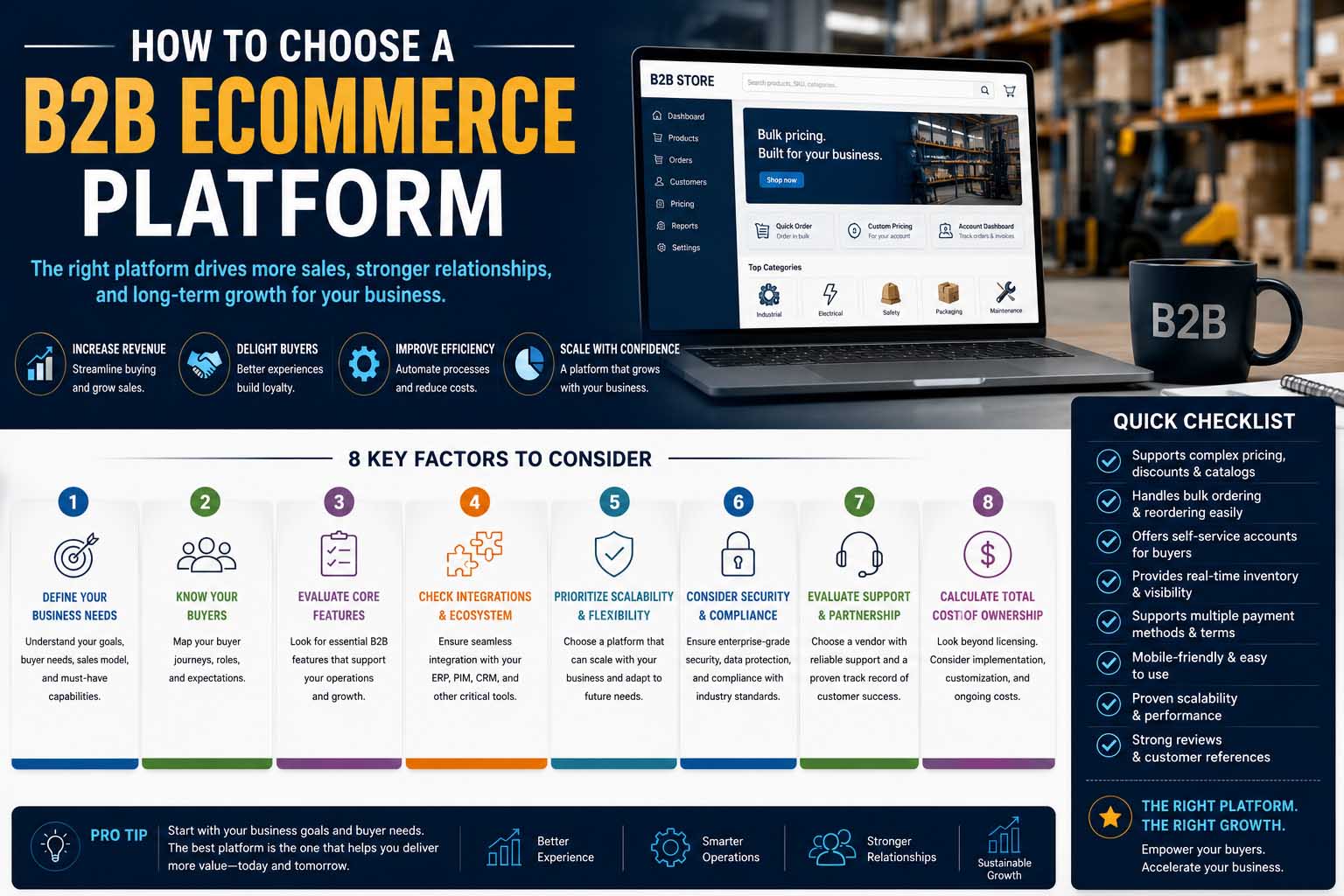
How to Choose a B2B Ecommerce Platform
Choosing the right ecommerce platform can shape your company’s growth for years. If you’re researching how to choose a B2B ecommerce platform, you’re already making a smart first step. Unlike consumer-focused online stores, B2B ecommerce platforms must support complex pricing, large orders, multiple buyers, and business-specific workflows.
The ideal platform should make buying easier for your customers while helping your team manage operations efficiently. Instead of focusing only on features or price, look at how well the platform supports your current business and future expansion.
This guide explains what to evaluate before making a decision and how to avoid common mistakes.
What Is a B2B Ecommerce Platform?
A B2B ecommerce platform is software that allows businesses to sell products or services to other businesses through an online portal.
Unlike traditional online stores, B2B platforms often include:
- Customer-specific pricing
- Bulk ordering
- Purchase approvals
- Account-based access
- Credit terms
- Quote requests
- Complex product catalogs
These features help businesses simplify purchasing while maintaining existing sales processes.
Why Learning How to Choose a B2B Ecommerce Platform Matters
Your ecommerce platform affects nearly every part of your business.
It influences:
- Customer experience
- Sales efficiency
- Inventory management
- Order accuracy
- Business scalability
- Operational costs
Switching platforms later can be expensive and disruptive, so selecting the right solution from the beginning saves both time and money.
Define Your Business Requirements First
Every business has different needs.
Before comparing software providers, answer questions like:
- How many products do you sell?
- Do customers require custom pricing?
- Will multiple employees place orders from one account?
- Do you sell internationally?
- Will sales representatives use the platform?
Creating a list of business requirements makes it much easier to eliminate platforms that don’t fit.
Understanding What Is a Target Market also helps clarify which customer groups your platform should support and what buying experience they expect.
Core Features Every B2B Ecommerce Platform Should Include
Not every platform offers the same capabilities.
Prioritize features that improve efficiency rather than simply increasing your feature list.
Customer Account Management
Business buyers often involve multiple decision-makers.
Look for features such as:
- Multiple users per company account
- Permission levels
- Purchase approval workflows
- Saved shopping carts
- Order history
These capabilities simplify repeat purchasing.
Flexible Pricing
Unlike B2C stores, B2B businesses frequently negotiate pricing.
A strong platform should support:
- Customer-specific pricing
- Contract pricing
- Volume discounts
- Promotional pricing
- Tiered pricing
This flexibility creates a smoother buying experience.
Product Catalog Management
Large catalogs become difficult to maintain without proper tools.
Useful capabilities include:
- Product categories
- Variants
- Bulk imports
- Digital catalogs
- Product filtering
- Technical specifications
If your business works with distributors or manufacturers, organizing product information clearly improves customer satisfaction.
Evaluate Vendor Management Capabilities
Some B2B marketplaces allow multiple suppliers to sell through one platform.
If this fits your business model, you’ll need robust management tools.
Knowing What Is a Vendor can help you better understand supplier relationships and how marketplace software should support vendor onboarding, communication, and performance tracking.
Good vendor management reduces administrative work while improving product availability.
Integration Is One of the Most Important Factors
Your ecommerce platform shouldn’t operate in isolation.
Instead, it should connect with existing business systems such as:
- ERP software
- CRM software
- Accounting software
- Warehouse management
- Shipping providers
- Payment gateways
- Marketing platforms
These integrations eliminate duplicate data entry and improve operational accuracy.
Think About Inventory Visibility
Inventory errors create delays, frustrated customers, and lost sales.
Choose software that provides:
- Real-time inventory updates
- Warehouse synchronization
- Backorder management
- Low-stock alerts
- Inventory forecasting
Businesses that understand the benefits of inventory visibility are often better prepared to reduce stockouts and improve customer satisfaction across multiple sales channels.
Prioritize a Smooth Customer Experience
Business buyers expect online purchasing to be just as convenient as consumer shopping.
Look for features including:
- Fast product search
- Advanced filters
- Personalized catalogs
- Saved reorder lists
- Quick checkout
- Mobile-friendly design
A better user experience often leads to higher customer retention.
Security and Compliance
B2B transactions often involve large purchase amounts and sensitive company information.
Your platform should provide:
- SSL encryption
- Secure payment processing
- Role-based permissions
- Multi-factor authentication
- Data backups
- Regular software updates
Strong security builds trust with customers and protects valuable business data.
Scalability for Future Growth
Many businesses outgrow their first ecommerce platform.
Before making a decision, ask:
- Can the platform handle more customers?
- Will it support larger product catalogs?
- Can it process higher order volumes?
- Does it support multiple warehouses?
- Is international selling available?
Choosing scalable software reduces the likelihood of costly migrations later.
Compare Pricing Beyond the Monthly Subscription
Software pricing isn’t always straightforward.
Consider the total cost of ownership.
Potential expenses include:
| Cost Category | Examples |
|---|---|
| Subscription | Monthly or annual fees |
| Setup | Implementation and configuration |
| Customization | Development work |
| Integrations | Third-party software connections |
| Training | Employee onboarding |
| Maintenance | Updates and ongoing support |
The least expensive platform isn’t always the most affordable over several years.
Evaluate Reporting and Analytics
Business decisions improve when supported by accurate data.
Useful reports include:
- Sales trends
- Customer purchasing behavior
- Product performance
- Inventory reports
- Revenue by customer
- Order fulfillment metrics
Easy-to-read dashboards help managers identify opportunities faster.
Customer Support Can Make a Big Difference
Even reliable platforms occasionally need technical assistance.
Before purchasing, review:
- Support hours
- Response times
- Live chat availability
- Phone support
- Documentation
- Training resources
Strong customer support reduces downtime when problems arise.
Consider Procurement Workflows
Many B2B companies have structured purchasing processes.
Your ecommerce platform should support quote requests, approval chains, purchase orders, and repeat ordering.
If your team is unfamiliar with these processes, learning What Is Procurement provides helpful background on how organizations purchase goods and services efficiently.
Common Mistakes Businesses Make
Many organizations focus on the wrong priorities during software selection.
Choosing Based Only on Features
A platform with hundreds of features may still be difficult to use.
Ease of use often matters just as much as functionality.
Ignoring Employee Adoption
Employees use the software every day.
If the platform is complicated, productivity may decrease instead of improve.
Request demonstrations and involve staff before making a final decision.
Forgetting About Mobile Users
Many purchasing managers place orders from tablets and smartphones.
Responsive design and mobile usability have become standard expectations.
Underestimating Growth
Businesses often choose software based only on current needs.
Instead, think about where your company will be three to five years from now.
A Simple Evaluation Framework
When comparing providers, score each platform using these categories:
| Evaluation Area | Questions to Ask |
|---|---|
| Features | Does it support your sales process? |
| Scalability | Can it grow with your business? |
| Integrations | Will it connect with existing systems? |
| Security | Does it meet industry standards? |
| Support | Is help available when needed? |
| User Experience | Is it easy for employees and customers? |
| Cost | Does the long-term value justify the investment? |
Using a structured framework makes vendor comparisons much more objective.
Align the Platform With Your Product Strategy
Your ecommerce platform shouldn’t only support current products.
It should also accommodate future product launches, catalog expansion, and evolving customer expectations.
Businesses that follow a structured Product Development Life Cycle often find it easier to introduce new products because their ecommerce systems already support organized product management and scalable catalog updates.
Best Practices Before Making Your Final Choice
Follow these steps before signing a contract:
- Define business goals.
- List required features.
- Compare multiple providers.
- Request live demonstrations.
- Test the user experience.
- Review integration capabilities.
- Estimate total ownership costs.
- Check customer reviews.
- Verify security certifications.
- Plan employee training.
This process reduces risk and increases confidence in your final decision.
Frequently Asked Questions
What is the best B2B ecommerce platform?
There isn’t a single best platform for every business. how to choose a B2B ecommerce platform The right choice depends on your products, customers, budget, required integrations, and growth plans.
Can B2B ecommerce platforms support custom pricing?
Yes. Most modern B2B platforms allow businesses to create customer-specific pricing, contract pricing, volume discounts, and negotiated rates.
Should I choose a cloud-based platform?
For many companies, cloud-based platforms offer easier maintenance, automatic updates, stronger scalability, and lower infrastructure costs compared to self-hosted solutions.
How long does implementation usually take?
Basic implementations may take a few weeks, while larger enterprise deployments with custom integrations can require several months.
Is mobile optimization necessary for B2B ecommerce?
Yes. Many business buyers research products, approve purchases, and place orders using mobile devices, making responsive design an essential feature.
Final Recommendations
Understanding how to choose a B2B ecommerce platform starts with knowing your business goals rather than chasing the longest feature list. A successful platform should streamline purchasing, integrate with your existing systems, support future growth, and provide a smooth experience for both your team and your customers.
Take time to evaluate vendors carefully, involve key stakeholders in the selection process, and think beyond your immediate needs. An informed decision today can improve operational efficiency, strengthen customer relationships, and create a solid foundation for long-term business growth.