
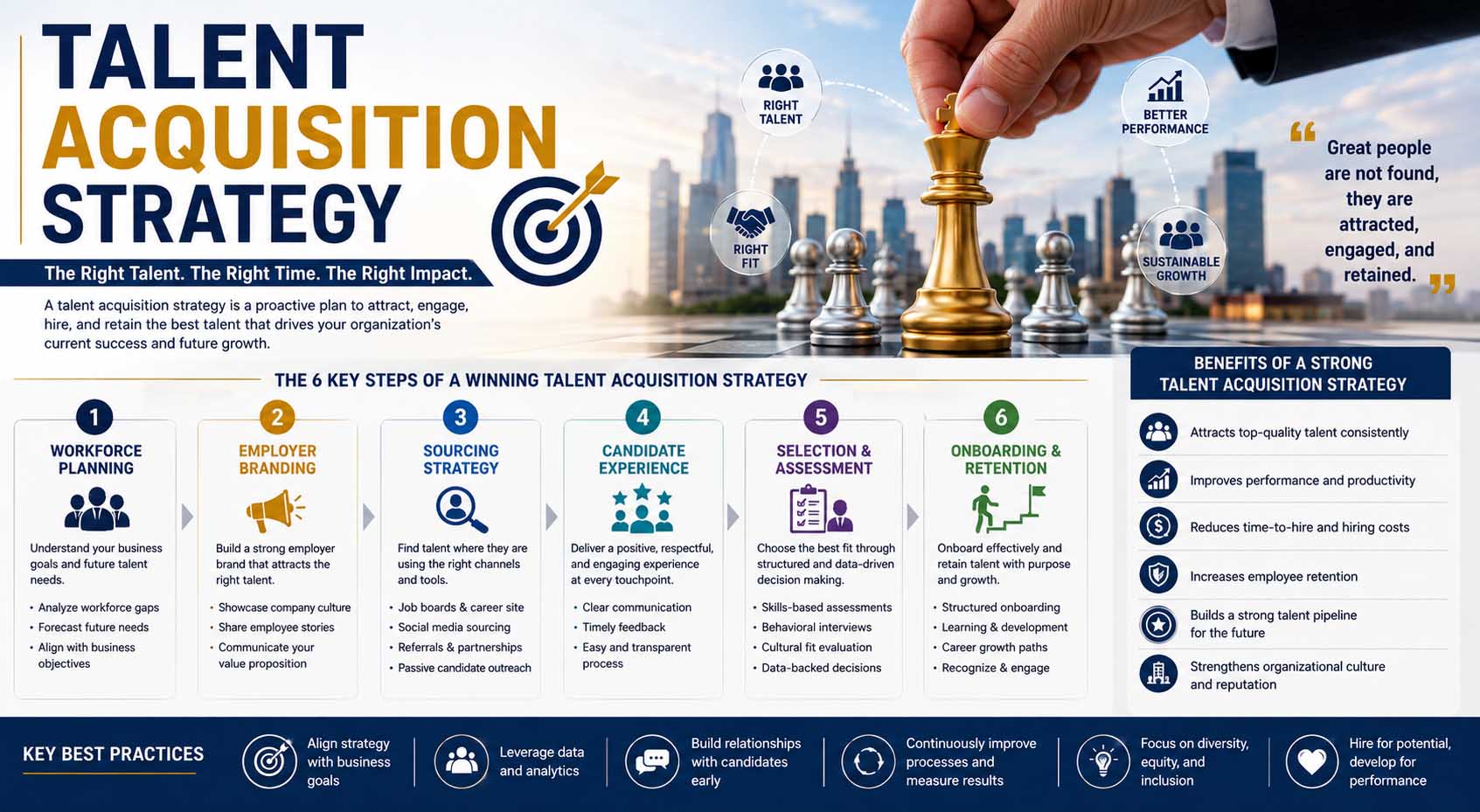
Talent Acquisition Strategy: How to Build a Smarter Hiring Plan
Hiring someone when a position suddenly becomes vacant is recruiting. Building a system that identifies future workforce needs, attracts suitable candidates, and develops a reliable talent pipeline is much broader. A strong talent acquisition strategy helps a company move from reactive hiring to planned, long-term workforce growth.
That difference matters for businesses of almost every size. When companies know which skills they will need, where qualified people can be found, and why candidates should choose them, hiring becomes more focused. Meanwhile, candidates get a clearer and more professional experience.
Talent acquisition does not require a huge HR department. Instead, it starts with understanding business goals and creating a repeatable process for finding people who can help achieve them.
What Is a Talent Acquisition Strategy?
A talent acquisition strategy is a long-term plan for finding, attracting, evaluating, hiring, and retaining the people a business needs. While recruitment often focuses on filling an immediate vacancy, talent acquisition considers both current and future workforce requirements.
For example, a growing software company may know that it plans to expand into a new market next year. Rather than waiting until expansion begins, its HR team can identify the technical, sales, and management skills that will be required months ahead.
As a result, recruiters have time to build candidate relationships, improve job messaging, study compensation expectations, and choose suitable sourcing channels.
Some businesses manage these activities internally, while others use Human Resources Outsourcing Services for selected recruiting or HR functions when internal resources are limited.
Why Talent Acquisition Planning Matters
Poor hiring decisions cost more than recruitment fees. They can also create productivity gaps, increase managers’ workloads, slow projects, and affect team morale.
By contrast, structured talent acquisition planning gives managers a clearer picture of what they actually need before advertising a role. Consequently, businesses can focus on relevant skills rather than simply replacing a previous employee with someone who has an identical résumé.
Planning also reduces rushed decisions. If an organization already has a pipeline of potential candidates, it does not have to start every search from zero.
However, a good strategy is not simply about hiring faster. Quality, candidate experience, workforce diversity, retention, and alignment with business needs also deserve attention.
Building a Talent Acquisition Strategy Step by Step
Building a talent acquisition strategy becomes easier when the process is divided into practical stages. Although every company will use a slightly different approach, the following framework works for many organizations.
1. Connect Hiring Plans to Business Goals
Start with the company’s direction rather than its current job openings.
Ask what the business expects to achieve during the next 12 to 36 months. Perhaps it plans to open another location, introduce a new product, automate part of its operation, or enter another geographic market.
Then identify the people and skills needed to support those plans.
For instance, opening a second retail location may require store managers, sales associates, inventory specialists, and administrative support. Meanwhile, a digital expansion might create demand for developers, analysts, content specialists, and cybersecurity professionals.
Understanding the different types of employees a company may need can also help HR teams distinguish permanent roles from temporary, seasonal, contract, or other workforce arrangements.
2. Identify Skills Gaps
Next, compare future requirements with the skills already available inside the organization.
Managers should ask whether existing employees can develop the required capabilities through training or promotion.
This step prevents unnecessary recruitment. In some cases, developing a current employee is more efficient than hiring someone new. In other cases, however, the business genuinely needs expertise that does not exist internally.
A simple skills-gap review can include current capabilities, future requirements, expected vacancies, hard-to-fill positions, and roles that are especially important to business continuity.
Create a Clear Candidate Profile
Once the business understands what it needs, define what a suitable candidate looks like.
Avoid creating an unrealistic wish list. Instead, separate essential qualifications from skills that can be learned after hiring.
For example, a marketing role might genuinely require strong writing ability and experience with analytics. However, experience with one specific software platform may be trainable.
The profile should also cover relevant behaviors. Depending on the role, these might include communication, adaptability, leadership, problem-solving, customer service, or attention to detail.
At the same time, consider the environment in which the person will work. Different types of work environments can suit different candidates, so expectations around remote work, collaboration, schedules, travel, or customer interaction should be clear from the start.
Build an Employer Value Proposition
Candidates evaluate employers just as employers evaluate candidates. Therefore, a talent acquisition plan needs a clear answer to a basic question: Why should a qualified person want to work here?
Your employer value proposition, often called an EVP, communicates what employees receive in return for their skills and contribution.
Compensation matters, but it is only one part of the picture. Candidates may also care about career development, flexible working arrangements, meaningful responsibilities, management quality, benefits, learning opportunities, workplace culture, or job stability.
Avoid vague claims such as “great culture” unless the company can explain what that means in practice.
For example, saying that employees receive structured quarterly development conversations provides more useful information than simply promising “career growth.”
Choose the Right Candidate Sources
Not every vacancy belongs on every recruitment channel.
General job boards may work well for common roles. Meanwhile, specialist positions may require professional communities, industry-specific platforms, employee referrals, universities, networking events, recruitment agencies, or direct outreach.
Internal hiring should also remain part of the strategy. Existing employees already understand the organization, and promotions can create visible career pathways for the wider workforce.
The right sourcing mix depends on the position. Therefore, track which channels produce qualified applicants rather than judging success by the total number of applications.
One hundred poorly matched applicants rarely provide more value than 15 strong candidates.
Talent Acquisition Strategy and Process
A clear talent acquisition strategy and process creates consistency without making hiring unnecessarily rigid.
| Stage | Main Goal | Example Activity |
|---|---|---|
| Workforce planning | Identify future needs | Forecast roles and skills |
| Candidate sourcing | Reach suitable people | Referrals, job boards, outreach |
| Screening | Find qualified applicants | Application review or phone screen |
| Assessment | Evaluate job fit | Interview, task, or skills assessment |
| Selection | Choose a candidate | Structured decision process |
| Offer | Secure the hire | Compensation and terms discussion |
| Onboarding | Support the transition | Training and role orientation |
| Review | Improve future hiring | Analyze hiring and retention data |
Each stage should have an owner. Otherwise, applications can sit unanswered, interviews can be delayed, and promising candidates may accept another offer.
Clear responsibilities become especially useful when several managers participate in hiring.
Make Candidate Assessment More Consistent
Unstructured interviews can easily become casual conversations. Although rapport matters, hiring teams also need consistent evidence for comparing candidates.
Structured interviews can help. In this approach, candidates for the same role receive a common set of job-related questions, while interviewers use agreed criteria to evaluate responses.
Practical assessments may also help when they closely reflect the job. For instance, a copywriter might complete a short writing exercise, while a data analyst might interpret a small sample dataset.
However, assessments should remain reasonable in length and directly connected to the role.
Hiring teams should also understand whether the position is full-time, part-time, contract-based, or another arrangement before sourcing begins. A clear understanding of the difference between part time and full time helps businesses communicate schedules, expectations, compensation structures, and benefits accurately to candidates.
The U.S. Office of Personnel Management’s structured interview guidance also explains how structured interviews use standardized questions and evaluation methods to support consistent candidate assessment.
Talent Acquisition Planning & Strategy Should Include Employer Branding
Recruitment marketing influences who applies before a recruiter ever speaks to a candidate.
Potential applicants may look at the careers page, employee reviews, social profiles, job advertisements, and public information about the company. Therefore, inconsistent or outdated messaging can weaken even a well-designed sourcing plan.
Strong employer branding should reflect the actual workplace rather than an idealized version of it.
Show candidates what work looks like, how teams operate, what development opportunities exist, and what the organization values. Meanwhile, job advertisements should explain responsibilities clearly instead of filling space with generic corporate language.
Consistency matters because the employee experience should reasonably match what candidates were promised.
Use a Talent Acquisition Strategy Template
A simple talent acquisition strategy template can prevent important decisions from being overlooked.
For each hiring area or role, document the business need, required skills, target candidate profile, sourcing channels, hiring timeline, responsible managers, interview process, compensation range, success measures, and likely hiring risks.
The document does not need to be complicated. In fact, a one-page framework may be enough for a smaller organization.
Larger businesses can expand the template by department, location, job family, or hiring quarter.
Most of all, treat the template as a working plan. Review it when business priorities, labor conditions, budgets, or skill requirements change.
Measure What Is Actually Working
Recruitment data becomes useful when it leads to better decisions.
Time to fill is one common measure, but speed alone can be misleading. A company could hire very quickly and still choose poorly.
Instead, consider several indicators together, such as qualified applicants per opening, source of hire, offer acceptance rate, time to fill, hiring manager satisfaction, candidate experience, early turnover, and retention.
Cost per hire can also provide useful context. However, cutting recruitment costs does not automatically create better results.
Some organizations compare internal HR capacity with the benefits of hr outsourcing when deciding whether specialist recruitment support could improve efficiency or provide access to expertise they do not maintain in-house.
Common Talent Acquisition Mistakes
One frequent mistake is waiting for a resignation before thinking about talent. That approach turns every unexpected vacancy into an urgent problem.
Another mistake is writing job descriptions around the previous employee rather than the company’s future needs. Roles change, so requirements should be reviewed before every major search.
Businesses can also lose candidates through unnecessarily long hiring processes. Multiple interviews may sometimes be justified, but every stage should have a clear purpose.
Poor communication creates another problem. Even candidates who are not selected should receive reasonable updates. After all, today’s unsuccessful applicant could be a strong candidate for another role later.
Finally, avoid collecting recruitment metrics without acting on them. If one sourcing channel repeatedly produces weak applicants, change the channel. Likewise, if candidates regularly reject offers because of compensation, investigate whether the package matches the market.
How to Improve a Talent Acquisition Strategy Over Time
A hiring strategy should evolve with the business.
After each major recruitment cycle, ask what worked and what created delays. For example, perhaps referrals produced excellent candidates, yet interview scheduling took too long. In that case, the sourcing strategy may be working while the internal process needs improvement.
Managers can also provide useful feedback after new employees have spent several months in their roles. Their performance can reveal whether the original candidate criteria accurately predicted success.
Meanwhile, employee feedback may highlight gaps between recruitment messaging and actual workplace experience.
Technology can support parts of this process through applicant tracking, scheduling, reporting, and communication tools. Still, software cannot replace clear hiring criteria or sound management judgment.
FAQs About Talent Acquisition Strategy
What Is the Main Goal of Talent Acquisition?
The main goal is to ensure an organization can attract and hire people with the skills needed to support current and future business objectives. Therefore, it looks beyond individual vacancies toward long-term workforce needs.
How Is Talent Acquisition Different From Recruitment?
Recruitment usually focuses on filling current openings. Talent acquisition has a wider scope that can include workforce planning, employer branding, candidate pipelines, sourcing strategies, succession needs, and long-term skill requirements.
Can Small Businesses Use Talent Acquisition Strategies?
Yes. A small business may use a much simpler system, yet planning future roles, defining candidate requirements, building referral networks, and tracking successful hiring sources can still improve results.
How Often Should a Talent Acquisition Plan Be Reviewed?
Many businesses benefit from reviewing it at least annually and whenever major business plans change. Fast-growing organizations may review hiring priorities quarterly or even more frequently.
What Makes a Talent Acquisition Strategy Successful?
A successful strategy connects hiring with business goals, defines realistic candidate requirements, uses effective sourcing channels, creates a fair assessment process, communicates well with candidates, and measures hiring outcomes.
Turn Hiring Into a Long-Term Business Capability
A useful talent acquisition strategy does more than help HR fill vacancies. It gives the organization a clearer view of the skills it will need, where those skills can be found, and how candidates should move through the hiring process.
Start with business goals, identify workforce gaps, define realistic candidate profiles, and choose sourcing channels based on evidence. Then, create a consistent assessment process and track results after people are hired.
As the company changes, update the plan rather than treating it as a fixed document. When hiring becomes an ongoing business capability instead of an emergency response to vacancies, organizations are better prepared to find the right people when growth creates new opportunities.