
How to Start a Non Profit
Learning how to start a non profit can help you turn a meaningful idea into an organization that serves your community. Whether you want to support education, rescue animals, fight hunger, or protect the environment, a nonprofit provides a structured way to pursue your mission.
However, starting an organization requires more than enthusiasm. You also need careful planning, responsible leadership, legal compliance, fundraising, and financial management.
This guide explains the major steps, from defining your mission to building a sustainable organization. In addition, our guide on How to Start a Nonprofi offers related advice for developing a mission-driven organization.
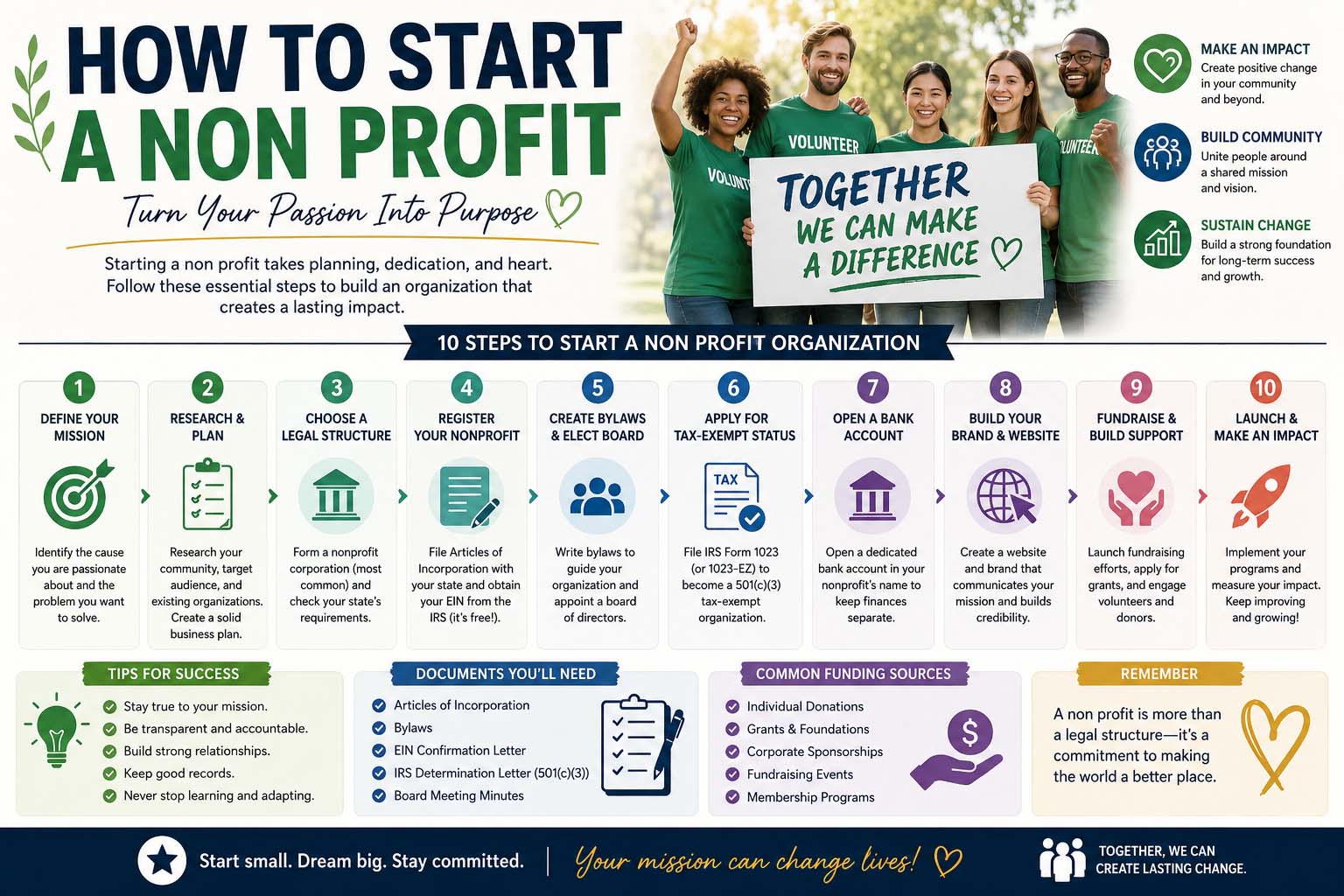
How to Start a Non Profit: Quick Checklist
Before beginning, review the main stages of nonprofit formation.
| Step | Purpose |
|---|---|
| Define your mission | Clarify your organization’s purpose |
| Research community needs | Confirm demand for your services |
| Write a business plan | Create a roadmap for operations and growth |
| Recruit a board | Establish leadership and accountability |
| Register your organization | Meet applicable legal requirements |
| Apply for tax-exempt status | Obtain recognition where available and appropriate |
| Create a fundraising plan | Develop reliable sources of income |
| Launch outreach efforts | Connect with donors, volunteers, and the community |
Although the steps may seem challenging, completing them in a logical order makes the process more manageable.
What Is a Non Profit Organization?
A nonprofit organization operates to pursue a mission rather than distribute profits to owners or shareholders.
Unlike a traditional for-profit company, a nonprofit generally reinvests any financial surplus into its programs, operations, and organizational goals.
For example, nonprofits commonly work in:
- Education
- Healthcare
- Environmental conservation
- Community development
- Animal welfare
- Arts and culture
- Youth development
- Human services
Although these organizations focus on public or community benefits, they still need effective financial management.
In fact, nonprofit leaders must make many of the same operational decisions as business owners, including hiring staff, preparing budgets, managing risks, and communicating with supporters.
Step 1: Define Your Non Profit Mission
Every nonprofit needs a clear purpose.
Before registering an organization, identify the problem you want to address and the people you intend to serve.
Start by answering these questions:
- What problem are we trying to solve?
- Who will benefit from our services?
- Why does this organization need to exist?
- What activities will support our mission?
- How will we measure success?
For example, a broad mission might say:
“We help children.”
However, a more specific statement provides clearer direction:
“Our organization provides free after-school tutoring and mentoring programs for underserved elementary school students.”
The second statement identifies the target audience and the services the organization intends to provide.
As a result, potential donors, volunteers, and community partners can understand its purpose more easily.
For additional guidance, read How to Write a Mission Statement.
Step 2: Research Community Needs Before Starting a Non Profit
Before completing legal paperwork, investigate the community you want to serve.
Research helps you understand whether your proposed services address an unmet need.
For example, consider these questions:
- Are similar organizations already operating nearby?
- What services do community members currently lack?
- Which groups need additional support?
- Could an existing nonprofit become a partner?
- What resources will your programs require?
Next, speak with people who understand the local situation.
Potential contacts include:
- Community leaders
- Schools
- Local businesses
- Volunteers
- Potential beneficiaries
- Government agencies
- Existing nonprofit organizations
For instance, if you want to provide after-school tutoring, ask local schools about current programs and student needs.
You may discover that another organization already offers tutoring but needs volunteers or funding.
In that case, partnering with an existing nonprofit could create more value than launching a separate organization.
Therefore, community research should guide your decision before you commit significant resources.
Step 3: Create a Business Plan for Your Non Profit
A nonprofit does not exist to generate profits for shareholders. However, it still needs a realistic business plan.
Your plan should explain how the organization will operate, serve its beneficiaries, and remain financially sustainable.
Mission and Organizational Goals
Begin with your mission statement.
Then, identify specific goals for the first year and the longer term.
For example, an educational nonprofit might aim to establish two tutoring programs during its first year.
Programs and Services
Describe the activities your organization will provide.
Include the people you intend to serve, the resources required, and the expected outcomes.
Target Community
Identify your intended beneficiaries.
For instance, your services might support low-income families, young people, older adults, or abandoned animals.
Startup Budget
Estimate your initial expenses, including:
- Registration and filing fees
- Insurance
- Website development
- Office or facility costs
- Equipment and supplies
- Program expenses
- Professional services
Next, estimate recurring operating costs and realistic funding sources.
Marketing and Outreach Plan
Explain how you will connect with donors, volunteers, and community partners.
In addition, identify the communication channels most likely to reach your audience.
A clear business plan can also support future grant applications and discussions with potential sponsors.
Step 4: Recruit a Board of Directors for Your Non Profit
A strong board helps establish responsible leadership.
Depending on the jurisdiction and organizational structure, a nonprofit may need a minimum number of directors.
Board members commonly oversee:
- Strategic planning
- Financial accountability
- Organizational policies
- Legal compliance
- Executive leadership
- Long-term performance
Therefore, choose people who understand your mission and can contribute useful expertise.
Consider individuals with backgrounds in:
- Accounting
- Law
- Education
- Healthcare
- Business management
- Fundraising
- Marketing
However, professional experience alone should not determine board membership.
Board members should also demonstrate integrity, sound judgment, and a willingness to participate.
In addition, establish clear responsibilities and procedures for handling potential conflicts of interest.
Step 5: How to Register a Non Profit Organization
Legal requirements depend on your country, state, and organizational structure.
In the United States, founders commonly establish a nonprofit corporation under applicable state law.
However, nonprofit incorporation and federal tax-exempt recognition are separate processes.
Typical formation activities include:
- Choose an appropriate organization name.
- Check whether the name is available.
- Select the appropriate legal structure.
- Prepare and file formation documents.
- Draft organizational bylaws.
- Appoint the required directors.
- Complete applicable registrations.
- Obtain necessary licenses or permits.
Before submitting documents, review the rules that apply to your location.
For example, some jurisdictions impose specific requirements for charitable organizations that solicit donations.
If you are considering a different charitable structure, How to Start a Foundation explains related planning considerations.
Step 6: Apply for Non Profit Tax-Exempt Status
Some nonprofit organizations qualify for tax exemptions.
However, creating a nonprofit corporation does not automatically provide federal tax-exempt recognition in the United States.
Organizations seeking recognition under Section 501(c)(3) generally must meet eligibility requirements and follow the applicable IRS application process.
Depending on eligibility, an organization may use Form 1023 or Form 1023-EZ.
For official eligibility information and application guidance, consult the IRS instructions for applying for tax-exempt status.
Tax-exempt recognition may provide benefits such as:
- Federal income tax exemption for qualifying activities
- Potential eligibility for certain grants
- Greater clarity about an organization’s recognized charitable status
- Potential donor tax deductions when applicable
However, tax rules and charitable registration requirements vary.
Therefore, consider consulting a qualified legal or accounting professional before applying.
Step 7: Open a Dedicated Non Profit Bank Account
Separate financial records are essential for responsible nonprofit management.
Therefore, avoid mixing organizational funds with personal money.
A dedicated bank account helps with:
- Accurate bookkeeping
- Financial reporting
- Donor transparency
- Expense tracking
- Tax and regulatory compliance
Banks may request formation documents, identification, and other organizational information.
In addition, establish a process for approving payments and recording transactions.
For example, requiring authorization for significant expenses can help reduce financial risks.
As your organization grows, regular financial reviews will become increasingly important.
Step 8: Fundraising for a New Non Profit
Even mission-driven organizations need reliable funding.
However, relying on a single source of income can create financial uncertainty.
Therefore, consider a combination of fundraising methods.
Individual Donations for Nonprofit Programs
Many nonprofits receive support from individual donors.
For example, monthly giving programs can provide more predictable revenue than occasional donations alone.
To encourage continued support, explain how contributions help your programs.
Nonprofit Grants and Funding Opportunities
Government agencies, private foundations, and other organizations may provide grants for qualifying projects.
Applications often require:
- A clear mission
- Program descriptions
- A realistic budget
- Measurable objectives
- Financial information
However, grants can be competitive and may restrict how recipients use the funds.
Therefore, review eligibility requirements before applying.
Corporate Sponsorships
Businesses sometimes support nonprofits through:
- Financial contributions
- Event sponsorships
- Employee volunteer programs
- In-kind donations
For example, a local company might provide supplies for a community education project.
In addition, strong relationships can create opportunities for future collaboration.
Nonprofit Fundraising Events
Events can raise money while introducing your mission to new supporters.
Popular options include:
- Charity runs
- Community dinners
- Auctions
- Benefit concerts
- Online fundraising campaigns
However, event expenses can reduce the amount available for programs.
Therefore, prepare a budget and estimate potential returns before committing resources.
When building relationships with sponsors and supporters, these Tips for Networking Events may help.
Membership Programs
Some nonprofits offer memberships that provide educational resources, newsletters, or event access.
As a result, membership fees may create another source of recurring income.
However, the program should support the organization’s mission and comply with applicable rules.
How to Start a Non Profit Beyond Legal Registration
Legal registration is only the beginning.
After completing the required formation steps, you need systems that support daily operations.
Long-term success depends on:
- Responsible leadership
- Community support
- Financial planning
- Volunteer engagement
- Clear communication
- Measurable outcomes
For example, an organization may successfully register but struggle if it launches programs without enough funding or volunteers.
Therefore, build a manageable operating plan before expanding services.
Step 9: Build Your Non Profit Website and Brand
A recognizable identity helps people understand and remember your organization.
Start with:
- An organization name
- A clear mission statement
- A suitable logo
- Consistent visual branding
- A professional website
- Relevant social media accounts
Your website should explain what the organization does and how people can participate.
Include information about:
- Your mission
- Current programs
- Leadership
- Donation opportunities
- Volunteer opportunities
- Contact details
In addition, provide clear information about how the organization uses donations.
For example, sharing program updates and financial reports can strengthen public confidence.
However, avoid making claims about impact that you cannot support with records.
Step 10: Recruit and Retain Non Profit Volunteers
Volunteers can help nonprofits deliver services without relying entirely on paid staff.
However, successful volunteer programs require organization and consistent communication.
To create a positive experience:
- Define volunteer responsibilities.
- Provide suitable training.
- Explain safety procedures.
- Offer regular feedback.
- Recognize contributions.
- Listen to concerns and suggestions.
For example, an animal rescue may need volunteers for transportation, feeding, cleaning, and adoption events.
Meanwhile, an educational nonprofit may need tutors, mentors, and administrative support.
Therefore, match volunteers with roles that suit their abilities and availability.
As your organization grows, Human Resources Outsourcing Services may also be relevant when evaluating administrative and workforce support.
Step 11: Promote Your Non Profit Mission
Nonprofits need visibility to attract supporters and reach beneficiaries.
Therefore, create a communication strategy that explains your work clearly.
Useful channels include:
- Email newsletters
- Local newspapers
- Community events
- Public speaking
- Educational blog content
For example, share updates about completed projects, upcoming events, and volunteer opportunities.
In addition, explain how donations support specific activities.
However, protect the privacy and dignity of the people your organization serves.
When sharing photographs or personal stories, obtain appropriate consent and avoid unnecessary disclosure of sensitive information.
As a result, your marketing can build trust while respecting beneficiaries.
Step 12: Measure Your Non Profit’s Impact
Measuring results helps you understand whether your programs are achieving their goals.
It also gives donors and community partners useful information about your work.
Depending on your mission, you might track:
- Families assisted
- Animals rescued
- Scholarships awarded
- Volunteer hours
- Meals served
- Trees planted
- Program attendance
- Funds raised
However, activity counts do not always show the full impact.
For example, an educational nonprofit might also track improvements in student attendance or learning outcomes.
Therefore, select measurements that reflect your actual mission.
In addition, consider publishing an annual report that summarizes activities, finances, challenges, and results.
How to Start a Non Profit Animal Rescue
Some founders want to create organizations specifically focused on animal welfare.
Although the general nonprofit formation steps still apply, animal rescue organizations often need additional operational planning.
For example, consider:
- Shelter facilities
- Foster networks
- Veterinary partnerships
- Adoption procedures
- Animal transportation
- Emergency care plans
- Volunteer training
- Local animal welfare requirements
Before accepting animals, determine how your organization will provide food, housing, medical care, and ongoing supervision.
In addition, develop clear procedures for emergencies and adoption decisions.
For instance, partnerships with local veterinarians may help your organization plan for routine treatment and urgent medical needs.
However, animal rescue work can involve significant costs.
Therefore, build a realistic budget before expanding the number of animals in your care.
Benefits of Starting a Non Profit Organization
Creating a nonprofit can provide opportunities to address problems that matter to your community.
Potential benefits include:
- Making a meaningful community impact
- Building partnerships
- Inspiring volunteer participation
- Creating educational opportunities
- Supporting underserved groups
- Accessing eligible charitable funding opportunities
For example, a nonprofit that provides school supplies may help families prepare their children for the academic year.
In addition, successful programs can encourage more people to participate in community service.
However, meaningful results require consistent work rather than registration alone.
Common Challenges When Starting a Non Profit
Nonprofit founders often encounter difficulties during their first years.
Common challenges include:
- Unpredictable fundraising
- Volunteer recruitment
- Administrative responsibilities
- Regulatory compliance
- Financial management
- Limited staffing
- Growing demand for services
For example, a nonprofit may receive strong initial donations but struggle to maintain the same funding level.
Therefore, develop financial reserves when possible and avoid committing to expenses without reliable support.
Similarly, create realistic workloads for staff and volunteers.
As a result, your organization will be better prepared to maintain services during difficult periods.
Mistakes to Avoid When Starting a Non Profit
Many nonprofit problems begin with decisions made during the planning stage.
Fortunately, careful preparation can reduce several common risks.
Choosing an Overly Broad Mission
A vague mission can make it difficult to decide which programs deserve attention.
Instead, define a clear audience, problem, and intended outcome.
Depending on One Funding Source
A single grant or major donor may provide valuable support.
However, losing that funding can disrupt operations.
Therefore, explore several appropriate funding options.
Keeping Weak Financial Records
Poor bookkeeping can create reporting problems and reduce donor confidence.
As a result, establish reliable accounting procedures from the beginning.
Communicating Inconsistently
Supporters need to understand how the organization is progressing.
For example, regular updates can explain achievements, challenges, and upcoming projects.
Expanding Too Quickly
Launching too many programs can stretch limited resources.
Instead, establish stable services before taking on additional responsibilities.
Best Practices for Growing a Non Profit
Sustainable organizations regularly evaluate their activities and improve their systems.
For example, effective practices include:
- Reviewing strategic goals annually
- Training board members
- Communicating openly with donors
- Monitoring financial performance
- Measuring program outcomes
- Building community partnerships
- Recognizing volunteer contributions
- Updating fundraising strategies
In addition, leaders should periodically assess whether existing programs still meet community needs.
For instance, changes in local conditions may require new services or adjustments to current activities.
Therefore, maintain enough flexibility to respond while staying focused on your mission.
How Long Does It Take to Start a Non Profit?
The following timeline illustrates one possible approach.
| Timeline | Main Goal |
|---|---|
| Month 1 | Define the mission and research community needs |
| Month 2 | Recruit directors and establish governance plans |
| Month 3 | Prepare the business plan and startup budget |
| Month 4 | Complete applicable formation and registration steps |
| Month 5 | Apply for tax-exempt recognition if appropriate |
| Month 6 | Develop outreach, fundraising, and initial programs |
However, this schedule is only an example.
Legal processing times, funding availability, and organizational requirements can vary significantly.
Therefore, avoid announcing a firm launch date before confirming that essential approvals and resources are in place.
Frequently Asked Questions About Starting a Non Profit
How Much Money Does It Take to Start a Non Profit?
Startup costs depend on the location, legal structure, insurance requirements, facilities, and intended programs.
For example, a small volunteer-led organization may need fewer resources than a nonprofit operating a residential shelter.
Therefore, prepare a detailed budget based on your actual activities.
Can One Person Start a Non Profit?
One person can develop the idea and begin planning.
However, the organization may need multiple directors or other governing members depending on applicable law.
In addition, shared leadership can improve accountability and decision-making.
Can Non Profit Founders Receive a Salary?
Yes, nonprofit founders may receive reasonable compensation for legitimate work when applicable laws and organizational policies permit it.
However, compensation must not become an improper distribution of organizational profits.
Therefore, establish transparent approval procedures and maintain appropriate records.
How Do Non Profits Earn Money?
Nonprofits may receive income from donations, grants, sponsorships, fundraising events, memberships, and program services.
However, the organization must manage that income according to its legal obligations and mission.
How Long Does It Take to Establish a Nonprofit?
The timeline varies by jurisdiction and organizational structure.
For example, registration may move relatively quickly, while tax-exempt applications or other approvals can take longer.
Therefore, check current processing guidance from the relevant authorities.
Is Running a Non Profit Easier Than Running a Business?
Not necessarily.
Nonprofits still need financial management, leadership, marketing, compliance, and strategic planning.
In addition, fundraising and donor reporting can create responsibilities that some traditional businesses do not face.
Final Thoughts: How to Start a Non Profit Successfully
Understanding how to start a non profit involves much more than completing registration paperwork. A sustainable organization needs a clear mission, realistic planning, responsible leadership, and a commitment to serving its community.
First, identify a meaningful problem and research the needs of the people you want to help. Next, prepare your business plan, establish appropriate governance, and complete the required legal steps.
Then, develop reliable fundraising methods, recruit volunteers, and build relationships with community partners.
However, launching is only the beginning. Your organization must also manage resources responsibly, communicate with supporters, and measure its results.
By focusing on these responsibilities from the start, you can build a nonprofit that serves its mission effectively and creates lasting community value.